Published by Dr. Rosa Ma. Moctezuma, Cédula No. 1135288: March 28, 2026.
Reviewed by Dr. Miguel Ángel S.: March 28, 2026.
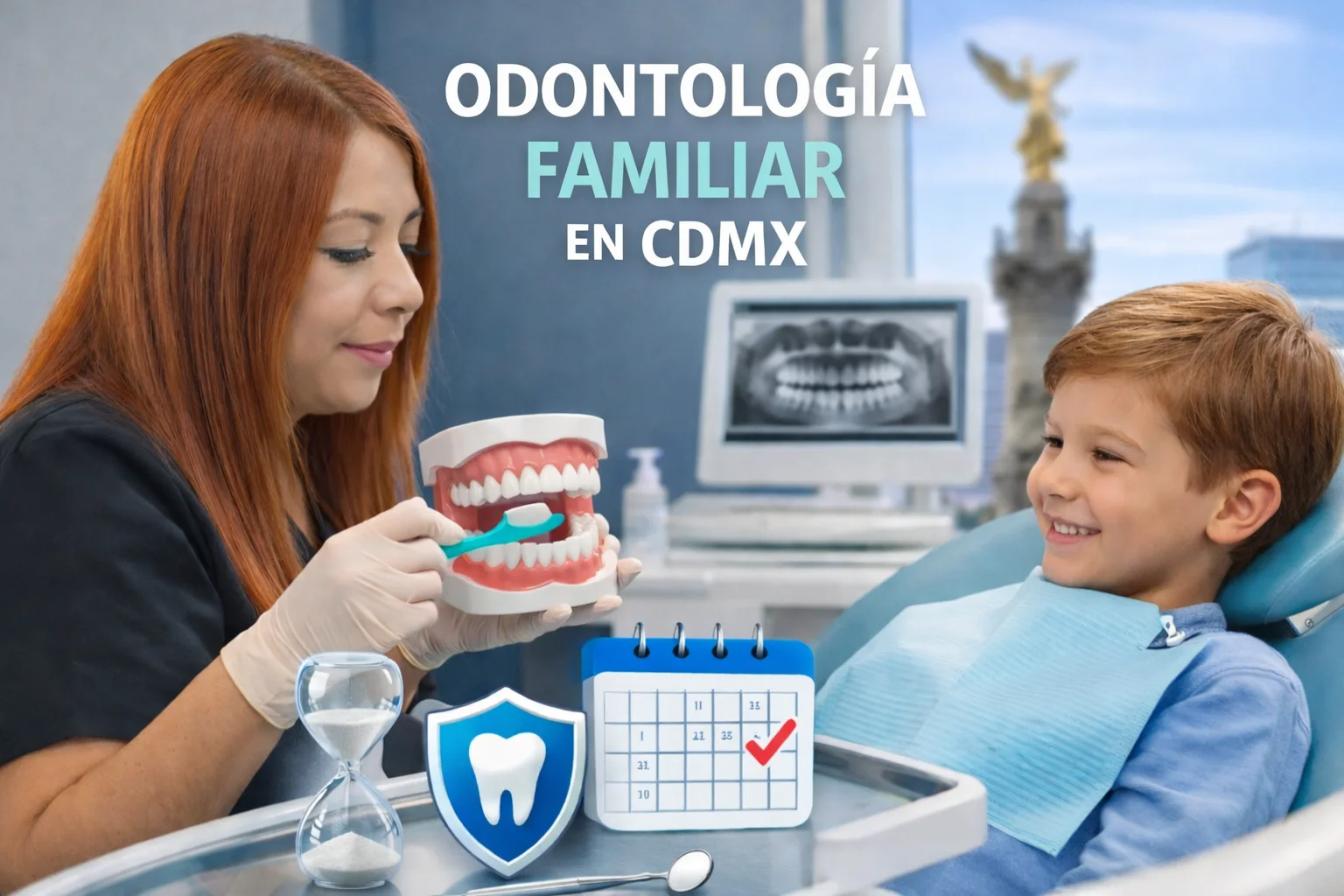
Family dentistry in CDMX allows children, adolescents, adults and seniors to receive dental follow-up within the same clinical vision, with prevention, diagnosis, gum control, orthodontics, restoration and long-term maintenance. More than solving isolated problems, a family dentistry clinic helps to monitor oral health at every stage of life, detect changes in time and maintain continuity in treatment.
A family dental practice should not be limited to “taking care of the whole family” as a marketing slogan. Its true value lies in providing clinical continuity, life-stage prevention and follow-up capability. It does not need to treat a child exactly the same as an adult with implants or an elderly person with wear and tear and periodontal disease, but it must be able to coordinate comprehensive and logical care for each case.
In practice, this means that a family can resolve in the same environment the first childhood visit, prevention in adolescence, gum control in adulthood, dental anxiety management, orthodontics when appropriate and maintenance of crowns, bridges, prostheses or implants with a more stable and less fragmented vision.
At La Clínica Dental, family dentistry covers areas such as preventive dentistry, pediatric dentistry, periodontics, orthodontics e implantologyto build a comprehensive, digital and multidisciplinary care.
What is family dentistry?
Family dentistry is a clinical approach that accompanies the oral health of different members of a family according to their age, risk, background and real needs. It is not just a matter of gathering appointments in the same clinic, but of having a coherent strategy that connects prevention, check-ups, education, diagnosis and treatment over time.
Its main objective is to prevent dental care from becoming reactive, fragmented or delayed.
Family dentistry seeks:
- accompanying oral health from infancy
- detect problems early
- adapt monitoring to each stage of life
- facilitate continuity of reviews
- coordinate different specialties when necessary
- habit building and long-term adherence
Why is family dentistry different from isolated dental care?
Because isolated care usually solves the problem of the moment. Family dentistry, on the other hand, helps to build a clinical history, understand repetitive risks and follow the oral evolution of each patient with continuity.
| Isolated dental care | Family dentistry |
|---|---|
| Attention is given only when a problem appears | We work with prevention and follow-up |
| Little continuity between appointments | History and control over time |
| Disconnected treatments | Integral vision by life stages |
| Less preventive education | Planned habits, check-ups and maintenance |
| More likely to be late | More likely to detect changes early |
What does a family dentistry clinic in CDMX include?
A true family clinic must be able to respond to different needs without losing clinical coherence.
May include:
- regular preventive check-ups
- professional cleaning and plaque control
- child care and parental guidance
- gum and periodontal risk assessment
- orthodontics in adolescence or adulthood
- digital diagnostics when needed
- bruxism and wear control
- restorations and follow-up of previous treatments
- maintenance of implants, crowns or prostheses
- support for patients with fear of the dentist
The real advantage is that these areas are not seen as isolated services, but as part of the same family oral health strategy.
Who benefits from family dentistry?
To virtually any family, but especially to those seeking order, monitoring and real prevention.
Very beneficial to:
- families with small children
- parents who want to centralize reviews
- adolescents undergoing orthodontics
- adults with bleeding gums or bruxism
- patients with dental anxiety
- elderly people with crowns, bridges or dentures
- families who have been postponing reviews for years
- patients who prefer a clinic with an integral vision
Family dentistry by life stages
Childhood: first habits, first check-ups and early prevention
Childhood is the best time to build habits, check eruption, control hygiene, detect early caries and reduce fear of the dentist. A good experience in these early stages can change the patient’s relationship with oral care for years to come.
Adolescence: orthodontics, hygiene, esthetics and follow-up care
At this stage, the need for orthodontics, alignment, more demanding hygiene control, gum education and prevention of wear and tear due to occlusal habits usually appear.
Many adults come to the dentist when something hurts, bleeds or breaks. Family dentistry helps change that logic to more strategic checkups, periodontal control, restorative maintenance and emergency prevention.
Older adults: function, stability and quality of life
In older adults, the priority is not just to “have teeth”, but to maintain function, stability, comfort and tissue health. This is where the maintenance of dentures, crowns, implants, gums and functional wear come into play.
What are the advantages of a dental clinic for children and adults in one place?
Centralizing family care has practical and clinical advantages.
| Advantage | Clinical or practical impact |
|---|---|
| Continuity | Allows to follow the oral evolution with more context |
| Shared prevention | Facilitates the whole family to adopt better habits |
| Coordination between specialties | Reduces fragmented treatments |
| Increased adherence to check-ups | Decreased abandonment of follow-up |
| Better experience | Helps anxious children and adults normalize dental care |
What is the role of prevention in family dentistry?
Total. Without prevention, family dentistry becomes meaningless.
Prevention makes it possible to check hygiene, detect early caries, control bleeding gums, evaluate bites, monitor restorations, protect implants and prevent small problems from becoming more complex treatments.
Does family dentistry include gum health?
Yes, and that is one of its most important bases. Many families come for caries or esthetics, but they forget that the condition of the gums defines much of the long-term oral prognosis.
Within the family approach, it is important to be vigilant:
- bleeding when brushing
- frequent tartar
- gum inflammation
- persistent bad breath
- tooth mobility
- history of gingivitis or periodontitis
- hygiene around implants or crowns
What if there are patients in the family who are afraid of the dentist?
A well-structured family practice should also be able to address dental anxiety with patience, clarity and appropriate comfort measures. This is especially important when there are children with first experiences, nervous teenagers or adults who have postponed their consultation for years due to fear, anesthesia or previous bad experiences.
How does family dentistry relate to technology and digital diagnostics?
A family clinic should not be seen as “basic” or limited. On the contrary: day-to-day care is greatly improved when there is adequate diagnostic capacity.
Digital diagnostics can help:
- better explain oral status to parents and patients
- document changes more clearly
- follow growth or attrition
- evaluate implants, gums or bite when needed
- improve future treatment planning
How to choose a family dentistry clinic in CDMX?
It is not enough that it says “family” on the website. The important thing is that it has structure to accompany different stages and needs with real criteria.
What to evaluate:
- clear preventive approach
- real child care, not just declared
- follow-up capacity for adults and seniors
- gum control and periodontal maintenance
- possibility of coordinating specialties
- good explanation of findings and priorities
- comprehensive and not superficial review
- diagnostic tools when needed
- appropriate treatment for patients with anxiety
| What to check in a family clinic | Why it matters |
|---|---|
| Prevention and follow-up | Reduces reactive and late treatments |
| Pediatric Dentistry | Allows to accompany well the infancy |
| Periodontics | Protects gums and dental support |
| Orthodontics | Adolescence and alignment assistance |
| Implantology / rehabilitation | Provides continuity when complex needs arise |
| Digital diagnostics | Improved accuracy and clinical explanation |
Family dentistry in CDMX with a comprehensive vision
Family dentistry done well accompanies growth, prevention, function and oral maintenance over time. It does not replace the need for specialties; it coordinates them. It does not just “do cleanings”; it builds continuity. It does not wait until something hurts; it seeks early detection.
At La Clínica Dental, family dentistry can be understood as a natural extension of a comprehensive, digital and multidisciplinary approach: from the first child visit to gum maintenance, orthodontics, restorations or implants in later stages of life.
When a family has follow-up, preventive education and access to coordinated care, oral health ceases to be a sum of emergencies and becomes a more stable and predictable process.
Frequently asked questions about family dentistry in CDMX
What is family dentistry?
It is an approach that accompanies the oral health of children, adolescents, adults and seniors with prevention, follow-up and clinical coordination according to each stage of life.
Can the Dental Clinic accompany a family from the first visit to more complex treatments?
Yes, the Dental Clinic can accompany a family from the first child visit to later stages of prevention, orthodontics, gum control, restorative maintenance and implantology when necessary. This approach allows us to provide continuity to children, adolescents, adults and seniors within the same clinical vision, with a more orderly follow-up, long-term prevention and coordination between different areas according to the needs of each stage of life.
Does a family clinic only treat basic problems?
No. A well-structured family practice can coordinate prevention, gums, orthodontics, restoration and, when necessary, more complex specialties.
Why is a family dentistry clinic better than a stand-alone practice?
Because a family clinic not only solves specific problems. It also helps to build history, detect early changes, order revisions and accompany the family over time with a more stable and preventive logic.
What should a good dental practice for families with children offer?
It must offer real child care, preventive screenings, parent education, friendly spaces and treatment, follow-up by stages and the ability to coordinate other areas if needed later on.
Does family dentistry include prevention programs for children and adolescents?
Yes. A strong family practice should clearly explain its preventive programs, check-ups, hygiene, gum follow-up, habits and early orthodontic control, because this is one of the territories where it is most convenient to gain authority.
What if I am looking for a clinic to accompany my family in the long term?
Then you should not think only of an isolated consultation. The ideal is a clinic that can accompany your child from the first visit to later stages of orthodontics, periodontics, restoration, maintenance and even more complex rehabilitation if necessary in the future.
Does family dentistry also work for teens with braces or aligners?
Yes, adolescence is a key time to review alignment, bite, hygiene, habits and prevention. A well-structured family clinic can integrate this stage within a broader follow-up and not as a separate care from the rest of oral health.
What if there are patients in the family who are afraid of the dentist?
A good family clinic must know how to accompany anxious patients, children who are afraid of their first visit and adults who have avoided consultation for years. This implies clarity of explanation, comfort measures and an experience that does not increase fear.
Does family dentistry include care for patients with anxiety?
Yes, it should be included. Today it is not enough to say that a clinic «attends with patience»; it is convenient to show protocols, comfort options and a calmer experience, especially because dental anxiety has a great influence on the abandonment of check-ups.
How to choose a family dentistry clinic in CDMX?
It is advisable to check if the clinic has prevention, real child care, follow-up for adolescents, gum control in adults, ability to coordinate specialties and a clear way to accompany the family in different stages of life.
What is the difference between family dentistry and pediatric dentistry?
Pediatric dentistry focuses on children. Family dentistry is broader: it integrates childhood, adolescence, adulthood and older adults within the same strategy of follow-up, prevention and clinical continuity.
Does family dentistry also include gum health?
Yes, a family practice should not only focus on cavities or cleaning. It should also look at gums, bleeding, tartar, hygiene and periodontal risk, because much of the future problems start there.
Can a family practice see adults with previous wear, gums or restorations?
Yes, that is part of the value of the family model: not stopping at childhood, but also accompanying adults with bruxism, inflamed gums, crowns, prostheses, implants or long-term maintenance needs.
Does technology also matter in a family dentistry practice?
Yes, a family practice should not look basic. Digital diagnostics can help explain findings, provide clearer follow-up and document changes at different life stages in both children and adults.
Does family dentistry work if my family needs different things?
Yes. In fact, that is one of its greatest benefits. A family rarely needs exactly the same thing in all its members. The value is that the clinic can tailor care without losing continuity.
What are the signs that a clinic really accompanies families and does not just use that term?
It must have visible prevention, real child care, guidance for adolescents, gum control, follow-up for adults, clear contact routes and content that speaks of lifelong accompaniment, not just isolated treatments.
Does family dentistry help prevent more complex treatments in the future?
Yes, when a family maintains check-ups, hygiene, gum control and follow-up in stages, it is easier to detect problems early and prevent small signs from becoming major treatments.
What types of families benefit most from this approach?
Families with children, adolescents undergoing orthodontics, adults with inflamed gums, anxious patients, older adults with previous restorations or families who want to centralize prevention and follow-up with the same clinical vision.
It is an approach that accompanies the oral health of children, adolescents, adults and seniors with prevention, follow-up and clinical coordination according to each stage of life.
Yes, the Dental Clinic can accompany a family from the first child visit to later stages of prevention, orthodontics, gum control, restorative maintenance and implantology when necessary. This approach allows us to provide continuity to children, adolescents, adults and seniors within the same clinical vision, with a more orderly follow-up, long-term prevention and coordination between different areas according to the needs of each stage of life.
No. A well-structured family practice can coordinate prevention, gums, orthodontics, restoration and, when necessary, more complex specialties.
Because a family clinic not only solves specific problems. It also helps to build history, detect early changes, order revisions and accompany the family over time with a more stable and preventive logic.
It must offer real child care, preventive screenings, parent education, friendly spaces and treatment, follow-up by stages and the ability to coordinate other areas if needed later on.
Yes. A strong family practice should clearly explain its preventive programs, check-ups, hygiene, gum follow-up, habits and early orthodontic control, because this is one of the territories where it is most convenient to gain authority.
Then you should not think only of an isolated consultation. The ideal is a clinic that can accompany your child from the first visit to later stages of orthodontics, periodontics, restoration, maintenance and even more complex rehabilitation if necessary in the future.
Yes, adolescence is a key time to review alignment, bite, hygiene, habits and prevention. A well-structured family clinic can integrate this stage within a broader follow-up and not as a separate care from the rest of oral health.
A good family clinic must know how to accompany anxious patients, children who are afraid of their first visit and adults who have avoided consultation for years. This implies clarity of explanation, comfort measures and an experience that does not increase fear.
Yes, it should be included. Today it is not enough to say that a clinic “attends with patience”; it is convenient to show protocols, comfort options and a calmer experience, especially because dental anxiety has a great influence on the abandonment of check-ups.
It is advisable to check if the clinic has prevention, real child care, follow-up for adolescents, gum control in adults, ability to coordinate specialties and a clear way to accompany the family in different stages of life.
Pediatric dentistry focuses on children. Family dentistry is broader: it integrates childhood, adolescence, adulthood and older adults within the same strategy of follow-up, prevention and clinical continuity.
Yes, a family practice should not only focus on cavities or cleaning. It should also look at gums, bleeding, tartar, hygiene and periodontal risk, because much of the future problems start there.
Yes, that is part of the value of the family model: not stopping at childhood, but also accompanying adults with bruxism, inflamed gums, crowns, prostheses, implants or long-term maintenance needs.
Yes, a family practice should not look basic. Digital diagnostics can help explain findings, provide clearer follow-up and document changes at different life stages in both children and adults.
Yes. In fact, that is one of its greatest benefits. A family rarely needs exactly the same thing in all its members. The value is that the clinic can tailor care without losing continuity.
It must have visible prevention, real child care, guidance for adolescents, gum control, follow-up for adults, clear contact routes and content that speaks of lifelong accompaniment, not just isolated treatments.
Yes, when a family maintains check-ups, hygiene, gum control and follow-up in stages, it is easier to detect problems early and prevent small signs from becoming major treatments.
Families with children, adolescents undergoing orthodontics, adults with inflamed gums, anxious patients, older adults with previous restorations or families who want to centralize prevention and follow-up with the same clinical vision.
Related contents about family dentistry
Family dentistry is not limited to a single stage of life. It also includes prevention, infant care, adolescent follow-up, gum control, dental anxiety and long-term oral care. Explore these contents to better understand how to accompany your family’s oral health with a comprehensive vision.
- Preventive dentistry in CDMX
- Pediatric Dentistry
- Periodontics
- Orthodontics
- Fear of the dentist: anxiety, pain control and what options are available?
Take care of your family’s oral health with follow-up, prevention and comprehensive care.
At La Clínica Dental, we help children, adolescents, adults and seniors to maintain follow-up, prevention and coordinated treatments at every stage of life.
Author:
Dr. Rosa María Moctezuma Lozano
National Autonomous University of Mexico
ID No. 1135288
Clinically reviewed and updated content for patient information guidance.
Last editorial revision: March 28, 2026.