Published by Dr. Rosa Ma. Moctezuma, Cédula No. 1135288: 01 April, 2026.
Reviewed by Dr. Miguel Ángel S.: April 01, 2026.
Smile design is a personalized plan that combines esthetic and functional diagnostics to improve color, shape, proportion and dental alignment with treatments such as veneers, resins, whitening or orthodontics. It is not a single procedure or a standard package: the ideal treatment depends on the condition of your teeth, your goals and the most appropriate clinical sequence for your case.
Before choosing a technique, it is important to understand what each option corrects, when they are used individually and when they should be combined. For many patients, smile design is not about “changing the whole smile”, but about arranging the treatment correctly to achieve a harmonious, functional and stable result.
If you are already in the decision stage, you can request a smile design assessment. If you first want to understand how this type of treatment works, what it includes and what factors influence the result, this hub is designed for that.
What is a smile design?
A smile design is the esthetic and functional planning of a customized dental improvement. Its objective is to correct aspects such as color, shape, size, wear, proportion or alignment to improve the appearance of the smile without losing clinical stability.
It is important to understand that not all cases need the same type of treatment. In some patients, the main change is focused on color. In others, the focus is on shape, alignment or visible restorations. Therefore, smile design should not be understood as a specific technique, but as a clinical strategy that may include different procedures according to the real need of each case.
A well-planned smile design is looking for:
- improve the visual harmony of the teeth
- organize treatment according to actual priorities
- integrate aesthetics and function
- leverage diagnostic technology when it adds value
- define a clear path of treatment and follow-up
Why does technology and a holistic approach change a smile design?
A well-planned smile design depends not only on the final treatment, but also on how the entire process is diagnosed, organized and executed. When a clinic integrates digital diagnostics, various specialties and a clear treatment sequence, it is easier to achieve an accurate, functional and stable result.
In a smile design, technology can help:
- better visualize proportions and tooth shape
- reduce unplanned decisions
- plan changes with more precision
- coordinate orthodontics, esthetics, and restoration if the case needs it
- improve patient-specialist communication
This is especially important when the case is not solved with a single technique. For example, there are patients who first need to align, others who need to correct old restorations, and others who need to combine esthetics with functional rehabilitation. In these scenarios, the value is not just in “doing veneers” or “whitening teeth,” but in the entire process being understood and managed within a coherent plan.
What treatments can a smile design include?
A smile design may include veneers, resins, whitening, orthodontics, indirect restorations or a combination of several options. The choice depends on whether the main problem is color, shape, alignment, wear or several factors at the same time.
Dental veneers
Veneers are usually valued when it is necessary to modify shape, size, proportion or color with high esthetic control, especially in anterior teeth.
Highly aesthetic resins
Resins can be useful for localized adjustments, small gap closure, edge repair or more conservative corrections.
Tooth whitening
Whitening is usually indicated when the main problem is color and the overall structure of the smile is already favorable.
Orthodontics or Invisalign
When the main problem is in dental position, orthodontics may be the basis of the plan before other cosmetic procedures.
Crowns or indirect restorations
When there is significant wear, extensive fractures or visible previous restorations, a more comprehensive restorative approach may be required.
How do you know what treatment your smile design may include?
The choice of treatment depends on the diagnosis. A smile design is not built by first choosing the technique, but by first identifying which aspect needs correction: color, shape, position, structure or a combination of these.
| If your main concern is… | Treatment usually assessed first | Main objective | Clinical commentary |
|---|---|---|---|
| Yellow but well aligned teeth | Tooth whitening | Improve color | No change in shape or position |
| Small fractures, gaps or irregular edges | High esthetic resins | Correct localized details | Usually a more conservative option |
| Visible change in shape, size or color | Dental veneers | Broader esthetic transformation | They are assessed according to the tooth structure and the objective of the case. |
| Crooked, crowded or unstable position of teeth | Orthodontics or Invisalign | Correct alignment and function | Can be combined later with other adjustments |
| Significant wear or visible restorations | Indirect restoration or esthetic rehabilitation | Restore function and harmony | Should not be treated as a case of color or shape only. |
If you want to delve specifically into criteria of harmony, visual result and decisions to avoid exaggeration, check out the guide to natural smile design in CDMX.
What is a smile design assessment like?
A smile design assessment should help you understand the case before making decisions. It’s not just about “which treatment looks best”, but identifying what is affecting the appearance of the smile and which clinical route makes the most sense.
An appraisal usually includes:
- teeth and gum checkup
- analysis of shape, color and proportion
- alignment and bite evaluation
- revision of previous restorations
- support with imaging and digital scanning in some cases
- explanation of options and timing
Is it possible to view a digital simulation before starting?
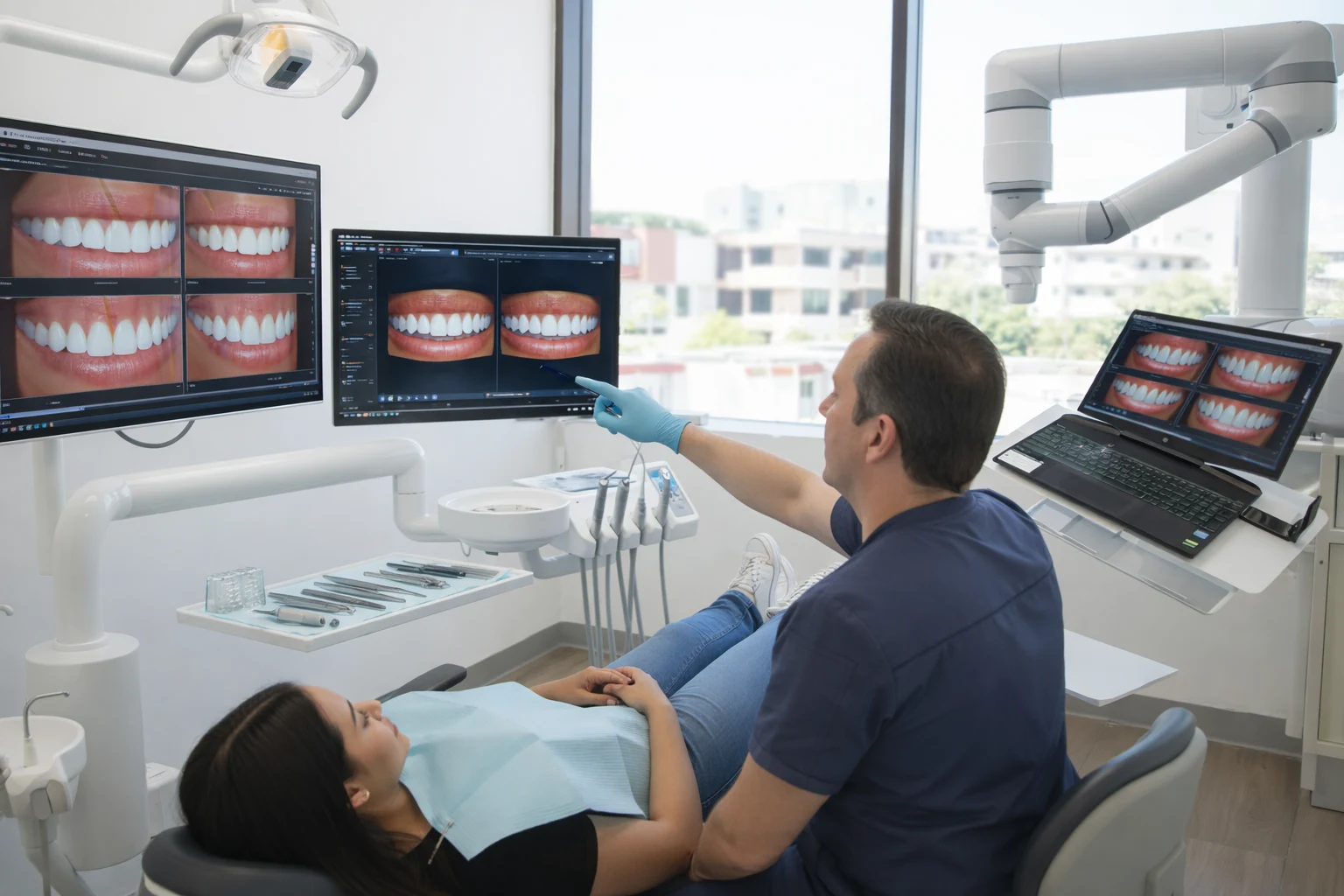
Yes, in many cases it is possible to support the assessment with intraoral scanning and digital design to better visualize changes in shape, proportion and treatment planning before starting.
Digital simulation can help:
- to better understand the case
- visualize treatment possibilities
- adjust expectations
- to facilitate aesthetic decisions
- improve patient-specialist communication
What are the advantages of digital planning in a smile design?
Digital planning helps make a smile design more predictable, clearer for the patient and less improvised. Instead of making decisions based on visual review or traditional models alone, the use of intraoral scanning, clinical photography and digital design allows you to better organize the case before you start.
This can bring advantages such as:
- a more accurate assessment of form, proportion and alignment
- better communication of realistic expectations
- possibility of explaining treatment phases more clearly
- support in deciding whether to use orthodontics, veneers, resins or a combination
- a stronger foundation for esthetic and restorative treatments
What materials are used in a smile design?
The materials most commonly used in dental esthetics and smile design include highly esthetic resins and ceramics such as E-max or zirconia, among others. The choice depends on the type of tooth, functional requirements, esthetic objective and clinical planning.
| Material | Aesthetics | Durability | Frequent use |
|---|---|---|---|
| Composite resin | High | Medium | Localized corrections and conservative adjustments |
| E-max porcelain | Very high | High | Veneers and esthetic restorations |
| Zirconia | High | Very high | Crowns and restorations with higher functional demand |
Why do materials matter in dental esthetics?
In a smile design, materials not only influence how the result looks, but also how it behaves over time. Color, translucency, texture, strength and functional adaptation are factors that change from material to material and from case to case.
Choosing the right material helps:
- achieve a more harmonious appearance
- improve aesthetic stability over time
- adapt the treatment to the level of load or wear
- defining when a more conservative option is appropriate and when a more resilient option is appropriate
- avoid decisions based on immediate appearance alone
How long does a smile design take?
The time depends on the type of treatment and the complexity of the case. Not all smile designs are resolved in the same number of appointments or in the same sequence.
In general:
- a color-focused case can be solved more quickly
- localized adjustments may require few appointments
- orthodontic cases need more time
- combined cases are usually resolved in stages
The correct question is not just “how long does it take”, but “which sequence gives the best result for this case”.
Can it be done in stages?
Yes. For many patients, a smile design is planned in stages to balance esthetics, function, timing and budget.
Working in phases can help:
- prioritizing health and function before aesthetic finish
- allocate investment
- make more accurate decisions
- adjust the plan according to developments
- avoid over-intervening at the outset
This is especially useful in combination treatments or when the case involves alignment, old restorations, wear or several targets at the same time.
How much does a smile design cost in CDMX?
The cost of a smile design in CDMX depends on the number of teeth, the type of treatment indicated, the materials, the functional complexity and whether the case is resolved in one or several stages.
It is not convenient to summarize it in a single figure because not all cases are comparable. What is important to understand is what factors influence the value:
- diagnosis and planning
- type of treatment
- materials
- number of teeth involved
- need for orthodontics or previous restoration
- digital technology when required
- clinical follow-up
What really influences the value of a smile design?
The value of a smile design does not depend only on the number of teeth or the material chosen. It is also influenced by how the case is diagnosed, what technology is used, how many specialties are involved and how well the treatment sequence is explained.
In a serious valuation, cost is usually related to factors such as:
- diagnosis and case planning
- need for scanning, photography or digital support
- type of material and aesthetic requirements
- functional, restorative or alignment complexity
- number of appointments and phases of treatment
- subsequent monitoring and stability of the result
Does a smile design hurt?
It depends on the treatment indicated, but many cosmetic procedures are well tolerated when properly planned and tailored to the patient’s experience.
Depending on the case, measures such as:
- explanations by phases
- adequate appointment times
- less obtrusive techniques
- digital tools that reduce discomfort
- protocols for sensitive or anxious patients
How is patient comfort taken care of during a smile design?
The patient’s experience is also part of a good smile design. It is not enough to plan for an esthetic result; it is also important that the process is clear, tolerable and handled with sensitivity, especially in people with a fear of the dentist, previous dental sensitivity or anxiety about certain procedures.
In many cases, comfort is enhanced when treatment includes:
- clear explanation of each phase
- adequate appointment times according to the procedure
- less obtrusive techniques when feasible
- digital tools that avoid cumbersome processes
- clearer monitoring in sensitive patients
- an approach that does not minimize fear or patient sensitivity
Why choose a multidisciplinary clinic for a smile design?
Because a smile is not always improved from a single specialty. In some cases, it is necessary to coordinate esthetics, orthodontics, periodontics, restoration and digital diagnostics to achieve a functional and stable result.
When a case is assessed from several disciplines, it is easier to define:
- what treatment is appropriate
- which order to follow
- what can be conserved
- which technology provides real value
- how to maintain the result over time
What differentiates a comprehensive center from a clinic that only offers aesthetics?
The difference is not only in how many treatments a clinic offers, but in whether it can coordinate the complete case when the smile design needs more than just an esthetic phase. There are patients who in addition to improving color or shape need to revise alignment, gums, bite, wear or previous restorations.
In a comprehensive center, this can facilitate:
- more complete diagnosis
- better definition of the order of treatment
- fewer isolated decisions
- greater coherence between aesthetics and function
- clinical continuity when the case requires more than one phase
Where to start if you are looking for a smile design in CDMX?
The best starting point is not to choose a technique in advance, but to understand what kind of change you are looking for and what is really affecting your smile. In some cases, the main problem is color. In others, the shape, alignment or the presence of visible restorations.
A distinction should also be made between:
- a one-time correction
- a combined treatment
- a previous phase of alignment or restoration
- a gradual improvement in stages
If you want to first understand the aesthetic criteria of harmony and naturalness, check out the guide to natural smile design in CDMX.
If you are ready to move from comparison to decision, the next logical step is to request a smile design assessment.
What should someone look for before choosing a smile design clinic in CDMX?
Before choosing a clinic for smile design, it is advisable to check whether the case is evaluated only from the aesthetic or from a more comprehensive approach. Not all clinics work in the same way and not all esthetic treatments respond to the same level of diagnosis.
It may be helpful to look at whether the clinic explains clearly:
- what treatment is proposed and why
- if the case requires one or more phases
- what digital tools do you use
- how to decide between veneers, resins, whitening or orthodontics
- what materials do you usually use
- how function integrates with appearance
Conclusion
Smile design in CDMX should not be understood as an isolated technique, but as a way to plan an aesthetic improvement with clinical criteria. In some patients, the best solution may focus on color. In others, on shape, alignment or a combination of several phases.
The key is to understand what the treatment includes, what options exist, how it is planned and what factors influence time, materials and outcome. When that foundation is clear, it is much easier to make the right decision.
If you want a personalized proposal according to your case, the next step is to go to the page of smile design service in CDMX and request an evaluation.
Frequently asked questions about smile design in CDMX
What is a smile design?
It is the esthetic and functional planning of a personalized dental improvement that may include veneers, resins, whitening, orthodontics or other treatments depending on the case.
Request your complete oral rehabilitation evaluation in CDMX
Receive a personalized proposal according to the diagnosis, the real complexity of your case and the most appropriate time for your treatment.
Author:
Dr. Rosa María Moctezuma Lozano
National Autonomous University of Mexico
ID No. 1135288
Clinically reviewed and updated content for patient information guidance.
Last editorial revision: 01 April 2026.