Published byDr. Rosa Ma. Montezuma : February 13, 2026.
All-on-4 and All-on-6 treatments allow a complete arch to be rehabilitated with a fixed prosthesis supported by 4 or 6 strategically placed implants. At La Clínica Dental CDMX we combine 3D planning, guided surgery and a specialized team to offer a stable, esthetic and planned solution for local and dental tourism patients looking for “fixed teeth” in a predictable way.
What is an All-on-4 / All-on-6 treatment?
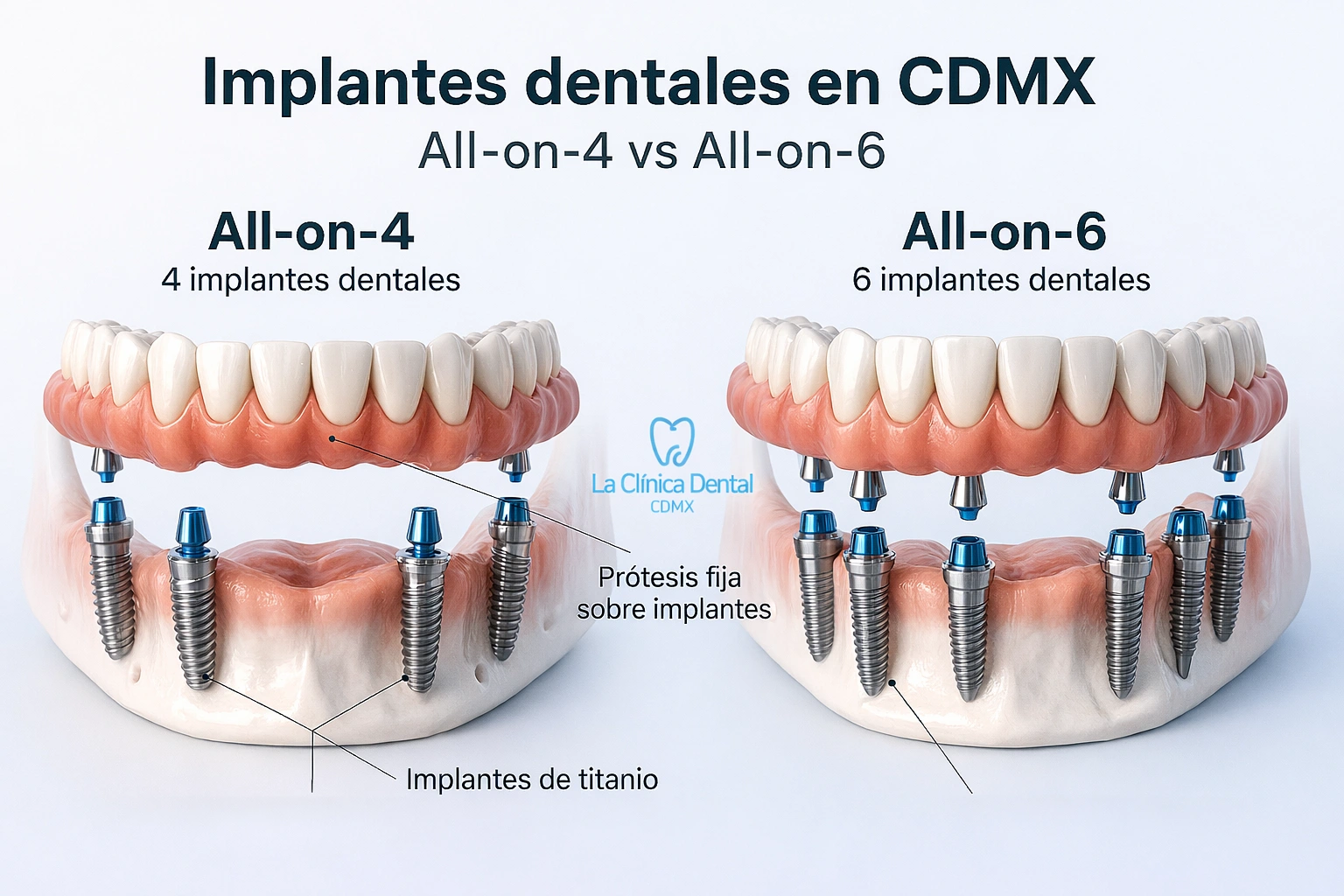
All-on-4 and All-on-6 are complete rehabilitation protocols in which 4 or 6 dental implants are placed per arch (upper, lower or both) to support a fixed prosthesis that replaces all the teeth in that arch.
Instead of placing an implant for each missing tooth, fewer implants are used, strategically distributed, to support a complete structure of teeth that are not in need of replacement:
- It is screwed to the implants (it does not come off and on like a removable denture).
- Allows chewing with greater stability.
- Significantly improves aesthetics and function.
Differences compared to other options:
- Versus traditional removable denture:
The fixed prosthesis does not move when speaking or chewing, does not require adhesives and transmits the bite force better. - Versus implant-borne overdenture:
The overdenture remains removable (patient removes it for cleaning). In All-on-4 / All-on-6 the prosthesis remains fixed, the patient does not remove it. - Versus single implants:
Instead of placing one implant per tooth, fewer implants are used to support the entire arch. This reduces surgeries, time and costs in many cases.
At La Clinica Dental CDMX we evaluate whether an arch can be solved with All-on-4, requires All-on-6 or combines other solutions (overdentures, strategic single implants, etc.) according to the anatomy and objectives of the case.
Who is a candidate for All-on-4 or All-on-6? Criteria we evaluate
Not all patients who have lost several teeth need or can receive an All-on-4 / All-on-6. Before indicating it, we assess:
Bone and gum evaluation
- Quantity and quality of bone available:
We use 3D studies (tomography, intraoral scanner) to measure bone volume and density. - Position of key anatomical structures:
- Inferior dental nerve in the mandible.
- Maxillary sinuses in the upper jaw.
- Periodontal health:
Gums free of active infection and periodontal disease under control.
If there is significant bone loss, it is assessed:
- Modify the inclination and position of the implants.
- Perform bone grafting or advanced techniques when the case warrants it.
- Alternatives if the predictability of All-on-4 / All-on-6 is not adequate.
General health and habits
We reviewed:
- Systemic diseases (diabetes, hypertension, osteoporosis).
- Medications (anticoagulants, bisphosphonates, etc.).
- Smoking and alcohol consumption.
Many patients with controlled conditions can be treated, but the plan is adjusted to minimize risk.
Expectations and maintenance
A key factor is the patient’s understanding:
- That it is a phased treatment, not “new teeth in one day” for everyone.
- What is required:
- Excellent daily hygiene.
- Periodic reviews.
- Professional cleaning and possible adjustments.
If the patient is looking for a fixed solution, is willing to take care of their oral health and understands the process, All-on-4 / All-on-6 can be an excellent option.
All-on-4 vs All-on-6 vs other options: quick comparison
Broadly speaking, the choice between All-on-4, All-on-6 and other alternatives is based on:
- Bone volume and quality.
- Bite force distribution.
- Aesthetics and smile design.
- Budget and patient preferences.
Comparative table
| Treatment | No. of implants per arch | Prosthesis Type | Common Indications | Key Advantages | Main considerations |
|---|---|---|---|---|---|
| All-on-4 | 4 | Fixed, bolted | Edentulous or nearly edentulous patients with limited but sufficient bone | Fewer implants, simpler surgery, optimized treatment times | Requires precise 3D planning; load distribution must be very well designed |
| All-on-6 | 6 | Fixed, bolted | Patients with adequate bone who need greater stability and support | Better distribution of forces, more support for wide prostheses | Slightly longer surgery; may require more up-front investment |
| Overdenture on implants | 2-4 | Removable, snap-on/clips on | Patients who prefer a prosthesis that they can remove for cleaning | Greater stability than conventional denture, lower cost than a complete fixed denture | Patient must remove denture daily; may feel less “own teeth” |
| Multiple single implants | Variable (1 per tooth or group) | Fixed (crowns/bridges) | Partial loss of teeth, localized spaces | Feels very similar to natural teeth, highly customized solutions | Requires more implants and often more surgeries; can be more expensive for full arches |
At your initial assessment, the implantologist will explain which option is best for you, why and what the short and long term implications are.
Stages of an All-on-4 / All-on-6 treatment at La Clínica Dental CDMX
Although each case is unique, treatment usually follows very clear phases.
Advanced valuation and 3D studies
On the first visit:
- We collect your medical and dental history.
- We perform a complete examination of the mouth, gums and bite.
- We take imaging studies:
- 3D tomography.
- Clinical photographs.
- In some cases, intraoral scanner.
With this information:
- We confirm if you are a candidate for All-on-4 / All-on-6.
- We identify if pre-treatment is required (extractions, deep cleaning, infection management).
2. Digital plan and simulation
Planning is key:
- We analyze the bone volume and the position of anatomical structures.
- We design digitally:
- The position of the implants.
- The type of prosthesis (materials, shape, tooth size, smile line).
- In many cases, we use computer-guided surgerydesigning a surgical guide that is 3D printed to place the implants with the utmost precision.
At this stage:
- You are reviewed with esthetic options (shape, size, color of the teeth).
- The appointment calendar is defined.
3. Implant placement surgery
On the day of surgery:
- It is performed under local anesthesia, with the possibility of conscious sedation if the case requires it and it is appropriate for your health.
- 4 or 6 implants are placed per arch, depending on the plan.
- The parameters of the digital plan are followed for:
- Depth.
- Angulation.
- Exact position.
Duration depends on:
- If one or both arches are operated.
- If it is necessary to perform extractions in the same act.
- If grafts are placed or complementary techniques are applied.
4. Provisional fixed prosthesis
In many cases it is possible:
- Fit a fixed temporary prosthesis over the implants on the same day or in the following days, provided that:
- The initial stability of the implants is adequate.
- The plan contemplated it from the beginning.
If stability does not permit or significant bone regeneration is required:
- A temporary removable prosthesis is used.
- Subsequently, when the bone has integrated the implants, the fixed prosthesis is placed.
5. Final prosthesis and fine adjustments
After the osseous integration period (which can vary several weeks or months):
- We take more accurate records:
- Prints / scanners.
- Bite and esthetic records.
- We design and manufacture your definitive prosthesis:
- Metal or zirconia structure.
- Ceramic coatings or specific composites.
- We adjust:
- Bite contacts.
- Fine occlusion.
- Aesthetics (shape, size, smile line, lip support).
6. Maintenance and periodic revisions
Once the definitive prosthesis has been placed:
- We establish a review schedule (generally every 3-6 months).
- We perform:
- Professional cleaning around implants and prostheses.
- Adjustments if necessary.
- Periodic radiographic controls.
Long-term success depends on both the quality of treatment and your commitment to maintenance.
Treatment times: patients from CDMX vs. dental tourism
Local patients (CDMX and surroundings)
For patients living in Mexico City or nearby areas, times are usually divided into:
- Phase 1: Diagnosis and planning
1-2 initial visits for studies, assessment and plan design. - Phase 2: Surgery and provisional prosthesis
1 surgical visit (one or both arches) + subsequent short check-ups. - Phase 3: Bone integration and definitive prosthesis
Waiting period (weeks/months) for the bone to integrate the implants, followed by 2-3 visits to fabricate and adjust the definitive prosthesis.
The total duration is always explained on a case-by-case basis:
- If bone regeneration is required.
- If there are other medical conditions that require longer times.
- The type of definitive prosthesis chosen.
National and international patients (dental tourism)
For patients traveling from other states or countries, we organize the treatment in blocks:
- Visit 1 (short):
- Valuation and 3D studies.
- Digital planning.
- Definition of options and budgets.
- Visit 2 (longer stay):
- Implant surgery.
- Provisional fixed prosthesis when feasible.
- Revisions close to surgery.
- Visit 3 (later):
- Record taking for the definitive prosthesis.
- Placement and adjustments of the final prosthesis.
The objective is:
- Minimize the number of trips.
- Ensure that each stay has sufficient time to perform procedures safely.
What can be done in one long visit and what can’t?
In some cases it is possible:
- Perform extractions, place implants and fit a fixed provisional prosthesis in a single large room.
However, the definitive prosthesis almost always requires:
- A period of bone integration.
- At least one subsequent visit for fine tuning.
During the initial assessment we explain what can be concentrated in a single trip and what requires a second visit to complete the treatment correctly.
All-on-4 / All-on-6 cost ranges in CDMX: what’s included
The cost of an All-on-4 / All-on-6 treatment is not directly comparable to “price per implant” as in single tooth cases. Includes:
- Advanced diagnostic studies (3D, photographs, models).
- Multiple implant placement surgery.
- Provisional prosthesis (when applicable).
- Full arch definitive prosthesis (materials and design).
- Revisions and controls in the initial phase.
Factors influencing cost
- Number of arches treated (one or both).
- If additional procedures are required:
- Bone grafts.
- Maxillary sinus lift.
- Complex extractions.
- Type of definitive prosthesis:
- Materials (metal-ceramic, zirconia, hybrid, etc.).
- Customized aesthetic features.
- Need for sedation and additional care due to medical conditions.
Why isn’t a single price given for all cases?
Two patients with “missing teeth” may require very different treatment plans. A responsible estimate should:
- Based on clinical assessment and 3D studies.
- Include what is necessary to achieve a stable, functional and esthetic result, not just “placing implants”.
At your first appointment we will explain:
- Your diagnosis.
- Possible options (All-on-4, All-on-6 or others).
- Investment ranges for each option.
- Payment methods available.
Results, durability and long-term care in All-on-4 / All-on-6
How long does an All-on-4 / All-on-6 treatment last?
When properly performed and well maintained:
- Implants can have a very high long-term success rate.
- The prosthesis may require:
- Periodic adjustments.
- Replacement of certain components (due to wear and tear) over the years.
The duration depends not only on the technique, but also on:
- Your general health.
- Your habits (hygiene, smoking, bruxism).
- The quality of professional maintenance.
Daily care
To maximize durability:
- Thorough brushing around the prosthesis and areas of union with the gingiva.
- Use of recommended interdental hygiene devices (special flossers, interproximal brushes, irrigators).
- Avoid using teeth as a tool (opening containers, biting hard non-food objects).
Professional reviews
We recommend:
- Revisions and professional cleaning every 3-6 months depending on the case.
- Periodic X-rays to evaluate:
- Bone level around the implants.
- Condition of bolts and components.
If any change is detected (slight mobility, discomfort, difficulty in cleaning, swelling), it is important to go early to correct it before it becomes a major problem.
Your initial assessment for All-on-4 / All-on-6 at La Clínica Dental CDMX
The first appointment is key to define if All-on-4 / All-on-6 is your best option or if there is a more suitable alternative for you.
In this assessment:
- We review your medical history and your objectives (esthetic, functional, time and budget).
- We make a detailed examination of the remaining teeth, gums and bite.
- We indicate the necessary studies (3D tomography, photographs, records).
- We discussed with you:
- If you are a candidate for All-on-4, All-on-6 or another combination of treatments.
- The phased plan.
- Approximate times and investment ranges.
Upon completion, you will have:
- A clear diagnosis.
- A proposed treatment plan with alternatives.
- Next steps defined (appointments, studies, date reservations).
Frequently Asked Questions about How to evaluate a dental clinic in Mexico City
What is the difference between All-on-4 and All-on-6?
Both are full-arch fixed rehabilitation treatments.
All-on-4: 4 implants are placed per arch; it is ideal when the bone is more limited but the load can be well distributed.
All-on-6: 6 implants are placed, which allows a better distribution of forces and, in some cases, a prosthesis with greater support.
The choice is based on your anatomy, amount of bone, prosthesis design and treatment goals.
In which cases is All-on-4 recommended and in which All-on-6?
All-on-4:
It is usually indicated in patients with limited bone or when a less invasive approach is sought, as long as the 3D study shows that good stability can be achieved with 4 implants.All-on-6:
Recommended when sufficient bone is present and desired:Increase long-term stability.
To better distribute the load in patients with high masticatory force or habits such as bruxism (always with the necessary care).
After your assessment, the implantologist will explain which option is best for you and why.
How long does an All-on-4 treatment take from the assessment to the definitive prosthesis?
It depends on the complexity of the case, but in general:
Diagnosis and planning: 1-2 initial visits.
Surgery and start of the integration phase: 1 main visit.
Fixed provisional prosthesis: in many cases it is placed the same day or in the following days, if the stability of the implants allows it.
Definitive prosthesis: it is made after the bone integration period, which can last several weeks or months, followed by 2-3 visits for tests and adjustments.
In your personalized plan we will give you an approximate schedule so you can get organized.
Is the All-on-4 procedure painful?
The surgery is performed under local anesthesia, and in indicated cases it can be complemented with sedation. During the procedure you should not feel pain, although you should feel pressure and manipulation.
After surgery it is normal:
Present some inflammation.
Have discomfort that can be controlled with medication.
Relative rest is required for the first days.
We will give you instructions and medication to make the postoperative period as comfortable as possible, as well as close controls in the following days.
Can I receive All-on-4 if I have a small amount of bone?
Depends on:
The quantity and quality of remaining bone.
The anatomical distribution in 3D tomography.
In some cases, techniques such as implant angulation or guided surgery make it possible to treat cases with limited bone. In others, it will be necessary:
Perform bone grafting.
Evaluate alternatives to All-on-4 / All-on-6.
The decision is always based on the safety and predictability of long-term treatment.
Is grafting always necessary to make All-on-4?
Not always. One of the reasons why All-on-4 became popular is that, in certain cases, it allows avoiding bulky grafts by maximizing the available bone and the angulation of the implants.
However:
If the 3D study shows that the bone volume is insufficient or inadequate, grafting may be recommended or even necessary.
The indication for grafting is made on a case-by-case basis, prioritizing your safety and good prognosis.
How long does a well-maintained All-on-4 treatment last?
When properly planned and executed, and the patient maintains proper hygiene and attends check-ups:
The implants can be maintained for many years with good stability.
The prosthesis may require adjustments and maintenance, as well as renewal of some parts over time.
There is no “fixed expiration” for all; the duration depends on:
Your habits.
Your general health.
Quality of maintenance.
Do the teeth look "false" or natural?
The goal is to make you smile:
Blends in with your face.
Respect your facial proportions.
Be functional and harmonious.
To this end:
We take photographs and aesthetic records.
We design the size, shape and color of the teeth according to your case and preferences.
In full-arch treatments, the lip support and smile line are also taken care of.
You can adjust the design until you are satisfied with the final look.
What daily care does an All-on-4 type prosthesis require?
Requires:
Meticulous brushing after each meal, including the junction area between the prosthesis and the gingiva.
Use of specific interdental hygiene tools (which we will teach you in the office).
Avoid risky habits, such as:
Biting hard objects (ice, lids, pens).
Use the teeth as a tool.
We will give you a hygiene protocol adapted to your case.
How often should I go for a check-up and professional cleaning?
We recommend:
Periodic check-ups every 3-6 months, depending on your situation.
Professional cleaning around implants and prosthesis.
Periodic radiographic controls to monitor the bone and supporting structures.
These visits are essential for:
Early detection of any inflammation or change.
Avoid major problems (bone loss, loosening of components, etc.).
Is it possible to do All-on-4 if I have diabetes or take anticoagulants?
In many cases, yes, as long as:
Diabetes is well controlled.
Treatment with anticoagulants should be discussed with your treating physician.
Careful planning and, when necessary, medication adjustments are made (always under medical supervision).
Before surgery:
We review your analysis.
We coordinate with your medical team if necessary.
We adapt the plan to minimize risks.
Can I finance my All-on-4 treatment?
Full arch rehabilitation is an important investment in your health and quality of life. In the assessment:
We will present you the budget broken down by phases.
We will discuss payment options and, if applicable, available financing plans or installment payments.
The goal is to allow you to plan your treatment in a way that is realistic and comfortable for you.
What risks exist and how do you minimize them?
As in any surgical procedure, there are risks, such as:
Infection.
Postoperative discomfort.
Failure to integrate one or more implants.
Inflammation or bone loss around implants over time.
To minimize them:
We perform an exhaustive medical and dental evaluation before indicating the treatment.
We use 3D studies and digital planning.
We follow rigorous disinfection and surgery protocols.
We give clear postoperative care instructions.
We maintain a program of periodic reviews.
What happens if an implant fails over time?
If an implant does not integrate properly or presents problems over the years:
We evaluate whether it can be removed and replaced.
We evaluate if the rest of the implants maintain sufficient support for the prosthesis.
We readjust the prosthesis design if necessary.
Each situation is analyzed individually, explaining the alternatives and steps to follow.
How many visits do I need if I am traveling from another country?
In many cases, we plan:
Visit 1: diagnosis, 3D studies and planning (short stay).
Visit 2: surgery and fitting of provisional prosthesis (longer stay).
Visit 3: definitive prosthesis and adjustments (short stay).
The number and duration of visits depend on:
Your diagnosis.
If grafts or previous procedures are required.
Your availability to travel and stay in Mexico City.
In the first consultation (face-to-face or online) we will provide you with an adapted schedule.
Can I still eat everything with an All-on-4 prosthesis?
After the initial adaptation phase and following the indications of the team:
You will be able to recover a chewing function very close to that of natural teeth.
In the provisional prosthesis phase there may be some temporary restrictions.
With the definitive prosthesis, the objective is that you can have a varied and balanced diet.
We will always tell you:
Foods to avoid or moderate.
How to gradually reintroduce harder textures.
What is the maximum age to consider this treatment?
There is no fixed “maximum age”. The important thing is:
Your general state of health.
Bone quality.
Your expectations and ability to maintain good hygiene.
We have successfully treated young adult, middle-aged and older patients. The key is to assess each case individually and safely.
Are you still unsure whether you need conscious sedation or just local anesthesia?
Schedule an evaluation at La Clínica Dental CDMX and a specialist will review your medical history, your level of anxiety and the type of treatment to recommend the safest and most comfortable option for you.
Make your decision with clear medical information, not fear.
Are you traveling to Mexico City for dental treatment and looking for a controlled and comfortable experience?
Request a video call with La Clínica Dental CDMX to determine whether conscious sedation, local anesthesia, or a combination is best for you, tailoring the plan to your travel schedule.