Published by Dr. Rosa Ma. Montezuma : January 15, 2026.
This article was last updated: April 20, 2026 by Dr. Juan Carlos V.
Computer-guided implants allow implant placement to be planned with the support of 3D studies and digital tools prior to surgery. Rather than a different way of “placing implants”, it is an approach that helps to better study the case, plan more accurately and coordinate the surgery with the final restoration.
In this type of treatment, resources such as tomography, intraoral scanning and planning software are used to define the ideal implant position according to the available bone, the bite and the desired outcome. In some cases, this planning can provide more control, more clarity and a more predictable experience for the patient.
What are computer-guided implants?
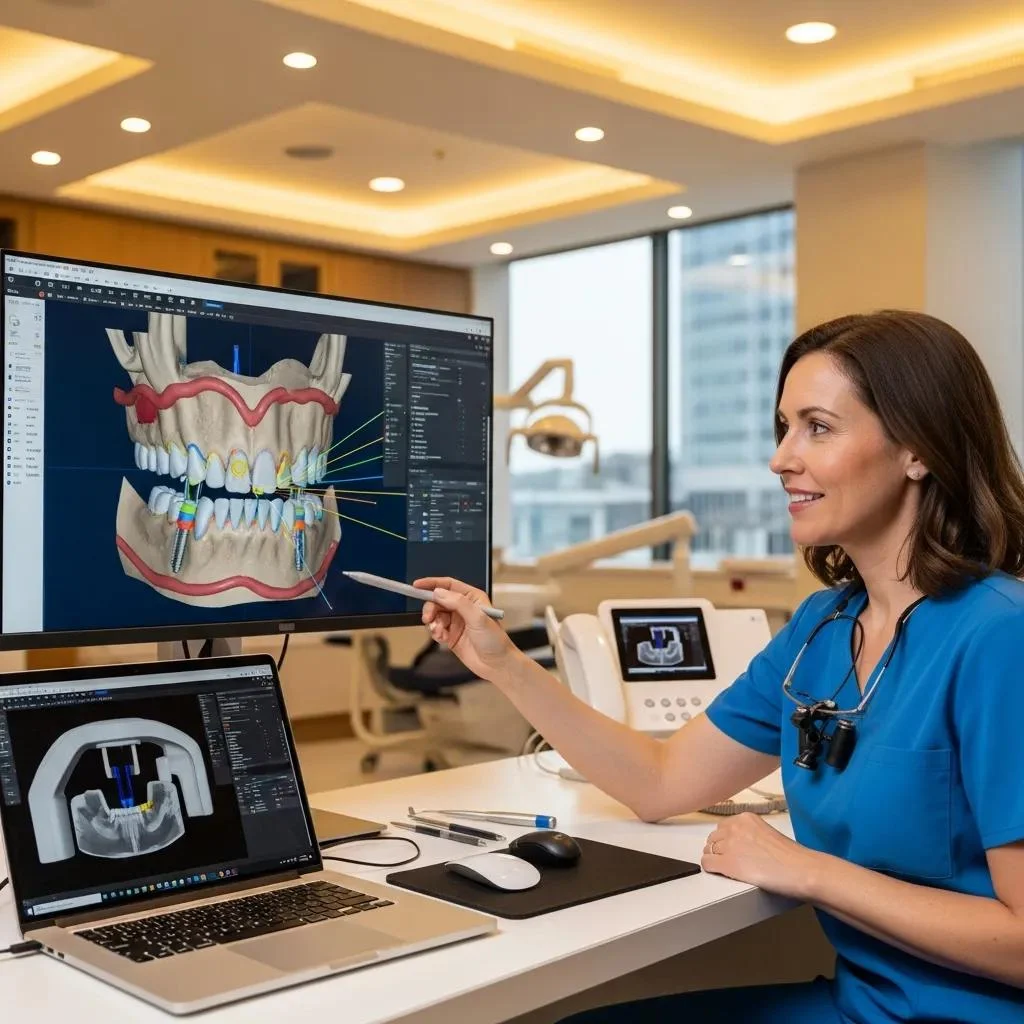
Computer-guided implants are dental implants placed from a previous 3D planning, based on digital studies such as CT scans and intraoral scans.
Rather than a different way of placing implants, it is an approach that helps to better study the case, plan more accurately and coordinate the surgery with the final restoration.
This information is integrated in a software that allows:
-
Visualize the bone in three dimensions.
-
Locate important anatomical structures (nerves, maxillary sinuses, roots).
-
Determine the ideal position of the implant in relation to the bone and the future prosthesis.
With this 3D planning, a surgical guide (a kind of customized “template”) is made and placed in the mouth during dental surgery, directing the instruments so that the implant is placed exactly where it was planned.
If you want to get an overview of the treatment first, you can check out our guide on dental implants in CDMX
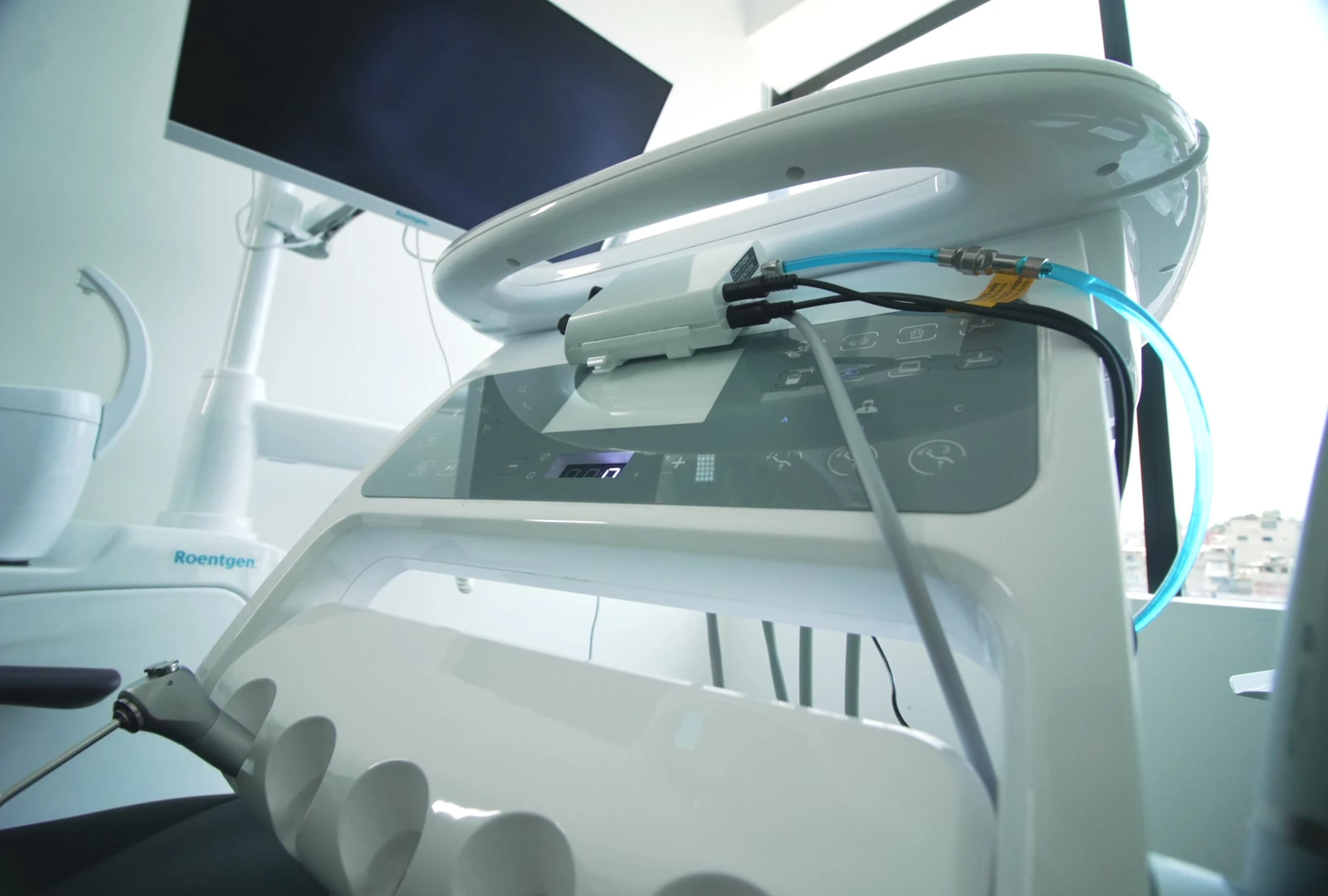
Dental technology and 3D planning: the basis for guided surgery
Although “computer guided surgery” may sound incredibly complex, the process is actually very logical and easy to understand. Think of it as your dentist using a high-precision GPS for your mouth. It all comes down to a perfect plan created before the procedure begins. That’s how guided implant placement works.
Guided surgery relies on several components of digital technology:
-
3D tomography (CBCT): allows to see the volume and quality of the bone.
-
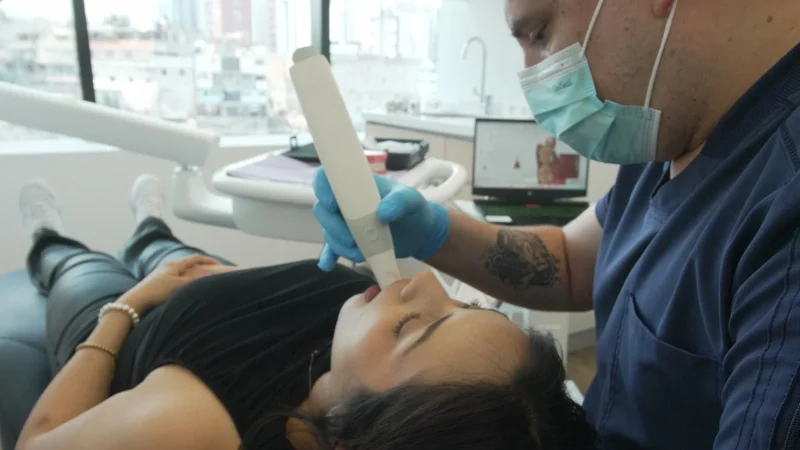
Intraoral scanner or digital models: record teeth, gums and occlusion. For a better understanding of this tool, see our intraoral scanner vs. traditional impressions comparison.
-
Planning software: integrates anatomical and prosthetic information.
-
Customized surgical guides: manufactured with 3D printing according to plan.
This approach to digital implants is typical of advanced dentistry, where the goal is not to “just put a screw in the bone”, but to design the entire treatment in a holistic way: esthetics, function and stability.
If you would like to better understand how this clinical environment works, please see also our page on advanced dental technology in CDMX
Benefits of computer-guided implants
Computer-guided dental implant surgery brings several advantages to both the specialist and the patient:
Increased accuracy in placement
-
3D planning makes it possible to accurately define the position, angulation and depth of the implant.
-
The risk of invading sensitive anatomical structures is reduced.
-
The use of available bone is optimized.
Less invasive in many cases
In certain cases, guided surgery allows for more controlled approaches, with smaller incisions and, consequently, potentially:
-
Less inflammation.
-
Less postoperative discomfort.
-
Faster recoveries (always depending on the case and the patient’s care).
3. Better integration with the prosthesis
Thanks to 3D planning, the position of the future crown or prosthesis is taken into account from the very beginning. This helps to achieve a result:
-
More aesthetic.
-
With better masticatory function.
-
More comfortable for the patient.
4. Greater predictability and communication
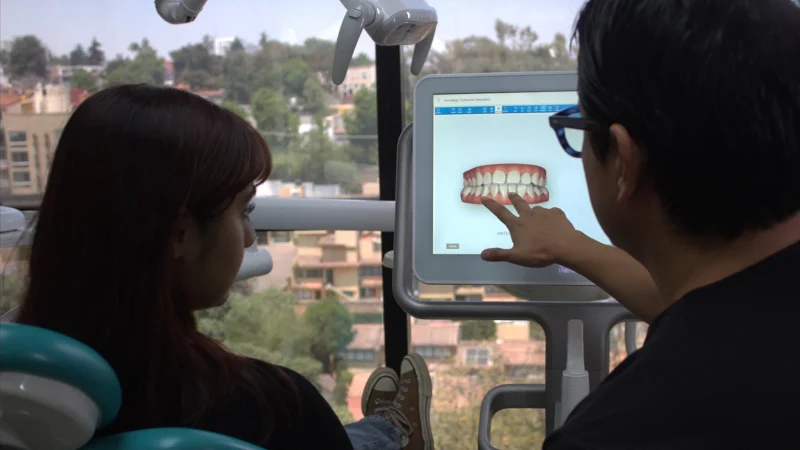
Digital technology makes it possible to show the patient images and simulations of the plan:
-
Explaining why certain placement points are recommended.
-
Aligning time, phase and outcome expectations.
-
Improving confidence in the procedure.
Computer-guided implant treatment steps
Although each case is different, the general flow of treatment with guided surgery usually follows these stages:
1. Clinical evaluation and digital diagnosis
-
Clinical history and examination of the mouth, teeth and gums.
-
Complementary studies (X-rays, photographs).
-
Request for 3D tomography and, if required, intraoral scanning.
2. 3D Planning
With the information obtained, 3D planning is carried out in specialized software:
-
The available bone is analyzed.
-
It is decided how many dental implants will be placed and in which positions.
-
The relationship between implant and future prosthesis (crowns, bridges, complete rehabilitation) is designed.
3. Design and fabrication of the surgical guide
-
A personalized surgical guide is designed for that patient.
-
The guide is 3D printed or manufactured with specific technology.
-
This guide will be used during surgery to direct the drilling and placement of the implant.
4. Guided surgery
On the day of dental surgery:
-
The surgical guide is positioned in the patient’s mouth (on teeth, gingiva or bone, depending on the design).
-
Drills and instruments that pass through the guide are used, respecting the planned positions.
-
The implants are placed following the digital plan.
5. Prosthetic phase and controls
After implant integration (according to the times indicated by the specialist):
-
Records are taken to design the final crown or prosthesis.
-
In many cases digital flows (intraoral scanner + CAD/CAM) are used.
-
Periodic check-ups are scheduled to check bone, gingiva and stability.
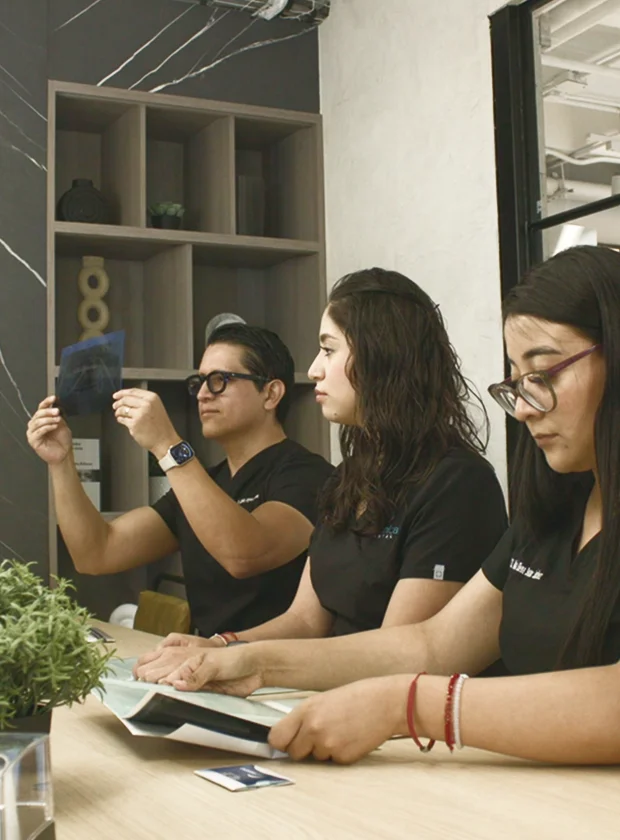
Who are candidates for computer-guided implants?
Computer-guided implants are not reserved only for very complex cases; they may be an option in many contexts, although the decision is a clinical one.
Good candidates could be:
-
Patients who require one or more dental implants and are looking for maximum precision.
-
People with complex anatomy or little bone in certain areas, where 3D planning helps to reduce risks.
-
Patients with extensive rehabilitations, implant-supported prostheses or “full-arch” type treatments. If you are researching full-arch treatments, you may be interested in our guide to All-on-4 and All-on-6 in CDMX.
-
Patients who value dental technology and want a gentle, modern approach.
At La Clínica Dental, the indication for guided surgery is performed on a case-by-case basis, always seeking a balance between digital technology, safety, cost and real benefit for the patient.
If you want to learn more about this type of scenario, check out our guide to complex dental implant cases.
When does guided surgery bring more control, precision and predictability?
Guided surgery can be supported by 3D studies, digital planning and a guide designed for each patient. Its function is not to use more technology for its own sake, but to help better plan implant placement prior to the procedure. This allows a more detailed review of the available bone, the ideal position of the implant, the bite and the type of restoration sought.
It can be especially useful when the area requires a lot of precision, when there is little margin for error, when the treatment is part of a broader rehabilitation or when the aim is to better coordinate the surgery with the final functional and esthetic result.
It also helps the patient better understand his or her treatment from the beginning. With clearer planning, many people feel more at ease because they know what is going to be done, why that approach was chosen and what to expect at each stage.
Not all cases require guided surgery. In some patients, a well-indicated conventional technique performed by an experienced team may be sufficient. The right decision depends on the diagnosis, the complexity of the case and the desired long-term outcome.
In some patients, in addition to the surgical technique, it may also be important to assess which type of material is best suited to the case. If you want to review this difference in more detail, please consult our guide on dental implants: titanium or ceramic..
If you want to understand how the budget for an implant changes according to the type of case and the procedures that may be required, check out our guide on dental implants price in CDMX
Is it always necessary to use guided surgery?
Not in all cases. Dental surgery with implants can be done conventionally with excellent results if performed with good technique and diagnosis.
Guided surgery provides added precision and predictability, especially valuable when:
-
There is little tolerance for errors in the position of the implant.
-
Work is performed near critical anatomical structures.
-
Highly demanding prosthetic results are sought.
The role of the practitioner is to decide when this technology provides a clear benefit and to explain this to the patient in a transparent manner.
Dental implants with the latest global standards at La Clínica Dental
The use of digital implants, 3D planning, digital diagnostics and guided surgery is part of La Clínica Dental ‘s commitment to advanced and safe dentistry. It is not only about having modern equipment, but also about:
-
Follow protocols based on current evidence.
-
Maintain continuous training in techniques and materials.
-
Accompany the patient throughout the entire process, from diagnosis to maintenance.
When we talk about Dental Implants with the latest world standards, we talk about integrating dental technology with clinical criteria and human attention.
Frequently asked questions about computer-guided implants
Are computer-guided implants safer than conventional surgery?
Guided surgery can increase precision and reduce certain risks, especially in anatomically complex areas or in extensive rehabilitations. Even so, both conventional and guided techniques should be performed by trained professionals with good digital diagnostics.
Does guided surgery change the treatment plan for an implant?
In some cases, guided surgery may require 3D studies, digital planning and personalized guidance. Rather than focusing only on cost, it is important to understand when such planning provides more precision, control and predictability depending on the complexity of the case.
Are all patients candidates for digital implants and guided surgery?
Not necessarily. Although many patients may benefit, the indication depends on your anatomy, type of treatment and clinical assessment. The decision is made after a complete evaluation and imaging studies.
Is guided surgery less painful than traditional surgery?
The goal of any dental surgery is for the patient to be comfortable and pain controlled. Guided surgery can, in some cases, reduce surgical trauma, but the experience also depends on technique, medication and postoperative care.
How long does a treatment with computer-guided implants last?
The planning phase may be more detailed, but dental surgery is usually very efficient on the day of surgery. The total treatment time also depends on the integration of the implant, the type of prosthesis and the need for grafting or other procedures.
What is the difference between digital implants and “normal” implants?
The implant as a device may be the same; what changes is the digital process used to plan and place the implant: digital diagnostics, 3D planning and guided surgery. This is encompassed in the concept of digital implants and is part of the most advanced dental technology available.
Guided surgery can increase precision and reduce certain risks, especially in anatomically complex areas or in extensive rehabilitations. Even so, both conventional and guided techniques should be performed by trained professionals with good digital diagnostics.
In some cases, guided surgery may require 3D studies, digital planning and personalized guidance. Rather than focusing only on cost, it is important to understand when such planning provides more precision, control and predictability depending on the complexity of the case.
Not necessarily. Although many patients may benefit, the indication depends on your anatomy, type of treatment and clinical assessment. The decision is made after a complete evaluation and imaging studies.
The goal of any dental surgery is for the patient to be comfortable and pain controlled. Guided surgery can, in some cases, reduce surgical trauma, but the experience also depends on technique, medication and postoperative care.
The planning phase may be more detailed, but dental surgery is usually very efficient on the day of surgery. The total treatment time also depends on the integration of the implant, the type of prosthesis and the need for grafting or other procedures.
The implant as a device may be the same; what changes is the digital process used to plan and place the implant: digital diagnostics, 3D planning and guided surgery. This is encompassed in the concept of digital implants and is part of the most advanced dental technology available.
La Clínica Dental branches with state-of-the-art equipment
The Dental Clinic has several branches in Mexico City equipped with 3D X-rays and intraoral scanners. Each center is designed to offer comfort and modern procedures, with trained staff ensuring uniform service at all locations.
Schedule your assessment at La Clínica Dental and receive a clear plan.
At La Clínica Dental we have 3D X-rays, intraoral scanner and digital design to plan your treatments with greater precision, safety and comfort. If you want a clear diagnosis and a modern plan for your smile, schedule an assessment with our team.
Author:
Dr. Rosa María Moctezuma Lozano
National Autonomous University of Mexico
License N° 1135288
Clinically reviewed and updated content for patient information guidance.
Last editorial revision: April 20, 2026.