Published by Dr. Rosa Ma. Moctezuma, Cédula No. 1135288: April 14, 2026.
Reviewed by Dr. Miguel Ángel S.: April 27, 2026.
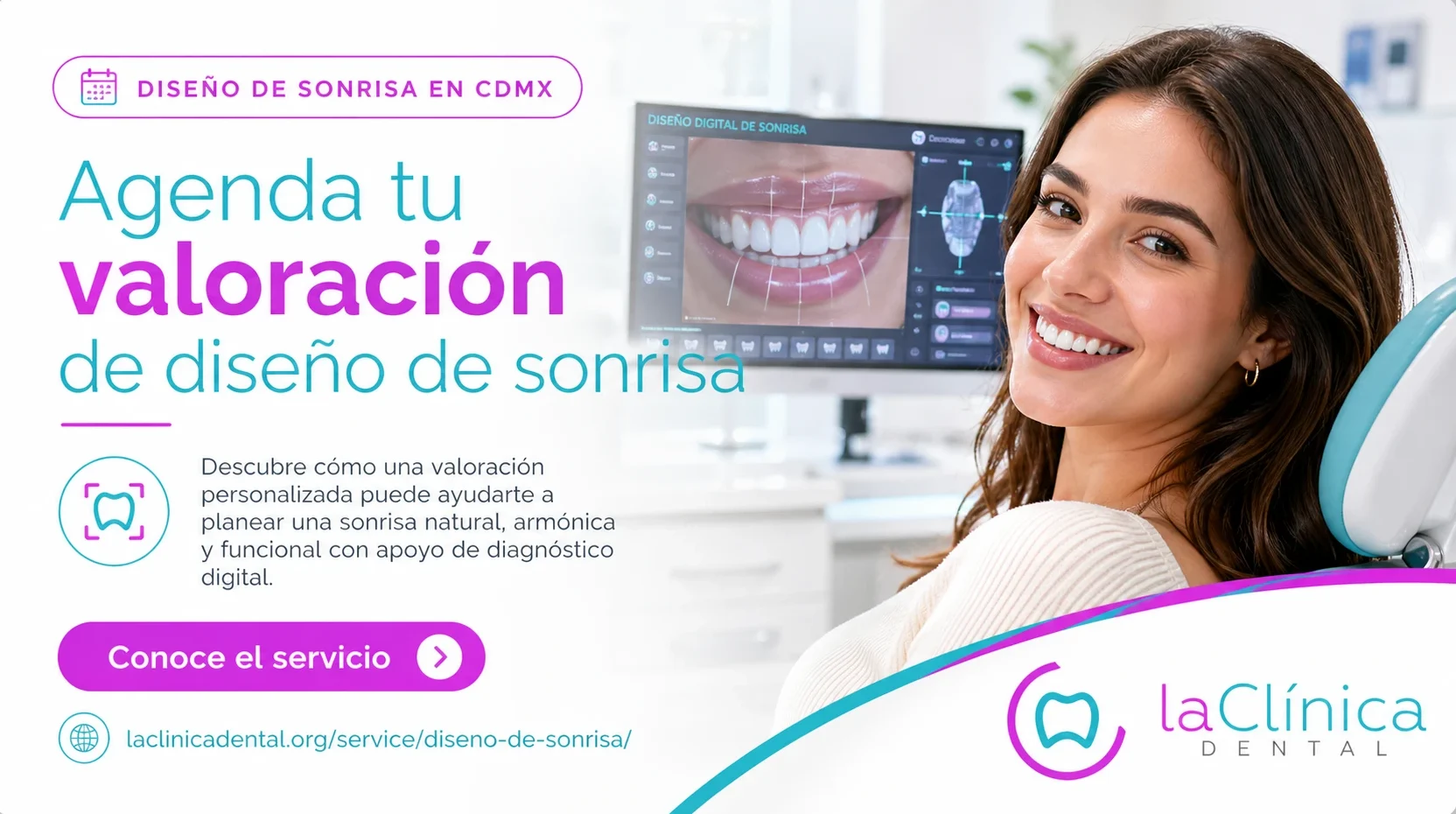
An aesthetic smile evaluation with digital simulation in CDMX allows us to analyze shape, proportion, color, alignment and possible results before starting treatment. It can include clinical photographs, intraoral scan, facial analysis and, when the case requires it, a dental mock-up to visually test the smile before placing veneers, resins or other definitive treatments.
The difference between choosing a treatment “for the sake of it” and choosing it with clinical criteria lies in the diagnosis. Before deciding whether you need veneers, resins, whitening, orthodontics or a combination, it is important to understand what is affecting your smile and what changes are really possible without losing naturalness, comfort or function.
At La Clínica Dental, the aesthetic assessment is part of a comprehensive approach: first your current smile is analyzed, then clinical options are reviewed and finally a treatment path is defined. If you want to understand the full treatment picture, check out our main guide to smile design in CDMX.
What is an esthetic smile assessment with digital simulation?
An aesthetic smile assessment with digital simulation is a diagnostic consultation focused on studying how your teeth look when speaking, smiling and at rest, and how they could be improved with a customized plan.
It is not just about “making teeth whiter”. The assessment analyzes elements such as:
- proportion between teeth, lips and face;
- shape and size of teeth visible when smiling;
- tooth color and presence of stains;
- gaps, fractured edges or wear;
- dental alignment and bite;
- visible, swollen or asymmetrical gums;
- old restorations that no longer look natural;
- feasibility of veneers, resins, whitening or orthodontics.
Digital simulation helps to visualize possibilities, but does not replace clinical diagnosis. Its value lies in improving communication between patient and specialist: it allows to discuss expectations, case limits, alternatives and phases before starting.
What does an esthetic smile assessment include?
A well-considered esthetic assessment should not be limited to looking at the teeth for a few minutes. It should gather enough information to decide what treatment is appropriate and in what order.
| Valuation element | What it analyzes | How it helps the patient | When it is used |
|---|---|---|---|
| Clinical photography | Smile, lips, visible gingiva, proportions and facial expression. | It allows to study the smile in context, not only tooth by tooth. | In almost every aesthetic evaluation. |
| Intraoral scanner | Dental shape, bite, volume of the teeth and digital records. | Avoids uncomfortable molds in many cases and facilitates digital planning. | When veneers, resins, aligners, crowns or restorations are evaluated. |
| Facial analysis | Relationship between teeth, lips, smile and face. | Helps to avoid artificial or disproportionate results. | In cases of visible aesthetic change. |
| X-rays or CBCT | Roots, bone, restorations, anatomy and internal structures. | Helps when the case combines esthetics with health, function or rehabilitation. | Only when the diagnosis justifies it. |
| Digital simulation | Possible changes in shape, size, proportion and visual alignment. | Allows to understand options before starting treatment. | When the aesthetic change needs more planning. |
| Dental mock-up | Temporary test of volume, shape and length on the teeth. | Helps to see a physical approximation of the result before finalization. | In selected cases, especially before veneers or esthetic restorations. |
What is the purpose of digital smile simulation?
The digital simulation is used to visualize an esthetic proposal before starting treatment. It can show approximate changes in shape, length, proportion or alignment, depending on the available records and the type of case.
Its main advantage is not to promise an exact result, but to help answer important questions:
- Will the change look natural on my face?
- Do I need veneers or are resins enough?
- Is it advisable to bleach before restoring?
- Should I align first with orthodontics?
- Is the problem color, shape, position or wear?
- How many teeth should be included in the plan?
- Can it be done in stages?
- How much of the result depends on my gums or my bite?
What is a dental mock-up and why does it help before veneers or resins?
A dental mock-up is a temporary try-in that allows the patient to visualize the shape, volume and length of the teeth before the definitive treatment is completed. In some cases it is placed directly on the teeth so that the patient can see how the proposal integrates with his or her real smile.
The mock-up can help to evaluate:
- if the teeth appear too long or too short;
- if the volume is comfortable;
- if the shape harmonizes with the lips;
- if the change looks natural when speaking;
- if the patient wants to adjust details before moving forward;
- if the aesthetic proposal matches the function and the bite.
Not all cases need mock-up. In small changes, a photograph, clinical analysis and explanation of the plan may be sufficient. In more visible changes, such as veneers or previous esthetic rehabilitations, the mock-up can be a very useful tool to reduce uncertainty.
If you are ready to move from comparison to a clinical decision, the next step is to request a smile design assessment.
Does digital simulation guarantee the final result?
No. Digital simulation should not be presented as an exact prediction. It is a planning and communication tool that helps visualize possibilities, but the final outcome depends on various clinical factors.
Factors that can change the outcome include:
- initial tooth color;
- type of material chosen;
- swollen or asymmetrical gums;
- dental wear;
- bite or bruxism;
- previous restorations;
- position of the teeth;
- tissue response;
- number of teeth included;
- hygiene and maintenance habits.
A responsible clinic should explain what part of the plan is predictable, what part requires adjustments and what alternatives exist if the case changes during the process. Digital simulation should be used to make better decisions, not to sell an unrealistic picture.
How does the intraoral scanner help in a smile design?
The intraoral scanner allows teeth and gums to be recorded in digital format. In many treatments it replaces traditional molds and helps to create digital models that can be used to plan restorations, veneers, resins, aligners or temporaries.
Its benefits within an aesthetic assessment are clear:
- records the current shape of the teeth;
- helps to study proportions and spaces;
- facilitates communication with the laboratory;
- can improve patient comfort;
- allows a comparison between the initial situation and the proposed plan;
- helps to coordinate esthetics, restoration and function.
What is the difference between digital simulation, mock-up and final processing?
These three concepts are often confused, but they are not the same.
| Concept | What it is | What it allows to decide | What not to promise |
|---|---|---|---|
| Digital simulation | Visual representation of possible aesthetic changes using photos, records or software. | Shape, proportion, esthetic direction and initial expectations. | Does not guarantee exact color, texture or final clinical response. |
| Dental mock-up | Temporary try-in of shape and volume on teeth or models. | How an approximate proposal looks and feels in the mouth. | Does not always reproduce the final material or its final behavior. |
| Final treatment | Definitive procedure with resins, veneers, whitening, orthodontics or restorations. | Clinical outcome adjusted to diagnosis, materials and function. | It should not be started without explaining risks, maintenance and alternatives. |
How does digital assessment help in deciding between veneers, resins, whitening or orthodontics?
The technique is not chosen first. The dominant smile problem is identified first. Then it is decided which treatment can correct it with the most conservative approach possible.
| What you want to improve | Treatment usually assessed | What corrects | What should be checked before |
|---|---|---|---|
| Yellow or stained teeth | Tooth whitening | Color of natural teeth. | Type of stain, sensitivity, visible restorations and gum health. |
| Small edges, fractures or localized details | High esthetics resins | Shape, edges, small spaces or imperfections. | Amount of tooth structure, bite and material stability. |
| Visible change in shape, size or proportion | Dental veneers | Shape, length, color and proportion in anterior teeth. | Available enamel, bite, bruxism, gums and expectations. |
| Crooked or crowded teeth | Orthodontics or aligners | Dental position, bite and alignment. | Treatment time, stability and need for subsequent esthetic phase. |
| Wear and tear, old restorations or altered bite | Restorations, crowns or esthetic rehabilitation | Function, support, esthetics and stability. | Comprehensive diagnosis, x-rays, gums, bruxism and number of teeth affected. |
If you are comparing between aesthetic options and want to understand what a harmonious result looks like, you can also review the natural smile design guide.
When should digital simulation be done before veneers are placed?
Digital simulation is especially useful when change will be visible or when the patient needs to compare various treatment routes. It is also useful when there are doubts between a conservative option and a more extensive transformation.
It may be recommended before veneers when:
- you want to modify shape and length of several teeth;
- there are visible spaces between teeth;
- there are old restorations in the anterior zone;
- you are looking to improve your smile without making it look artificial;
- you have worn teeth;
- there are doubts between resins and veneers;
- you want to check ratios before deciding;
- the case requires coordination with the laboratory;
- it is necessary to evaluate whether whitening or orthodontics should be done first.
Veneers may be an option for modifying the visible front of teeth, but should not be chosen without a thorough assessment. The American Dental Association describes veneers as custom veneers that cover the front of the tooth and cautions that the treatment is not reversible and should be performed by a licensed dentist.
For specific treatment, check out our dental veneers page.
When are highly esthetic resins suitable for a digital assessment?
High esthetic resins can be useful when the change is localized and dental structure is to be preserved. In many cases they are valued to correct irregular edges, small spaces, slight fractures or details of shape.
They can be considered when:
- the required change is moderate;
- the entire front of the tooth does not need to be covered;
- there are small fractures or wear and tear;
- a conservative option is sought;
- the patient needs a staged solution;
- the base color of the teeth is favorable;
- the bite does not compromise the stability of the material.
The digital assessment helps to decide whether a resin can solve the esthetic objective or whether the case requires an alternative with greater coverage, such as veneers or indirect restorations.
To learn more about this treatment, check out our high esthetic resins page.
What questions to ask before accepting a smile design?
Before accepting an aesthetic plan, it is not enough to ask the price. It is advisable to ask for clinical clarity.
These are useful questions:
- What was the main problem detected: color, shape, alignment, wear or bite?
- Is the digital simulation only visual or will it be used for treatment planning?
- Do I need an intraoral scanner?
- Do I need X-rays or CBCT?
- Does the case require mock-up?
- What alternatives do I have besides veneers?
- Which option preserves more tooth structure?
- How many teeth will be included?
- Should bleaching be done before or after?
- Is there inflamed gums or periodontal disease to treat first?
- Can my bite or bruxism affect the outcome?
- What maintenance will I need?
- How much of the result is approximate and how much is predictable?
- Can it be done in stages?
- Who will clinically review the case?
Where to have an aesthetic assessment with digital simulation in CDMX?
The best place to have an aesthetic evaluation with digital simulation in CDMX is a clinic that combines diagnosis, technology and clinical criteria, not just an attractive image of the possible result.
Look for the clinic to be able to explain:
- what digital tools you use;
- when he recommends an intraoral scanner;
- when CBCT is really needed;
- how you decide between veneers, resins, whitening or orthodontics;
- how it protects the naturalness of the result;
- which specialist reviews your case;
- what phases the treatment will have;
- how it will be followed up later.
At La Clínica Dental, smile design is approached as a personalized process that can integrate digital diagnosis, esthetic analysis, different specialties and a clear treatment sequence. The current service page already describes the use of Digital Smile Design, intraoral scanner, CBCT and CAD/CAM as tools to plan with more control when the case requires it.
Conclusion
An esthetic smile assessment with digital simulation helps you to make a better decision before starting an esthetic treatment. It allows you to analyze your current smile, visualize possibilities, compare options and understand whether your case requires veneers, resins, whitening, orthodontics or a combination.
The key is not to confuse simulation with promise. A good simulation does not replace the diagnosis; it strengthens it. When combined with clinical photography, intraoral scanning, facial analysis and, if applicable, mock-up, the patient can make clearer decisions and the clinical team can plan more accurately.
If you want to evaluate your case with an esthetic, functional and digital approach, schedule a smile design assessment.
Frequently asked questions about esthetic smile assessment with digital simulation
What is an aesthetic smile evaluation with digital simulation in CDMX?
An aesthetic smile evaluation with digital simulation in CDMX is a diagnostic consultation where shape, color, proportion, gums, bite and possible outcome are analyzed before starting a treatment. It can include clinical photographs, intraoral scan, facial analysis and dental mock-up when the case requires it.
What does an aesthetic assessment include before a smile design?
An esthetic evaluation may include clinical review, photographs, facial analysis, intraoral scan, evaluation of gums, bite, tooth color and previous restorations. Its objective is to define if the patient needs veneers, resins, whitening, orthodontics or a combination. To understand the complete treatment, see smile design in CDMX.
What is the purpose of digital smile simulation before treatment?
Digital simulation is used to visualize possible changes in shape, proportion, length, alignment or color before treatment begins. It helps to compare alternatives, adjust expectations and decide whether veneers, resins, whitening or orthodontics are appropriate before modifying teeth.
What is a dental mock-up and when is it recommended?
A dental mock-up is a temporary try-in that allows a physical approximation of the new smile to be seen on the teeth. It is recommended when the change will be visible, when veneers or esthetic restorations are planned, or when the patient needs to try out shape, volume and length before definitive treatment.
What is the difference between digital simulation and dental mock-up?
Digital simulation is a visual view of the possible outcome on screen or through digital records. Dental mock-up is a temporary physical try-in that allows you to see how the proposal integrates in the mouth. The simulation provides guidance; the mock-up helps to test actual proportions.
Does digital simulation guarantee what my smile will look like?
No. Digital simulation does not guarantee an exact result; it serves as a planning tool. The final result depends on the diagnosis, materials, initial shade, gums, bite, habits, the number of teeth treated, and the clinical response during the process.
How accurate is a digital smile simulation?
Accuracy depends on the quality of the records, photographs, intraoral scan, diagnosis and complexity of the case. It is useful for planning and communicating expectations, but should not be confused with an exact promise of color, texture, volume or final tissue response.
How does the 3D intraoral scanner help in an esthetic assessment?
The 3D intraoral scanner digitally records the shape of teeth and gums. It helps to study proportions, bite, spaces, wear and dental volume. It also facilitates the planning of veneers, resins, aligners or restorations with greater communication between patient, dentist and laboratory.
When is an X-ray, CBCT or 3D study needed in dental esthetics?
An X-ray or CBCT may be requested when the case requires a review of roots, bone, old restorations, dental anatomy, bone loss, implants or functional problems. Not all smile designs require it; the study is indicated according to the clinical diagnosis and complexity of the treatment.
Does digital assessment help in deciding between veneers, resins or whitening?
Yes, digital assessment helps to identify whether the main problem is color, shape, wear, alignment or proportion. If the change is slight, resins or whitening may be sufficient. If the change is major, veneers or other esthetic treatments may be considered. Check also our dental veneers.
When should digital simulation be done before dental veneers?
Digital simulation should be done prior to veneers when the shape, size, length or proportion of several teeth will be changed. It is also useful if the patient wants to avoid an artificial result, compare conservative options or visualize the smile before starting an irreversible treatment.
Can I see a trial of my smile before veneers are placed?
Yes, in some cases a digital simulation or dental mock-up can be done before veneers are placed. This allows to check proportions, volume and overall appearance. The test does not replace the diagnosis, but it helps to make a clearer decision before the final treatment.
Does digital simulation work if I have crooked teeth?
Yes, it can help to visualize possibilities, but if the teeth are very misaligned it may be necessary to consider orthodontics or aligners before veneers or resins. The simulation helps to decide whether to move the teeth first or resolve with restorative treatment.
What if I have bruxism before a smile design?
If you have bruxism, your bite should be evaluated before veneers, resins or esthetic restorations are placed. Bruxism can fracture, wear or peel materials. In some cases, night guarding, functional adjustment or stronger planning is recommended before the final result.
What if I have swollen gums before cosmetic treatment?
If swollen gums are present, periodontal health should be treated first before starting a smile design. Inflammation can alter color, gum shape, registration accuracy and stability of the esthetic result. Esthetics should be planned on healthy gums.
How long does an aesthetic assessment with digital simulation take?
The time depends on the complexity of the case and the records required. An assessment may require clinical review, photographs, intraoral scan and subsequent analysis. If mock-up, radiographs or interdisciplinary planning is needed, the process may require more than one visit.
Can I make an initial assessment if I live outside of CDMX?
Yes, a patient who lives outside of CDMX can start with orientation, photographs or available studies, especially if he/she plans to travel for treatment. However, the definitive plan must be confirmed with an in-person clinical evaluation, bite, gum and complete diagnostic records.
Where to have an aesthetic assessment with digital simulation in CDMX?
The best option is a clinic that combines clinical diagnosis, photography, intraoral scan, facial analysis, aesthetic criteria and specialists capable of explaining options, limits, phases and maintenance. At La Clinica Dental you can request a smile design assessment.
Schedule your smile design assessment in CDMX
Schedule your smile design assessment and discover how a personalized assessment with digital diagnostics can help you plan a natural, harmonious and functional smile before starting veneers, resins, whitening or other aesthetic treatments.
Author:
Dr. Rosa María Moctezuma Lozano
National Autonomous University of Mexico
ID No. 1135288
Clinically reviewed and updated content for patient information guidance.
Last editorial revision: 27 April 2026.