Published by Dr. Rosa Ma. Moctezuma, Cédula No. 1135288: April 12, 2026.
Reviewed by Dr. Miguel Ángel S.: April 12, 2026.
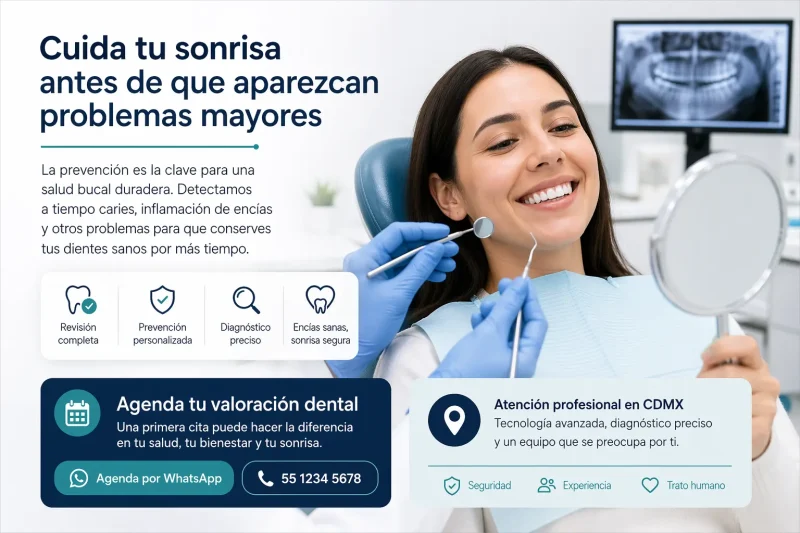
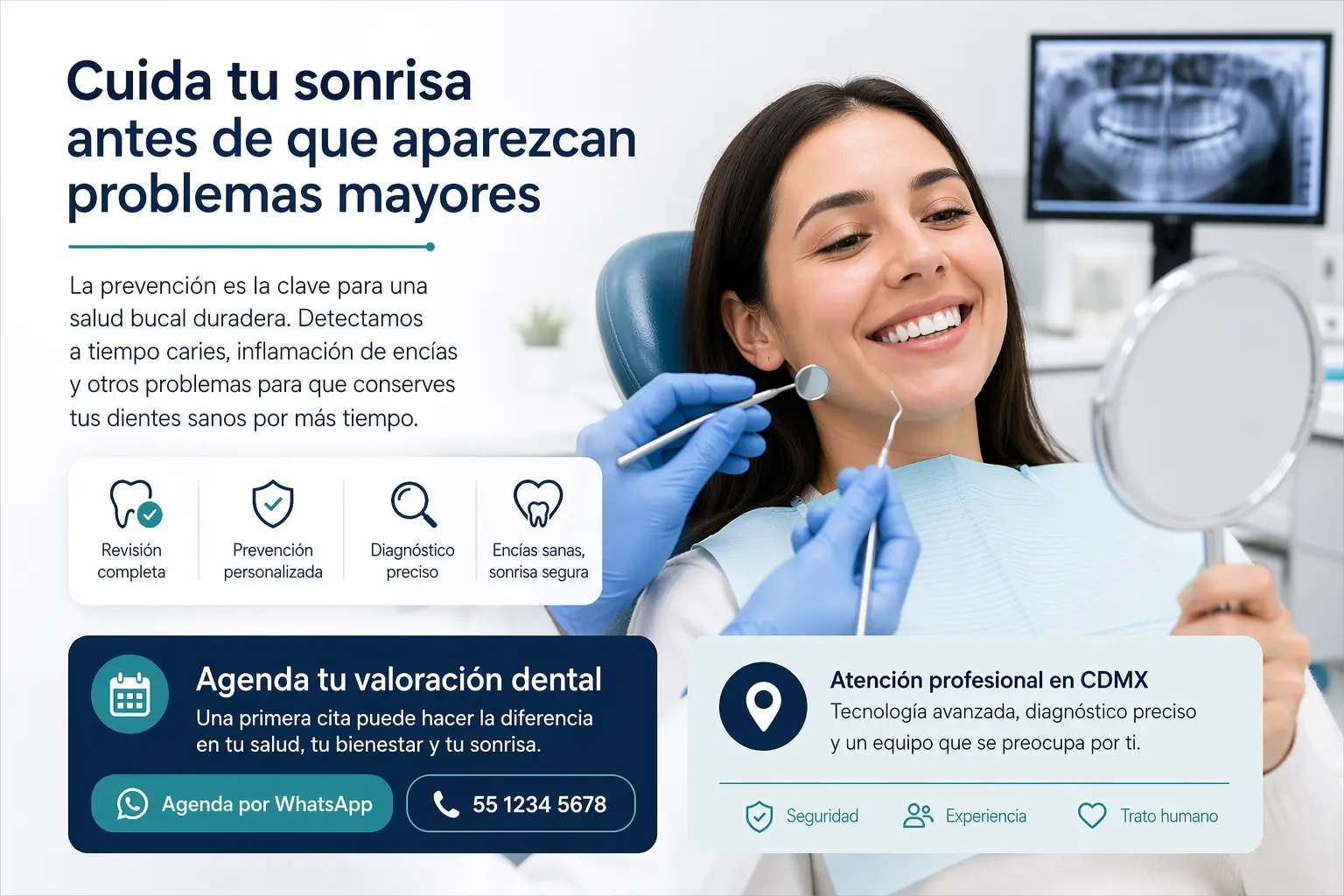
General and preventive dentistry in CDMX helps detect cavities, gum inflammation, wear and tear, infections and other dental problems before they become more costly, painful or complex to treat. A timely checkup, professional cleaning and proper diagnosis can prevent major treatment and help you keep your teeth longer.
What is general and preventive dentistry?
General and preventive dentistry is the branch that focuses on taking care of oral health on an ongoing basis, not only in solving emergencies or restoring teeth when the damage has already progressed.
Its goal is to help you:
- detect dental problems in early stages,
- control plaque, tartar and inflammation,
- check gums, bite and wear,
- prevent caries and periodontal disease,
- and define when restorative, periodontal, orthodontic or rehabilitative treatment is required.
In other words, it’s not just about “getting a cleaning”. It’s about monitoring the health of your mouth with clinical judgment to prevent a small problem from ending in pain, infection, fracture, bone loss or tooth loss.
What does a preventive dental check-up include?
A well-done preventive check-up should not be limited to a “quick look at the teeth”. It should include a real clinical evaluation and, when necessary, diagnostic support to understand what is going on.
What is normally reviewed
- presence of visible or suspicious caries,
- condition of the gums,
- accumulation of tartar and plaque,
- bleeding when brushing,
- tooth sensitivity,
- mobility or wear and tear,
- old restorations in poor condition,
- bite,
- and signs of infection or inflammation.
When diagnostic support may be required
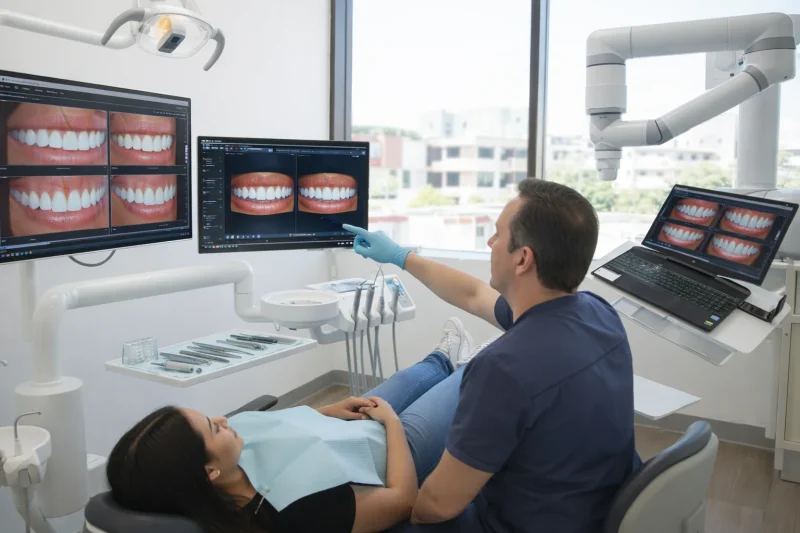
Depending on the case, the dentist may recommend x-rays, clinical photographs or digital diagnostics to check areas that cannot be seen with the naked eye, assess bone, detect interproximal caries or better plan treatment. If you want to better understand this process, check out what to expect at your first dental appointment, advanced dental technology in CDMX y how to evaluate a dental clinic in CDMX.
How often should you go to the dentist?
Not everyone needs to be checked at the same frequency.
The recommendation depends on factors such as:
- history of caries,
- bleeding or swollen gums,
- use of orthodontics,
- implants or prostheses,
- smoking,
- diabetes or other systemic conditions,
- pregnancy,
- and hygiene quality at home.
Indicative frequencies
- Low risk: review every 6 months
- Intermediate risk: every 4 to 6 months
- Increased periodontal or restorative risk: every 3 to 4 months
Going “only when it hurts” is usually too late. Many cavities, gum inflammations and small fractures progress painlessly in the early stages.
When is a dental cleaning preventive and when is it not enough?
Professional teeth cleaning helps remove plaque, stains and supragingival calculus. It is an important part of prevention, but is not a substitute for diagnosis.
A cleaning helps when
- there is plaque or tartar buildup,
- you want to improve hygiene and maintenance,
- there are stains from coffee, tea or tobacco,
- you need periodic follow-up,
- or you are entitled to preventive control.
Simple cleaning is not enough when
- there is frequent bleeding,
- persistent bad breath,
- mobility,
- periodontal pockets,
- localized pain,
- active caries,
- fractures,
- or infection.
In these cases, periodontal treatment, restorative treatment or a more complete diagnosis may be required.
| Situation | Can a normal cleaning be sufficient? | What should be assessed? |
|---|---|---|
| Preventive maintenance without discomfort | Yes, with clinical review | Ideal frequency according to risk |
| Bleeding gums when brushing | Not always | Gingivitis or periodontal disease |
| Accumulated tartar under the gum | No | Deep cleaning / periodontics |
| Localized pain or tenderness | No | Caries, fissure, recession or infection |
| Persistent bad breath | Not always | Defective gums, caries, hygiene or restorations |
Bleeding gums, tooth decay and sensitivity: signs not to ignore
Many people normalize symptoms that are already warnings.
Bleeding gums
Recurrent bleeding is not “normal because I brushed hard”. It may indicate inflammation, poor hygiene, gingivitis or early periodontitis.
Sensitivity to cold or sweets
It may be related to wear, recession, caries, leaks or small fractures.
Toothache
Pain does not always mean the same problem. It can range from advanced caries to pulp inflammation or infection.
Persistent bad breath
It is sometimes related to plaque, inflamed gums, deep caries, defective restorations or poor hygiene habits.
If you suffer from frequent discomfort, it is advisable to learn more about toothache: frequent causes, what to do today and when is it a real emergency?on the relationship between periodontitis and periodontitis and heart problems and what we do know about caries and stomach problems.
What problems can preventive dentistry detect early?
Prevention does not eliminate all risks, but it does greatly improve the possibility of intervening earlier.
Common problems that can be detected early
- initial caries,
- leaks in resins, crowns or inlays,
- gingivitis,
- incipient periodontitis,
- wear and tear due to bruxism,
- small fractures,
- malposition that complicates hygiene,
- bite injuries,
- and bone loss in certain cases.
Detecting this earlier changes the type of treatment, time, cost and discomfort.
What happens if you let “small” problems go by?
A small problem in the mouth can advance without making much noise.
What usually happens when you postpone
- caries grows and is no longer restorable with something simple,
- gum inflammation becomes chronic,
- increase sensitivity and bleeding,
- an old leaked resin ends in pain or endodontics,
- a small fracture can become complicated,
- and a simple treatment can turn into a longer or more costly one.
The preventive logic is not to overdo it. It is to intervene when there is still room for maneuver.
Who should pay more attention to prevention?
There are patients who need closer monitoring.
Groups that tend to require more careful monitoring
- patients with a history of frequent caries,
- people with inflamed gums,
- patients with implants, crowns or prostheses,
- older adults,
- children and adolescents,
- people with diabetes,
- smokers,
- pregnant women,
- and patients with fear of the dentist who postpone check-ups.
Here it is convenient to expand with dental treatments for patients with diabetes, dental care during pregnancy y fear of the dentist, anxiety and pain management..
General dentistry vs periodontics vs rehabilitation: how do they differ?
Not every dental problem is treated at the same level.
| Area | What does it mainly solve? | When do you usually intervene? |
|---|---|---|
| General Dentistry | Examination, initial diagnosis, caries, resins, preventive control. | First contact and regular follow-up |
| Periodontics | Gums, subgingival tartar, loss of support, periodontal inflammation | Bleeding, pockets, mobility, bone loss |
| Oral rehabilitation | Restore function and esthetics when there is wear, tooth loss or complex damage. | Cases with multiple affected teeth or complex restorations |
This helps to understand that a preventive review does not compete with other areas; it orders them and activates them when necessary.
What habits do help prevent dental problems?
Prevention doesn’t just depend on the office. It also depends on what you do between appointments.
Basic habits
- correct and constant brushing,
- interdental cleaning according to clinical recommendations,
- periodic professional review,
- timely attention to bleeding, pain or tenderness,
- maintenance if you already have restorations, implants or prostheses,
- and not wait for a symptom to become disabling.
How to choose a clinic for prevention and general dentistry in CDMX?
It is not enough to search for “teeth cleaning near me”. The criteria used to diagnose and decide on treatment are also important.
What to check
- clarity of diagnosis,
- follow-up,
- prevention criteria,
- technological support when needed,
- case traceability,
- explanation of options,
- and possibility of escalation to other specialties in the same clinical system if the case requires it.
This is important because many people come in thinking they only need cleaning and end up discovering a periodontal, restorative or functional problem that also needs to be addressed.
If you want to better evaluate these criteria before deciding, check out how to evaluate a dental clinic in CDMX.
When to schedule a dental assessment?
Schedule a dental assessment if:
- you have not been reviewed for months or years,
- your gums bleed,
- you have repeated pain or tenderness,
- you notice persistent tartar or bad breath,
- you see stains, fractures or wear,
- you are bothered by an old resin or crown,
- or you simply want to know if everything is OK before an emergency arises.
A timely first dental appointment allows you to check hygiene, gums, cavities, restorations and preventive needs before the problem progresses.
Frequently asked questions about general and preventive dentistry in CDMX
What does general dentistry do?
General dentistry reviews your oral health, detects cavities, inflammation, wear, fractures and functional problems, and defines if you need prevention, resins, periodontics, endodontics or another specialty.
How often should I go to the dentist?
It depends on your risk. Many people benefit from checkups every 6 months, but those with inflamed gums, frequent cavities, implants or diabetes may require closer checkups.
Does a dental cleaning replace a check-up?
No. Professional teeth cleaning aids in maintenance, but does not replace a clinical evaluation, nor does it alone detect all problems.
Is it normal for my gums to bleed when I brush?
No. Professional teeth cleaning aids in maintenance, but does not replace a clinical evaluation, nor does it alone detect all problems.
If I don’t have any pain can I wait longer?
This is not ideal. Many cavities and gum problems progress painlessly at first.
What does a preventive check detect?
It can detect caries, leaks, tartar, gingivitis, wear, mobility, small fractures and signs of infection or loss of support.
Does a small cavity always hurt?
No. Many early cavities are painless, so preventive dental checkups are important.
Does tooth sensitivity always mean caries?
Not always. It may also be related to wear, recession, small fractures or defective restorations.
What happens if I let bleeding gums pass?
Inflammation can progress to a more serious periodontal problem, with damage to tooth support.
Do patients with diabetes need more frequent check-ups?
Often yes, because diabetes can influence periodontal health and tissue response. Here it may help you to read dental treatments for patients with diabetes.
Does pregnancy change the way you take care of your mouth?
Yes, during pregnancy it is advisable to monitor gums, hygiene and inflammation more closely. You can read more in dental care during pregnancy.
If I am afraid of the dentist, should I still get checked?
Yes. In fact, putting off checkups out of fear often makes future treatments more complicated. If this applies to you, read about dental fear, anxiety, and pain management.
Does general dentistry also check resins, crowns or implants?
Yes. Part of preventive follow-up is to verify that your restorations or rehabilitations continue to function well.
When should I schedule a dental evaluation?
When you have not had a check-up for a long time, you have bleeding, pain, sensitivity, visible tartar, persistent bad breath or doubts about the condition of your teeth and gums.
General dentistry reviews your oral health, detects cavities, inflammation, wear, fractures and functional problems, and defines if you need prevention, resins, periodontics, endodontics or another specialty.
It depends on your risk. Many people benefit from checkups every 6 months, but those with inflamed gums, frequent cavities, implants or diabetes may require closer checkups.
No. Professional teeth cleaning aids in maintenance, but does not replace a clinical evaluation, nor does it alone detect all problems.
No. Professional teeth cleaning aids in maintenance, but does not replace a clinical evaluation, nor does it alone detect all problems.
This is not ideal. Many cavities and gum problems progress painlessly at first.
It can detect caries, leaks, tartar, gingivitis, wear, mobility, small fractures and signs of infection or loss of support.
No. Many early cavities are painless, so preventive dental checkups are important.
Not always. It may also be related to wear, recession, small fractures or defective restorations.
Inflammation can progress to a more serious periodontal problem, with damage to tooth support.
Often yes, because diabetes can influence periodontal health and tissue response. Here it may help you to read dental treatments for patients with diabetes.
Yes, during pregnancy it is advisable to monitor gums, hygiene and inflammation more closely. You can read more in dental care during pregnancy.
Yes. In fact, putting off checkups out of fear often makes future treatments more complicated. If this applies to you, read about dental fear, anxiety, and pain management.
Yes. Part of preventive follow-up is to verify that your restorations or rehabilitations continue to function well.
When you have not had a check-up for a long time, you have bleeding, pain, sensitivity, visible tartar, persistent bad breath or doubts about the condition of your teeth and gums.
Schedule your preventive dental assessment in CDMX
Receive an accurate clinical evaluation with a preventive approach, clear diagnosis and professional care aimed at preserving the function, health and esthetics of your smile before the problem progresses.
Author:
Dr. Rosa María Moctezuma Lozano
National Autonomous University of Mexico
ID No. 1135288
Clinically reviewed and updated content for patient information guidance.
Last editorial revision: 12 April 2026.