Published by Dr. Rosa Ma. Moctezuma, Cédula No. 1135288: March 25, 2026.
Reviewed by Dr. Miguel Ángel S.: March 26, 2026.
Complete oral rehabilitation in CDMX is a comprehensive treatment for people who have several dental problems at the same time, such as tooth loss, wear, pain when chewing, old restorations, diseased gums or an unstable bite. At La Clinica Dental, the case is studied with a multidisciplinary approach and advanced digital diagnostic support to recover function, health and esthetics with a realistic, orderly and tailored plan for each patient.
Not all complex cases need exactly the same treatment. Some people require dental implants in CDMX, others need to first take care of gums, change old prostheses, reorganize the bite or combine several specialties in the same clinical path. That is precisely the role of a complete oral rehabilitation: to sort out the whole case, not solve isolated pieces.
What is a complete oral rehabilitation?
A complete oral rehabilitation is a treatment plan that seeks to restore chewing function, bite stability, tooth and gum health and the natural appearance of the smile when the patient has several problems at the same time.
It may include, as the case may be:
- replacement of missing teeth
- periodontal control
- fixed or removable prostheses
- reconstruction of worn teeth
- bite correction
- esthetic phases
- long-term monitoring and maintenance
In some patients, rehabilitation includes implantology and fixed prostheses; in others, the first step is to treat gums with periodontics, stabilize teeth that can be retained or redefine priorities before thinking about more advanced procedures.
Who needs a complete oral rehabilitation in CDMX?
It is usually a good option for people who present one or more of these situations:
- have lost one or more teeth
- use old bridges or prostheses that no longer function properly
- have severely worn, fractured or sensitive teeth
- feel pain or fatigue when chewing
- have swollen gums, bleeding or mobility of teeth
- want to solve a complex case in one place, with coordinated specialists
- seek a functional and aesthetic solution, not an isolated treatment.
It is also a very useful route for patients who arrive thinking only of aesthetics, but after diagnosis discover that they need something more than a natural smile design in CDMX, because underneath the visible problem there is wear, lack of support, compromised gums or teeth with poor prognosis.
What problems can a complete oral rehabilitation solve?
| Problem | What may be occurring | What part of the treatment corrects it |
|---|---|---|
| Tooth loss | Decreased support, changes in bite, difficulty chewing | Implants, dentures or combined plans |
| Worn or fractured teeth | Bruxism, inadequate contacts, failed restorations | Functional reconstruction, crowns or resins |
| Diseased gums | Gingivitis, periodontitis, attachment loss or bone loss | Previous periodontal treatment |
| Old prostheses | Poor fit, discomfort, poor esthetics | Prosthetic replacement and comprehensive redesign |
| Unstable bite | Muscle pain, wear and tear, overloads | Occlusal rearrangement and phased adjustment |
| Functional + esthetic case | Crooked, missing, dark or worn teeth | Multidisciplinary plan with function and esthetics |
How is a complete oral rehabilitation case evaluated?
A complete oral rehabilitation should not be planned just by looking at “how the smile looks”. In a complex case, bone, gums, bite, previous restorations, habits, remaining structure and real expectations must be reviewed.
The assessment may include:
- medical history and relevant background
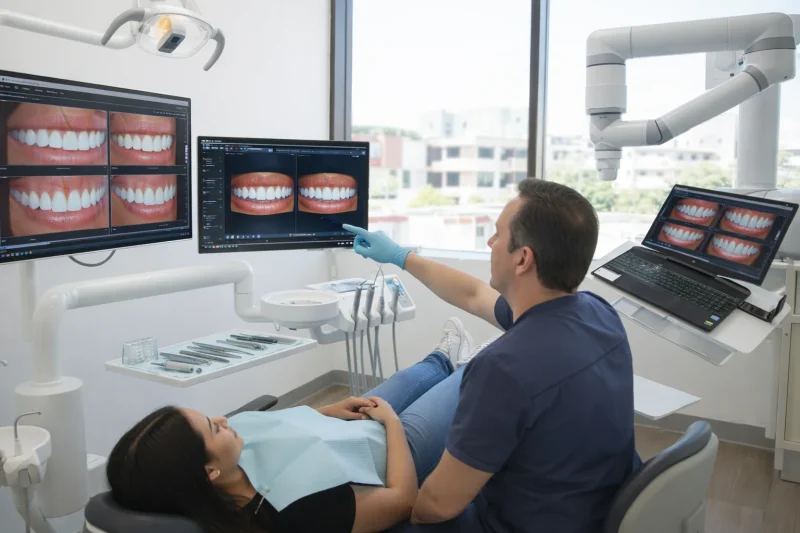
- intraoral and extraoral photographs
- digital radiographs
- 3D tomography when the case requires it
- functional bite analysis
- periodontal evaluation
- revision of previous restorations
- intraoral scanner instead of traditional impressions
Which specialists can be involved in a complete oral rehabilitation?
One of the advantages of integrated treatment is that the plan does not depend on a single discipline. Depending on the case, they can intervene in a coordinated manner:
Does complete oral rehabilitation always include implants?
No. Complete oral rehabilitation does not always include implants. Its goal is to restore function, oral health and bite stability when several problems exist at the same time, but that does not mean that all patients need to have teeth replaced with implants from the start.
In some cases, dental implants do form part of the treatment, especially when there is tooth loss, unstable dentures or lack of chewing support. However, in other patients it is first necessary to treat gums, control infections, stabilize the bite or replace old restorations before deciding on the best solution.
The need for implants depends on the diagnosis, the number of teeth involved, the condition of the bone and gums, and whether it is still possible to preserve teeth with a good prognosis. Therefore, in a complete oral rehabilitation, the most important thing is not to indicate a single procedure, but to define the correct order of treatment to recover function, comfort and long-term stability.
If several teeth are missing or there are older dentures that have lost stability, it may be necessary to consider a complete fixed solution. In such cases, options such as All-on-4 and All-on-6 in CDMX may be part of the plan, depending on the diagnosis and the amount of support available.
When does a complex case need All-on-4, All-on-6 or a complete fixed rehabilitation?
Not all patients with advanced tooth loss need the same type of solution. In some cases, when several teeth are missing, there are removable prostheses that no longer offer stability or there are teeth with a poor prognosis, it may be necessary to consider a complete fixed rehabilitation to recover function, chewing support and greater security in daily life.
The choice between All-on-4, All-on-6 or another fixed rehabilitation alternative depends on the diagnosis. The most important thing is to determine how many teeth can be preserved, how the bone and gums are doing, how stable the bite is and what kind of functional and esthetic result is sought in the long term.
Factors that often influence this decision include:
- quantity and quality of bone available
- periodontal status
- real possibility of preserving teeth with good prognosis
- bite stability
- extent of damage or wear
- processing times
- expected maintenance after rehabilitation
Therefore, before thinking about a specific technique, it is helpful to first understand the complete case. When there is bone loss, a need for grafting or doubts about whether a full-arch solution is viable, it may help to review complex cases with bone loss, grafting and All-on-4. And when a full-arch fixed option is already being considered, All-on-4 and All-on-6 in CDMX explains in more detail what each alternative consists of.
Can the entire treatment be done in one long visit?
In some cases it is possible to concentrate several phases of treatment in a single visit, but not all complex cases should be resolved in a single day. When there is bone loss, infection, periodontal disease, multiple extractions or the need for bite adjustment, it is usually wiser to proceed in stages to achieve a more stable and predictable result.
Some patients need a sequence like this:
- diagnosis and planning
- periodontal or infection control
- extractions or surgery
- healing time
- temporary restorations
- functional and bite adjustment
- final phase
- subsequent maintenance
Therefore, rather than trying to do “everything at once”, the important thing is to define which parts of the treatment can be grouped together and which parts should be done at different times. Such planning helps to reduce risks, improve patient adaptation and protect the long-term outcome.
If you want to learn more about which cases can be concentrated in several phases and which cannot, you can review Can I do all my dental treatment in one long visit?
Does full oral rehabilitation hurt?
The discomfort depends on the procedure and the complexity of the case, but a well-planned complete oral rehabilitation aims to make the process more controlled, more predictable and more bearable for the patient. In many cases, the concern is not only the pain, but also knowing what is going to happen, how long each phase will last and how the recovery will be accompanied.
To reduce discomfort and avoid improvisation, treatment is usually organized in a clear sequence: prior diagnosis, explanation of each stage, choice of the type of anesthesia or support required according to the procedure, realistic times between phases and follow-up after each intervention. This orderly approach is especially important in complex cases, because it makes it possible to move forward with greater safety and better adaptation.
When there is also anxiety, fear of anesthesia or fear of the dentist, this aspect should be assessed from the beginning. In such cases, it may help to review the guide on fear of the dentist, anxiety and pain management and also to understand the differences between conscious sedation and local anesthesia, depending on the type of treatment and the needs of each patient.
What technologies help in a complete oral rehabilitation?
In complex cases, technology is not a frill. It is a tool to plan more accurately and for the patient to better understand what is to be done and why.
Depending on the case, they may be useful:
- digital radiography
- 3D tomography
- clinical photography
- intraoral scanner
- digital implant planning
- digital smile design
- in-house laboratory or rapid restorative flows
What does the step-by-step treatment include?
A well-planned complete oral rehabilitation usually follows a sequence. The exact order changes from case to case, but this walkthrough helps to understand it.
Comprehensive diagnosis
It reviews what can be retained, what should be corrected first, and what functional and esthetic goal is realistic.
2. Active disease control
If infection, extensive decay, bleeding gums, tooth mobility or periodontitis are present, these problems must be addressed before moving on to the restorative phase. In many cases, this involves initiating periodontal treatment to control inflammation, stabilize the supporting tissues and improve the prognosis of the rest of the plan.
Treating active disease first helps to reduce risks, better manage subsequent phases and create a more stable foundation for procedures such as prosthetics, restorations or implants.
3. Structural preparation
Extractions, regeneration, previous adjustments or support preparation can be included. In specific cases, also extractions or maxillofacial surgery.
4. Implantological or prosthetic phase
When the case requires it, implants, oral prostheses or complete fixed restorations are integrated.
5. Aesthetic and bite adjustment
At this stage, the shape, color, tooth-to-tooth contacts and overall harmony of the smile are refined so that the result not only looks good, but also functions in a stable manner when speaking and chewing. When the case also includes an esthetic objective, treatments such as natural smile design or restorations such as crowns, veneers and resins may be integrated, depending on the wear, color and function of each case.
6. Maintenance
A good complete oral rehabilitation does not end the day it is delivered. To maintain stability, function, comfort and esthetics in the long term, it is necessary to follow up the case with periodic check-ups, professional hygiene and control of gums, bite and restorations.
This phase is especially important when there are implants, fixed prostheses or a history of periodontal disease, because maintenance helps to detect changes in time and to protect the result obtained with the treatment.
How long does a complete oral rehabilitation take?
There is no single duration for all patients.
The time depends on:
- if there is active periodontal disease
- if extractions or grafts are required
- whether there will be implants
- if temporary measures are needed
- if the patient lives in CDMX or travels from another city
- whether the purpose is primarily functional, aesthetic or both
How much does a complete oral rehabilitation in CDMX cost?
The cost depends on the starting point and what the case really needs. Not all patients require implants, surgery, provisionals or multiple specialties, so there is no single universal figure.
The price may vary due to factors such as:
- number of teeth to be treated or replaced
- need for implants or grafts
- presence of periodontal disease
- type of prosthesis or restoration
- complexity of the bite
- required steps
- necessary diagnostic tests
Can it be paid in stages or with a staggered plan?
In many cases, yes. In fact, when a rehabilitation is complex, it often makes sense to divide the treatment by clinical and financial phases.
This allows:
- first resolve pain or infection
- Stabilize gums before investing in definitive restorations.
- plan implants with better prognosis
- to distribute the investment in a more orderly manner
What if I have bone loss, diabetes or a complex history?
Having bone loss, controlled diabetes, failed restorations or years without treatment does not automatically mean there are no options. It does mean that more careful planning is needed.
The important thing is to evaluate:
- systemic control
- periodontal status
- bone quality
- feasibility of preserving teeth
- healing times
- real objectives
Is it a good option for patients coming from another city or from abroad?
Yes, as long as the case is planned with realistic timelines.
For patients who travel, a complete oral rehabilitation should be considered:
- pre-assessment where possible
- clinical studies and documentation
- likely number of visits
- which phases can be grouped together
- which procedures require waiting or follow-up
- provisional restorations and definitive phase
- subsequent control
What are the advantages of doing a complete oral rehabilitation in one place?
When the case is complex, centralizing the treatment can help:
- more consistent diagnosis
- better communication between specialties
- clearer clinical sequence
- fewer contradictions between treatments
- more control over studies, restorations and timing
- better case traceability
How do you know if you need a comprehensive assessment?
It may be time to schedule a comprehensive oral rehabilitation evaluation if you identify with two or more of these situations:
- you are missing several teeth
- you have old dentures, crowns or bridges
- you notice pain, wear or fatigue when chewing
- you have postponed treatment for years
- you feel that your case requires several specialists
- you want a functional and aesthetic solution at the same time
- you need to know what can be done in stages and what should not be delayed any longer
If you still don’t know where to start, you may also find it helpful to review what to expect at your first dental appointment and how to evaluate a dental clinic in CDMX.
Complete oral rehabilitation in CDMX with digital diagnosis and realistic plan
Complete oral rehabilitation is not about selling a single procedure. It is about understanding the complete case and building a stable, clear clinical sequence tailored to your goals.
At La Clinica Dental, this approach integrates digital diagnostics, different specialties and a step-by-step plan for patients with functional, structural and esthetic needs that cannot be solved with a single isolated intervention. If you are looking to restore teeth, bite, chewing comfort and a natural smile with a well-explained clinical pathway, comprehensive assessment is the right starting point.
Frequently asked questions about complete oral rehabilitation in CDMX
What is a complete oral rehabilitation?
It is a comprehensive treatment plan that seeks to restore function, bite stability, tooth and gum health, and esthetics when there are several problems at the same time, such as tooth loss, wear, old dentures, periodontal disease or difficulty chewing.
Who needs a complete oral rehabilitation?
It is often useful for people with several missing teeth, badly worn teeth, unstable dentures, altered bite, diseased gums or old restorations that no longer work well. It may also be the best option when the case requires more than one coordinated specialty.
Does complete oral rehabilitation always include implants?
No. Some patients do need them, but in other cases it is first necessary to treat gums, control infection, stabilize the bite or evaluate which teeth can still be preserved. The decision depends on the complete diagnosis, not on a single technique.
When might a complete fixed rehabilitation be necessary?
When there is multiple tooth loss, removable prostheses that are no longer stable or teeth with poor prognosis, it may be necessary to evaluate a complete fixed solution. Feasibility depends on the available bone, gum condition, bite and functional objective of the case.
Can the entire treatment be done in one long visit?
Yes, in some cases several phases of treatment can be concentrated into one long visit, but not all complex cases should be resolved in a single day. When there is bone loss, periodontal disease, multiple extractions, surgery, need for healing or bite adjustments, it is usually safer and more predictable to proceed in stages.
The important thing is not to do “everything at once”, but to define which parts of the treatment can be grouped together and which parts should be done at different times to protect function, comfort and the long-term outcome. In patients who travel or seek to optimize time, this pre-planning also helps to avoid unrealistic expectations and to better organize each phase of the process.
How long does a complete oral rehabilitation take?
It depends on the case. The timing changes depending on whether there is active infection, periodontal disease, implants, grafting, temporaries, healing phases or functional adjustments. Some patients may progress quickly; others need a more gradual sequence to achieve long-term stability.
Does full oral rehabilitation hurt?
The discomfort depends on the procedure, but a well-planned treatment aims to make the process more controlled, explainable and bearable. In many cases the real concern is not only the pain, but knowing what is going to happen, how long each phase will last and what the recovery will be like.
What if I am afraid of the dentist or afraid of anesthesia?
This aspect should be assessed at the outset. When there is anxiety or fear of treatment, it may be important to plan pain control, explain each stage clearly and assess whether local anesthesia, conscious sedation or other comfort measures are appropriate. The report identifies pain and anxiety management as part of frequent consultations and differential brand perception.
What studies are usually requested before starting?
Depending on the case, photographs, digital radiographs, 3D tomography, intraoral scan, periodontal evaluation and bite analysis may be required.
What is the role of digital diagnostics in a complete oral rehabilitation?
Helps to better understand the case before starting. It allows you to evaluate bone support, status of previous restorations, gums, bite and treatment options more accurately. It also makes it easier to explain the plan to the patient and better order the treatment phases.
Which specialists can be involved in a complete oral rehabilitation?
Depending on the case, they can intervene in implantology, periodontics, prosthetics, oral or maxillofacial surgery, endodontics, orthodontics and dental esthetics.
What if I have bone loss?
Bone loss does not automatically eliminate treatment options, but it does require more precise planning. In some cases it may be necessary to modify the strategy, evaluate grafts or decide whether to keep teeth, place implants or choose another type of rehabilitation.
Can I do a complete oral rehabilitation if I have controlled diabetes?
In many cases yes, as long as there is an adequate clinical evaluation and good systemic control. The important thing is to review healing, periodontal health, risk of infection and treatment sequence before defining the plan.
How much does a complete oral rehabilitation in CDMX cost?
There is no single figure for all patients. The cost depends on the number of teeth to be treated or replaced, the condition of the bone and gums, the type of restorations, whether there is surgery or implants and the number of stages required.
Can I pay in stages?
Yes, in many cases, treatment can be organized by clinical and financial stages in order to attend to the most urgent matters first and spread out the investment without losing sight of the whole case.
This makes it possible to move forward with a more orderly plan, prioritizing what affects function, pain or stability and defining the next phases according to the diagnosis. The important thing is that this division is not improvised, but is part of a comprehensive planning from the beginning.
What are the advantages of doing a complete oral rehabilitation in one place?
It can provide a more consistent diagnosis, better communication between specialties, clearer sequencing and greater control over studies, restorations and timing. In complex cases, such clinical integration is often more valuable than treating each problem separately.
What happens after treatment?
Serious rehabilitation does not end the day it is delivered. It needs follow-up, professional hygiene, check-ups, periodontal control and maintenance to preserve long-term stability, function and comfort. This also helps to broaden the brand narrative beyond “great treatments” to ongoing care, an explicit recommendation of the report.
How do I know if I need a comprehensive assessment?
It may be a good idea to ask for an evaluation if you are missing several teeth, have old dentures or crowns, notice wear, pain when chewing, swollen gums, tooth mobility or the feeling that your case requires several solutions at the same time.
Request your complete oral rehabilitation evaluation in CDMX
Receive a personalized proposal according to the diagnosis, the real complexity of your case and the most appropriate time for your treatment.
Author:
Dr. Rosa María Moctezuma Lozano
National Autonomous University of Mexico
ID No. 1135288
Clinically reviewed and updated content for patient information guidance.
Last editorial revision: March 25, 2026.