Published byDr. Rosa Ma. Montezuma : January 22, 2026.
Did your dentist recommend a “panoramic radiograph” and you’re not sure what it is? If you imagine a complicated or uncomfortable procedure, the good news is that it’s quite the opposite: it lasts less than a minute and is completely painless. In this patient guide, we will explain in a simple way what to expect so that you go to your appointment with complete confidence and peace of mind.
This study, formally known as orthopantomography, is much simpler than its name suggests. Think of it as the complete map of your mouth. While the small X-rays taken in the dental chair are like seeing a single street, digital panoramic X-rays give your dentist a view of the entire city: your teeth, jaws, and joints, all in one clear image.
Having this perspective is essential to detect problems that are not visible to the naked eye, such as the exact position of the wisdom teeth or the need for orthodontic treatment. This tool is so common, safe, and necessary because it protects your oral health in a comprehensive manner.
Summary
Orthopantomography is a panoramic radiograph that offers a complete view of teeth, jaws, and joints in a single image, through a quick and painless procedure. In its digital version, it significantly reduces radiation (up to ~80%), delivers instant and sharp images, and improves diagnosis and planning. It detects problems that are not visible to the naked eye—such as impacted wisdom teeth, bone abnormalities, or TMJ disorders—and is complemented by periapical radiographs (detail) and CBCT tomography when a 3D view is required. Its cost is understood as an investment that prevents complications, and the radiation dose is low, comparable to that of a short flight.
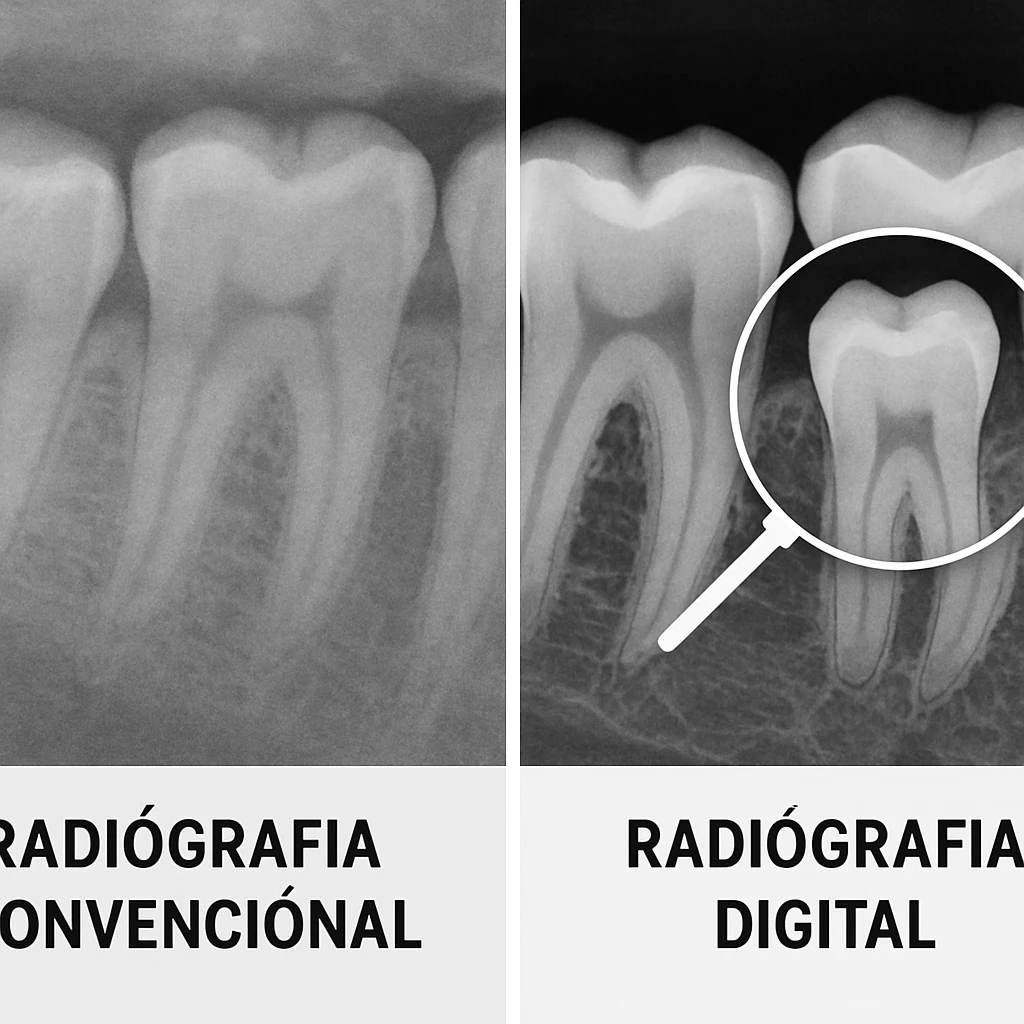
Digital panoramic X-rays
How do they work?
Instead of film, a digital sensor or a special plate is used to capture the image.
The information is sent to a computer and processed with specific software.
The radiograph is viewed directly on a screen a few seconds after it is taken.
Main benefits
Lower radiation exposure (in many systems)
Many modern digital devices are designed to use lower radiation doses than analog systems, while maintaining adequate diagnostic quality.
Immediate image
No need to develop the film: the image appears on the computer almost instantly.
This speeds up the consultation and allows decisions to be made at the same time.
Image adjustments
You can modify brightness, contrast, zoom in, and highlight areas of interest.
This reduces the need to repeat the shot due to exposure problems.
Storage and backup
Radiographs can be stored in the patient’s digital record.
It is easier to organize, search, and compare images over time.
Backups can be made so you don’t lose the information.
Ease of sharing
They can be sent electronically to other specialists or to the patient.
Ideal for second opinions, interconsultations, or referrals.
Lower environmental impact
No developing chemicals or disposable films are used.
Reduces the consumption of paper and plastic associated with plates and envelopes.
Conventional (analog) panoramic X-rays
How do they work?
A radiographic film is used (similar to old cinema or photography).
After exposure to X-rays, the film is developed in a dark room with chemicals.
The image is displayed on a physical plate that is placed in front of a negatoscope (light box).
Advantages
Technology proven for decades.
Initially more economical equipment (historically).
Disadvantages
Use of chemicals (developer and fixer), which require proper handling and disposal.
Longer time between shooting and viewing (the film has to be developed).
Difficulty adjusting brightness or contrast: if the shot is too light or dark, it must be repeated.
Physical preservation of the plates (they deteriorate, take up space, can be lost).
Less ease in sharing the image (the plate must be scanned or transported).
Digital vs. Conventional Panoramic X-rays: Why Digital Technology is Great News for You
You may remember the X-rays from before, which used a dark film that had to be developed. Technology has come a long way since then. The difference between a digital vs. conventional orthopantomography is like comparing your smartphone to a roll film camera: one is instant, sharper, and much more efficient. This change is not only a technical improvement, but a giant leap in safety and accuracy for you as a patient.
The most important benefit of digital dental radiology is the drastic reduction in radiation exposure. Because digital sensors are much more sensitive than old film, they need much less energy to capture a detailed image. This translates into a lower dose of radiation in dental x-rays, which can be up to 80% lower compared to conventional methods.
In addition to safety, digital technology offers speed and clarity. The image appears on the computer screen instantly, eliminating the waiting for development and making your visit shorter. For your dentist, these benefits of digital dental radiology are crucial, since they can enlarge the image, adjust the contrast, and analyze every detail with a precision unthinkable in a physical film, ensuring that nothing escapes them.
In summary, digital technology has transformed panoramic radiographs into a safer, faster, and more accurate tool. By choosing a digital system, your dental clinic is investing directly in your well-being.
How Much Radiation Does an Orthopantomography Have? The Answer Will Reassure You
The word “radiation” may sound alarming, but it is important to put it in context. We are exposed to small amounts of radiation every day naturally, which is known as background radiation. It comes from the sun, the earth, and even some foods. The key question is: how does the dose of a panoramic radiograph compare to this everyday exposure?
The lower dose of radiation in digital dental x-rays is a fact. The exposure of a single digital panoramic is incredibly small, approximately equivalent to the radiation you would receive on a short plane flight (1 to 2 hours) or that you absorb naturally from the environment in just a couple of days.
Therefore, the enormous diagnostic benefit that your dentist obtains—the ability to detect cysts, impacted wisdom teeth, or plan orthodontics—far outweighs the minimal risk. Safety in dental radiology is an absolute priority, making this an extremely safe procedure for adults and children.
Panoramic vs. Periapical: The Complete Map vs. the Magnifying Glass
If the panoramic radiograph is the complete map of your mouth, the smaller radiographs, called periapical or bitewing, are the magnifying glass. While the panoramic offers a dental image of the entire mouth to assess the general structure, the periapical focuses on a tiny area with extraordinary sharpness.
Surely you remember them: they are those small plates that you hold with your teeth inside your mouth for a few seconds. Its superpower is detail. They are irreplaceable for an accurate dental diagnosis of problems such as a cavity between two teeth or to examine the tip of the root of a tooth that causes pain. The panoramic tells you where to look, and the periapical shows you exactly what is happening there.
Therefore, it is not a competition of panoramic vs. periapical radiograph, but a teamwork. Your dentist uses the map to orient themselves and the magnifying glass to investigate. But when the problem is more complex and you need to see the depth and volume, the technology offers a three-dimensional view.
When a 3D View is Needed: A Brief Look at CBCT Tomography
Sometimes, a flat map is not enough. To place a dental implant, the dentist needs to know how thick and dense the available bone is. A 2D image is like a photo of a wall: it shows the height and width, but not its thickness. For that, a third dimension is needed.
For these cases, there is cone beam computed tomography (CBCT). Although the name sounds imposing, its function is simple: it is a 3D scanner for the mouth. The machine rotates around you capturing hundreds of images that a computer combines to create an exact three-dimensional model of your teeth and jaw. It is the quintessential tool for dental implant preparation.
With this 3D model, the specialist can virtually navigate through your anatomy, measure spaces with millimeter precision, dodge nerves, and ensure that the implant will have perfect support. It is also essential for an evaluation of the temporomandibular joint in complex cases. It is not a routine study, but when maximum precision is necessary, this technology guarantees the safety and success of the treatment.
What You Should Know About the Price of a Dental Panoramic Radiograph?
When talking about medical tests, it is logical to think about the cost. The price of a dental panoramic radiograph may vary, but it is crucial to understand it not as an expense, but as an investment in dental health. This image is the basis on which your dentist will build an accurate diagnosis. Without it, it is like asking an architect to design a house without knowing the land.
The true value of the panoramic is its ability to detect hidden problems before they worsen. Identifying a poorly positioned wisdom tooth in time can avoid emergency surgery, and seeing the arrangement of all the roots is essential for a successful orthodontic treatment. Therefore, the cost of orthopantomography saves you money and complications in the long term.
In addition, in many cases this study is already part of a comprehensive plan for orthodontics, implants, or wisdom teeth extraction. Often, the price is included in the total treatment budget, not as an additional surprise.
Your Appointment for the Panoramic: A Summary to Go Without Stress
The idea of a “panoramic radiograph” could sound complex, but now you see it as what it really is: a simple and powerful tool to take care of your smile. You have gone from uncertainty to understanding, and it is no longer a cause for anxiety, but a clear and positive step towards better oral health.
To make you feel completely safe, this brief summary of dental x-rays is all you need to remember:
It’s Fast and Comfortable: The entire process lasts less than a minute, without any discomfort.
It’s Safe: It uses a minimal dose of radiation, often less than you receive on a short flight.
It’s Essential: It offers a complete map of your mouth that is key for an accurate diagnosis and successful treatment.
The next time you go to your appointment, you will not see that machine as an unknown device, but as an ally. With this panoramic radiograph guide in mind, you have the power to participate in your own care, strengthening confidence in your dentist. There is no longer room for doubts, only for the peace of mind of knowing that you are making the best decision for your health.
In which treatments are digital panoramics especially useful?
Digital panoramic X-rays are very useful in:
Orthodontics: evaluation of roots, tooth eruption, absence or excess of teeth, wisdom teeth.
Dental implants (as a first approximation): to see spaces, approximate bone height, missing teeth.
Oral surgery: wisdom teeth, cysts, lesions.
Pediatric dentistry: monitoring dental replacement, retained or supernumerary teeth.
Rehabilitation and prosthetics: global vision of dental remnants and bone structures.
In many cases, the digital panoramic is complemented with other studies (periapical radiographs, CBCT/3D tomography) depending on the complexity of the case.
Are panoramic X-rays always necessary?
Not always. Its use must be clinically justified:
In routine low-risk check-ups, intraoral radiographs may be sufficient.
In orthodontics, third molar surgery, implant planning, or comprehensive evaluation, the panoramic is very useful as a base study.
A good criterion is: “The radiograph that is taken must provide relevant information for the diagnosis or treatment planning”.
What you can ask at your dental clinic
If you are concerned about the issue of radiographs, you can ask:
Is the equipment they use digital or conventional?
Why do they need the panoramic in your specific case?
What other complementary studies might they require?
How do they store your radiographs and can you receive them in digital format?
This not only reassures you, but allows you to get more involved in the care of your oral health.
Do digital panoramic X-rays have less radiation than conventional ones?
Does a smile design always involve veneers on all teeth?
In many modern systems, yes. Digital panoramic equipment is often designed to use lower radiation doses than analog equipment, maintaining sufficient image quality for diagnosis. Even so, any study is indicated only when it provides relevant information.
Why does my dentist prefer a digital panoramic radiograph?
Because it allows you to see your entire mouth in a single image, obtain it instantly, adjust it on the screen, and save it in your digital record. This facilitates the diagnosis, the explanation of your case, and the comparison with future studies.
Does it hurt to have a panoramic radiograph?
Does it hurt to have a panoramic radiograph?
Can I ask not to have radiographs taken?
You can express your concerns, but the dentist will explain why they consider the X-ray necessary in your case. Without the information it provides, the diagnosis may be incomplete or inaccurate. If you have any questions, ask them what they are looking for with that study and how it will influence your treatment plan.
How long does it take to get a digital panoramic radiograph?
The image capture process usually lasts seconds, and the image appears on the screen almost immediately. The rest of the time is spent on patient preparation, explanation, and analysis of the X-ray by the dentist.
How long does it take to get a digital panoramic radiograph?
The image capture process usually lasts seconds, and the image appears on the screen almost immediately. The rest of the time is spent on patient preparation, explanation, and analysis of the X-ray by the dentist.
What are the advantages for me that my clinic uses digital X-rays?
Among others:
Lower cumulative exposure (depending on the equipment and protocols).
Faster results.
Ability to adjust the image to better detect problems.
Easy to share the X-ray with other specialists or keep it in your file without it deteriorating.
Are conventional panoramic radiographs still used?
In some places, it is still done, due to infrastructure or technological transition reasons. However, more and more clinics are migrating to digital systems for their advantages in image quality, turnaround times, information management, and environmental sustainability.
Clearer and safer diagnosis with digital X-rays
At La Clínica Dental, we have digital panoramic X-rays that allow us to obtain clear images of your entire mouth with less exposure, without waiting, and ready to analyze on screen. This translates into more precise diagnoses, better-designed treatment plans, and a more comfortable experience for you.
If you have not had a complete check-up in a while or need to evaluate wisdom teeth, orthodontics, or implants, schedule your evaluation with digital studies included according to your case.