Published by Dr. Rosa Ma. Montezuma : February 23, 2026.
Dental implants and fixed prostheses type All-on-4 / All-on-6 can accompany you for many years, but only if they are cared for properly: specific daily hygiene, regular check-ups and control of risk factors such as smoking, diabetes or bruxism. In this guide we answer the most frequent questions people ask about AIs: how long they last, how to clean them, how often they need maintenance, what happens if I smoke and what are the warning signs.
How long can implants and All-on-4 / All-on-6 prostheses last?
Under ideal conditions, a well-integrated and maintained implant can last for decades. In practice, we are talking about:
Very high 10-year success rate with good diagnosis and maintenance.
The fixed prosthesis (the “screw-retained denture”) may require adjustments, repairs or tooth/acrylic replacement over time, even if the implants continue to function.
Factors influencing duration:
Bone quality and initial diagnosis.
Plaque control and daily cleaning.
Tobacco, uncontrolled diabetes and bruxism.
Periodic maintenance assistance.
👉 If you want to better understand the surgical and planning part, see:
All-on-4 and All-on-6 in CDMX: complete fixed rehabilitation
and
Dental implants in CDMX: recover your smile and chewing function.
Do they clean like normal teeth?
Not exactly. Implants and fixed prostheses require specific tools and angles to clean well around the abutments and under the prosthesis.
Basic daily routine
Brushing 2-3 times a day
Soft bristle brush, small movements around the gums and abutments.
In All-on-4/6 type prostheses, insist on the gingiva-prosthesis junction.
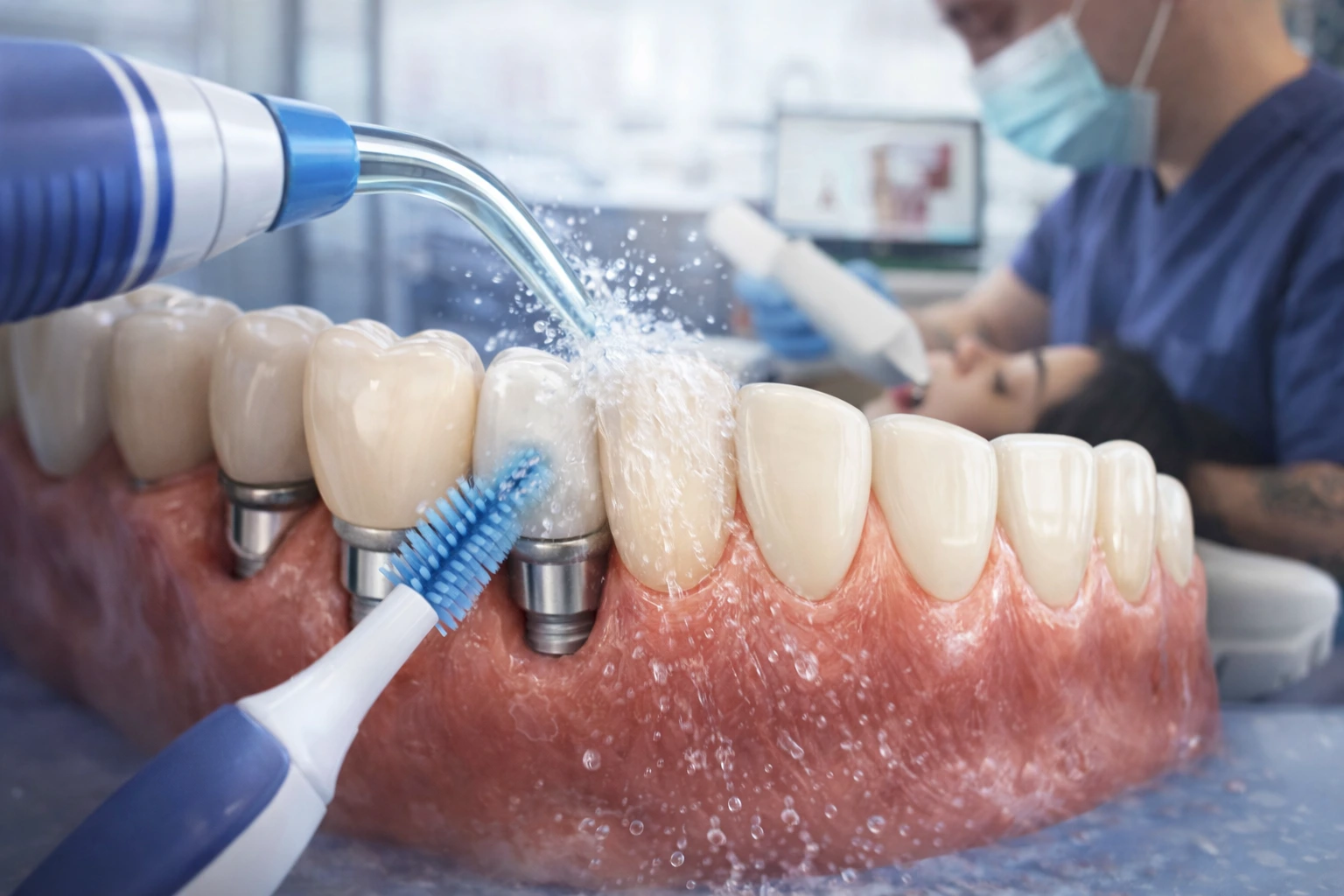
Interproximal brushes or special brushes for implants
In areas where there are spaces, they allow cleaning where the normal brush does not fit.
Special or superfloss
In some fixed prosthesis designs it is possible to pass underneath, in others alternatives are used.
Oral irrigator (optional but very useful)
It does not replace the brush, but helps to remove debris under the prosthesis and around the implants.
Alcohol-free mouthwash
It can help reduce bacterial load, especially in patients with periodontal or peri-implantitis risk.
In the control appointment we teach you which tool to use in each area; it is part of the protocol of integral dental treatment in CDMX: complete rehabilitation step by step.
How often should I go for maintenance if I have implants or All-on-4?
It depends on your level of risk, but as a general rule:
Healthy patient, without tobacco or previous periodontal disease:
every 6 months for check-up and professional cleaning.Patients with a history of periodontitis, smokers or diabetics:
every 3-4 months is the most prudent.
In these quotations it is reviewed:
Plaque and calculus accumulation around implants.
Gum condition and probing depth (to detect peri-implantitis in time).
Adjustment of screws, contacts and occlusion (how teeth collide).
Integrity of the prosthesis: acrylic, teeth, fractures or wear.
Smokers, diabetics and bruxists: special care
Smokers
They increase the risk of peri-implantitis and reduced healing.
We often recommend more controls and detoxification programs.
In some cases we advise minimizing or quitting smoking before All-on-4/6.
Diabetics
It is key to have diabetes under control before surgery and during maintenance.
We recommend strict hygiene controls and more frequent visits.
Bruxers (clenching or grinding)
They almost always need customized night guarding.
They require frequent revision of contacts to avoid overloads that may loosen screws or fracture acrylic/ceramic.
To see how we handle these contexts in complex cases, you can review:
Complex cases: bone loss, grafting, All-on-4 and older patients – what to expect.
What happens if I don’t take good care of my implants?
The main risks are:
Peri-implant mucositis
Inflammation of the gum around the implant, reversible if prompt action is taken.Peri-implantitis
Loss of bone around the implant. If it progresses, it can compromise stability and force the implant to be removed.Loosening or fracture of screws and components
Due to excessive load, poor hygiene or lack of adjustments.Bad odor and “dirty” sensation
Due to accumulation of plaque and food under the prosthesis.
Most of these problems are manageable if caught early at maintenance appointments.
Warning signs: when should I go before my scheduled appointment?
You should contact your clinic as soon as possible if you notice:
Persistent bleeding when brushing around the prosthesis.
Pain or localized pressure sensation in one of the implants.
Mobility or “play” of the prosthesis or of any tooth on the implant.
Constant bad odor or bad taste that does not improve with hygiene.
Redness, swelling or pus discharge near an abutment.
Although it does not hurt much, it may be the beginning of a peri-implantitis that should be treated as soon as possible.
I live outside of CDMX or in another country, how do I organize the maintenance?
Frequently asked question in dental tourism: “If I go from USA/Canada, how do I follow up?”
In general:
First phase in CDMX
Implant surgery and placement of temporary or definitive prosthesis, depending on the case.
Detailed explanation of hygiene and immediate care.
Combined maintenance plan
Key checkups at La Clínica Dental when you come to CDMX (e.g., at 1 or 2 years).
Intermediate check-ups with a trusted dentist in your city, following our written instructions.
Digital communication
Photos, radiographs and video calls to monitor progress between face-to-face visits.
To better understand the context of travel and timing, check out:
Dental tourism in CDMX: planning, timing, visits and safety.
Is implant maintenance painful?
Maintenance should not be painful. It can be somewhat annoying depending on the amount of plaque build-up or the condition of the gums, but:
Topical or local anesthetics may be used on sensitive areas.
The cleanings are performed with instruments adapted to implants in order not to damage the surface.
If you have a fear of the dentist or a history of bad experiences, it is worth reading:
Fear ofthe dentist, anxiety, pain management and what options exist – a realistic guide.
How much does it cost to maintain implants and All-on-4/6?
Maintenance is usually much less expensive than the initial surgery. The cost varies according to:
Number of implants and complexity of the prosthesis.
If only cleaning and overhaul is done or if adjustments, screw replacement or acrylic/teeth repair is required.
The important thing is to see it as an investment to protect your complete rehabilitation.
To orient yourself in price ranges and context in CDMX, you can check:
Dental implants price in CDMX: what it includes, factors and ranges per case
How much does dental treatment cost in CDMX: price guide and how to compare clinics
What do we do at La Clínica Dental during your maintenance visits?
At La Clínica Dental CDMX the maintenance of implants and All-on-4/6 includes:
Complete clinical revision of gums, prosthesis and bite.
Professional cleaning around implants with specific techniques and tips.
Evaluation of radiographs or digital studies when necessary.
Adjustment of occlusal screws and verification of stability.
Reinforcement of personalized hygiene instructions according to your habits and skills.
This approach is integrated into our comprehensive and digital dental treatment model:
Comprehensive dental treatment in CDMX: complete step-by-step rehabilitation in one place.
Frequently asked questions on implant maintenance and All-on-4 / All-on-6
How often should I have a professional cleaning if I have implants?
In most cases we recommend a professional cleaning every 6 months, and every 3-4 months in patients at higher risk (smokers, diabetics, history of periodontitis).
Can electric toothbrushes be used on implants and fixed prostheses?
Yes, as long as they have soft brush heads and are used with proper technique. Even so, they should be combined with interproximal brushes or irrigators to clean the areas where the toothbrush cannot reach.
Is flossing mandatory if I have All-on-4?
It depends on the design of your denture. In some cases, special floss or superfloss is used; in others, interproximal brushes and irrigators are more effective. Your dentist will indicate the ideal combination.
Can I eat anything with implants and fixed prostheses?
In general yes, but it is advisable to avoid biting extremely hard things (ice, bones, packaging, very sticky sweets) to avoid damaging acrylic, ceramics or overloading the implants.
Can smoking cause me to lose my implants?
Smoking increases the risk of peri-implantitis and implant failure. It does not mean that all implants will be lost, but the probability of complications is clearly higher.
Can peri-implantitis be cured?
In initial stages it can be controlled with professional hygiene, disinfection and improvement of habits. In advanced cases it may require surgery and, if the bone loss is severe, even removal of the affected implant.
Do I need antibiotics every time I have maintenance?
No. The use of antibiotics is reserved for specific situations, not for every routine cleaning. Most of the maintenance works with local hygiene measures.
What if I hear a "click" or notice something moving in my prosthesis?
It may be a loosened screw, an acrylic fracture or a fitting problem. It is important to have it checked as soon as possible to prevent the load from concentrating on a single point.
Are implants "guaranteed" for life?
No medical treatment can guarantee results for life. However, many manufacturers offer warranties on components and clinics establish follow-up policies, always conditional on proper maintenance.
Can I use strong or alcohol rinses?
Prolonged use of alcohol rinses is not recommended because they can irritate tissues and dry out the mouth. It is preferable to use rinses without alcohol and only use specific products when indicated by the dentist.
Is it normal for me to bleed a little when cleaning around the implants?
Slight bleeding may occur if there is inflammation. If it persists for more than a few days despite improved hygiene, it is advisable to go for a check-up to rule out mucositis or peri-implantitis.
What if I have periodontal disease in other teeth?
Active periodontitis is an important risk factor for peri-implantitis. It is essential to treat and control periodontal disease before and during implant maintenance.
Can I sleep without removing the All-on-4 / All-on-6 prosthesis?
Yes, All-on-4/6 fixed prostheses are screw-retained and remain in the mouth 24 hours a day. The important thing is to maintain excellent hygiene and use a night guard if you have bruxism.
How long does a full maintenance appointment take?
It depends on the complexity, but an implant and All-on-4/6 maintenance appointment usually lasts between 45 and 90 minutes, including check-up, cleaning and adjustments.
Can I do my maintenance in another city and only go to CDMX from time to time?
Yes, the ideal is to coordinate a shared plan: routine maintenance near your place of residence and key check-ups at La Clínica Dental during your visits to CDMX, especially if your case was complex.
Is the maintenance of implants more expensive than that of natural teeth?
Not always. Many times it is possible to repair or replace the damaged tooth without changing the entire structure. The decision depends on the general condition of the prosthesis and the years of use.
Do I need to replace the entire prosthesis if a tooth breaks?
The cost per appointment is usually similar or slightly higher in complex cases, but it is much lower than the cost of having to redo an entire rehabilitation. Think of it as investment protection is the key.
Do you want your implants or your All-on-4/6 prosthesis to last for many years?
Schedule an assessment and maintenance appointment to review the condition of your implants, your hygiene and your risk factors. We can adjust your prosthesis, update your cleaning routine and answer all your questions about long-term care.