Published by Dr. Rosa Ma. Montezuma : January 28, 2026.
This article was last updated: March 10, 2026. by Dr. Rosa Ma. Montezuma
The price of a dental implant does not depend only on the implant. It changes according to the diagnosis, the complexity of the case, the technology used, the materials and whether the treatment includes surgery, abutment, crown and follow-up. Therefore, comparing estimates without reviewing what is included in each one can lead to wrong conclusions.
Are you missing a tooth and want to know how much a dental implant in CDMX really costs? At La Clínica Dental, a titanium dental implant with standard abutment and crown is priced at USD 2,200. The reason is simple: an “implant” is not a single piece, but a treatment that may include surgery, implant, abutment, crown, controls and, in some cases, additional procedures such as bone grafting or sinus lift.
To understand the price, the first thing to know is that a single dental implant is actually a three-part system. Think of hanging a heavy picture: first, you need a firm socket inside the wall; that’s the function of the implant, a titanium screw that integrates with the bone and acts as the new artificial root. It is the solid foundation on which everything else is built.
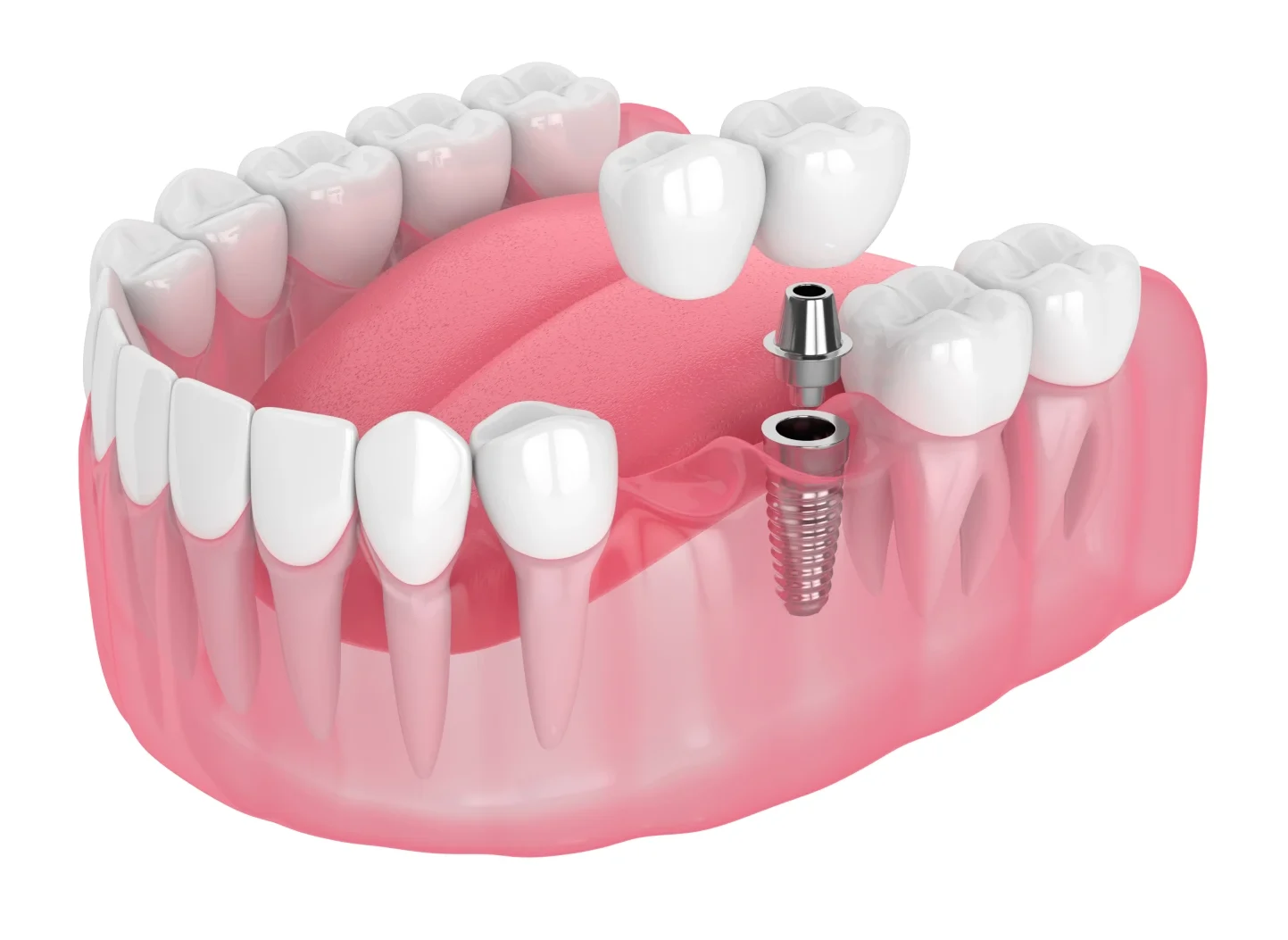
To that socket you add a screw that protrudes; that is the pillar (or attachment), a piece that connects the inner base with the outer part. Finally, you hang the frame, which in this case is the crown: the ceramic “tooth” that you see and chew on. Therefore, when you receive an estimate, your first question should be whether the price includes these three pieces and the entire process of placing an implant.
Price of a single dental implant in CDMX: how much should you consider?
At La Clínica Dental, the price of a titanium dental implant with standard abutment and crown is USD 2,200. This price corresponds to a complete unitary treatment, that is, an implant to replace a dental piece, with the component that connects the artificial root and the visible crown.
When comparing prices of dental implants in CDMX, the important thing is not to check only the initial figure. Some quotes only include the surgery or the titanium screw, but do not include the abutment, the final crown, the diagnostic studies or the subsequent controls. Therefore, before accepting an estimate, ask if the cost includes the implant, abutment and crown.
If the patient needs additional preparation, the price may change. For example, a small bone graft is priced at $1,300, a large bone graft at $1,350 and a sinus lift at $1,770. These procedures are not necessary in all cases, but may be necessary when there is not enough bone to hold the implant securely.
The 4 Key Factors that Justify the Price Difference in Implants
Understanding why a single implant can cost USD 2,200 and a complete implant-supported rehabilitation can exceed USD 17,000 is essential to make an informed decision. The difference is not accidental: it responds to the number of implants, the type of prosthesis, the surgical complexity, the need for grafts, the materials used and the planning technology.
Generally, the best dental implant clinics in CDMX like La Clínica Dentalinvest in four pillars of quality to ensure successful and predictable results:
- Specialist Experience and Certification: A certified implantologist has the expertise to handle complex cases and minimize risks.
- The Implant Brand: There are premium brands with decades of scientific backing that guarantee better and faster integration into the bone.
- Crown Material: The choice of the visible “tooth” directly impacts esthetics and cost.
- Clinic Technology: The use of advanced tools ensures a more precise and safer procedure.
The price difference becomes clear when analyzing these points. For example, a Zirconia crown is highly esthetic and resistant, but more expensive than a metal-porcelain crown, which, although functional, may show a grayish edge on the gum. Similarly, a clinic that uses a 3D CT scan to create an accurate map of your jaw is investing in your safety, allowing the implant to be placed with pinpoint accuracy.
You are not just paying for a “screw and a tooth”; you are investing in the expertise of the specialist, the reliability of the materials and the safety of the technology. These elements make up the base cost of the implant, but sometimes additional procedures are necessary.
The technology used in diagnosis and planning also explains part of the price difference. A clinic that works with 3D tomography, digital planning and precision tools is not adding “luxuries”; it is improving the ability to study the case, identify anatomical risks and place the implant with more control.
If you want to better understand how this influences safety, accuracy and predictability, we recommend you review our page on advanced dental technology in CDMX and our article on computer-guided implants. Both help you understand why digital diagnostics can change both the way treatment is planned and the range of investment required.
Additional Costs: What Extra Procedures Might You Need?
Beyond the base cost, sometimes the jawbone needs special preparation. If it has been a long time since you lost the tooth, the bone may have shrunk or weakened in a natural process called bone loss (resorption). If the foundation is not strong, the implant will not have the support it needs to last.
To fix this, your specialist may recommend bone grafting, which involves adding bone material to rebuild the area and create a strong base. A particular case is a sinus lift, a type of grafting for the upper back teeth, where the bone is usually thinner. These techniques ensure that the implant is properly integrated.
In La Clínica Dental’s price list, preparatory procedures have defined ranges: small bone graft is priced at USD 1,300, large bone graft at USD 1,350 and maxillary sinus lift at USD 1,770. These costs are considered apart from the single implant when the diagnosis shows bone loss or lack of anatomical support.
Not all patients require these treatments. The only way to know for sure is during the dental implant assessment consultation. Using a 3D CT scan, the specialist will evaluate the quantity and quality of your bone and explain if you need any extra steps in the step-by-step implant placement process.
The only real way to know if extra steps are required is through an assessment and imaging studies. Therefore, accepting a closed price without a diagnosis can lead to misleading comparisons. If your situation includes bone loss, previous surgeries or doubts about the feasibility of treatment, please revisit our guide to complex cases with bone loss and grafting, where we explain what to expect in less straightforward scenarios.
Dental Implant vs. Fixed Bridge: Why the More Expensive Option Can Save You Money and Teeth
Comparing an implant to a fixed bridge by initial price alone can lead to misleading conclusions. A bridge may seem more affordable at first, but it usually requires the wearing down of neighboring teeth to use them for support. In other words, in order to replace a missing tooth, healthy teeth that may not have needed direct intervention are modified.
The implant, on the other hand, functions independently and seeks to replace the root and crown of the lost tooth without relying on the adjacent teeth. This difference has functional, biological and long-term maintenance implications. In many cases, the greatest value of the implant is not only in esthetics, but in the ability to preserve healthy tooth structure and better distribute chewing function.
The correct comparison should not be made between a low number and a high number, but between two treatment philosophies. A bridge may be useful in certain cases, but when the patient is a good candidate for an implant, the higher initial investment may result in a more conservative and more stable solution over time.
Your Path to a New Smile: The Implant Process Step by Step
A dental implant is not usually resolved in a single appointment, it is a carefully planned journey that usually lasts between 3 and 6 months, designed to ensure a lasting result that integrates perfectly with you. It is a treatment that requires well-defined phases to ensure that the foundation is well integrated and that the final restoration functions stably. Understanding this process also helps to understand why the price depends on the case and cannot be summarized in a single universal figure.
The step-by-step implant placement process is divided into four key phases to ensure your safety and the quality of the result:
- 3D Valuation and Planning:
In this first phase, your oral health, the area to be rehabilitated, the quality of the available bone and the relationship with neighboring teeth, gums and bite are analyzed. In many cases, this stage is supported by imaging studies to decide if the implant can be placed directly or if additional preparation is needed first.
If you have not yet undergone a formal evaluation or want to know how a complete first checkup is usually conducted, you may also want to read what to expect at your first dental appointment. This content will help you understand what the specialist reviews before discussing timing, costs and alternatives.
- Surgery: Implant placement: Once the case has been planned, the implant is placed in the bone. The complexity of this phase depends on the patient’s anatomy, the quality of the bone, the position to be rehabilitated and the need or not of complementary techniques. In some cases, the surgery may benefit from digital planning tools or guides that help to improve the accuracy of placement.
- Healing and Osseointegration (3-6 months): After placement, the implant needs a period of integration with the bone. This phase should not be seen as a simple “waiting”, but as an essential biological stage for the long-term stability of the treatment. The times may vary according to the case, the patient’s health, the quality of the bone and the protocol used.
- Final Phase: Crown Placement: When the integration is adequate, the final restoration is placed. Here the quality of the original plan comes into play again, because it is not just a matter of “putting in a tooth”, but of achieving a well-fitted, functional, stable crown that is coherent with the esthetics of the rest of the smile. This stage is also influenced by the material chosen and the prosthetic design defined from the initial planning.
The most important stage is healing, where a biological process called osseointegration occurs. Following the postoperative care of a dental implant indicated by your specialist is essential to build this foundation for life. Once complete, your new crown is designed and placed, restoring function and esthetics with a result that feels completely natural.
Ultimate Checklist: 7 Key Questions to Ask Your Implant Specialist in CDMX
The best way to compare quotes is not to ask for “the cheapest”, but to ask questions that allow you to understand the real scope of the treatment. A well-informed patient makes better decisions, avoids surprises and detects more easily when a clinical proposal is well structured and when it only shows a part of the cost.
Use these questions at your next dental implant assessment consultation. They show that you value both your health and your investment:
Does the price include the complete treatment (implant, abutment and crown)?
This question is basic because many quotes advertise only the implant or surgery, but do not include the complete final restoration.
What brand of implant do you use and why do you recommend it?
The answer should explain support, traceability, compatibility and why that system is right for you, not just mention a brand.
Does my case need extra procedures such as bone grafting?
This question helps to detect if the initial budget could change after the complete diagnosis.
What guarantee do you offer on the implant and crown?
It is not only a matter of talking about commercial guarantee, but also of understanding follow-up, controls and treatment conditions.
Will you perform both the surgery and the final placement?
It is useful to know who is involved at each stage and how the surgical part is coordinated with the restorative part.
What financing options do you offer for dental treatment?
Financial clarity is also part of a good patient experience, especially in major investment treatments.
If you also want to learn how to compare a clinic beyond price, check out our guide on how to evaluate a dental clinic in CDMX. That article helps you review protocols, materials, specialists and traceability before making an important decision.
Factors influencing the price of dental implants in CDMX
Not all patients need the same thing. These are the factors that most change the final cost:
Number of parts to be replaced
-
An implant + crown does not cost the same as a multi-tooth or full-arch rehabilitation.
-
As the number of parts increases, clinical time, materials and prosthetic complexity increase.
Bone quality and quantity
If the bone is adequate, placement can be relatively straightforward. But if there is:
-
Significant bone loss.
-
Need for bone grafting, sinus lift or other techniques.
The plan includes additional procedures (grafting material, extra surgical time, controls), and this is reflected in the cost.
Type of implant and prosthetic system
-
Systems with more scientific support, better connections and prosthetic options tend to have a higher cost, but also advantages in the long term.
-
Generic” solutions may be cheaper, but limit future repair or expansion options.
Technology used
The dental technology used also has an influence:
-
Use of 3D tomography for diagnosis.
-
Digital planning and guided surgery (computer-guided implants).
-
Intraoral scanner and CAD/CAM systems for prosthetics.
What is actually included in the price of a dental implant?
The initial diagnosis may include clinical history, oral examination, gingival examination, functional analysis and imaging studies. This phase is essential because it defines whether the patient is a candidate, whether additional preparation is required and how best to restore the lost area. Without a good diagnosis, any figure loses value as a real reference.
Although each clinic may present their plans differently, a complete dental implant treatment usually consists of several parts:
Assessment and diagnosis
-
Clinical history and oral examination.
-
X-rays and, in many cases, advanced imaging studies (e.g. 3D tomography).
-
Analysis of gums, bite and neighboring parts.
Some clinics include it in the overall budget; others charge it separately. Without a good diagnosis, the “cheap” price becomes meaningless.
Dental surgery and implant placement
This part includes the surgical phase in which the implant is placed inside the bone. This is influenced by the anatomical complexity, the supplies, the clinical time, the team involved and the protocol used. In some cases, there is also the added value of working with digital planning and guided support to improve precision and safety.
It should not be assumed that all budgets cover exactly the same thing at this stage. The surgery may be described in a very general way or include a more detailed approach depending on the case. That is why asking for a breakdown always helps to compare better.
Includes:
-
Surgical act to place the implant in the bone.
-
Surgical materials, supplies and sterilization.
-
Time of the specialist and the assistant team.
At La Clínica Dental, depending on the case, this phase can be supported by 3D planning and computer-guided surgery (see article on guided implants for details), which adds precision and safety.
The dental implant as a device
The implant as an internal component is only one part of the treatment. Although it tends to get a lot of attention when discussing prices, it alone does not explain the total cost. The abutment, the final restoration, the quality of the chosen system and the prosthetic compatibility of the implant over time are also important.
The best way to communicate this to the patient is to insist on a simple idea: they are not paying for just one part, but for a set of clinical and material decisions that must work well together.
The implant is the titanium (or other biocompatible material) “screw” that replaces the tooth root. Its cost varies according to:
-
Brand and system.
-
Guarantees and scientific support.
-
Compatibility with different prosthetic components.
Not all implant systems are the same; therefore, a professional estimate usually indicates the type of implant to be used.
Attachments and prostheses (the visible part)
Many “low” budgets only talk about the implant, but do not include it:
-
The abutment or attachment that connects the implant to the crown.
-
The final crown (the visible “tooth”), bridge or implant-supported prosthesis.
This phase is key for esthetics, bite and chewing comfort. It is usually performed once the integration of the implant with the bone has been completed.
1.5. Controls and maintenance
After surgery and also once the prosthesis is in place, it is necessary:
-
Check the healing.
-
Assess stability and signs of inflammation.
-
Adjust contact points and occlusion.
Some clinics include certain controls in the initial price; others consider them part of long-term maintenance.
Price ranges by case type: single implant, grafting and complete rehabilitation
The price of dental implants varies according to the type of case. A single implant does not cost the same as an implant-supported overdenture or a full-arch fixed restoration. The difference is in the number of implants, the type of prosthesis, the need for grafting and the clinical time required.
| Type of treatment | Price at La Clínica Dental | When is it recommended? |
|---|---|---|
| Mini dental implant | USD 325 | In selected cases where a smaller diameter solution is required, according to clinical diagnosis. |
| Small bone graft | USD 1,300 | When there is localized bone loss and the base needs to be improved before or during implant placement. |
| Large bone graft | USD 1,350 | When bone loss is greater and the patient requires more extensive reconstruction. |
| Maxillary sinus lift | USD 1,770 | When upper posterior teeth are missing and the available bone is close to the maxillary sinus. |
| Titanium dental implant with standard crown and abutment | USD 2,200 | When a tooth is missing and the patient has adequate bone and gum conditions. |
| Removable overdenture on 2 implants | USD 5,900 | When seeking to improve the stability of a conventional removable denture. |
| Removable overdenture on 4 implants | USD 8,800 | When greater retention, comfort and masticatory function is required in an arch. |
| Removable overdenture on 6 implants | USD 10,850 | When the patient needs an overdenture with greater implant support. |
| Removable overdenture on 8 implants | USD 12,550 | When you are looking for a removable prosthesis with wide support and greater stability. |
| Full arch porcelain bridge on 4 implants | USD 17,150 | When the objective is a full-arch fixed restoration with multiple support points. |
| Full arch porcelain bridge on 6 implants | USD 19,600 | When greater load distribution and support is required in an extensive fixed restoration. |
| Full arch porcelain bridge on 8 implants | USD 21,400 | When the case requires a fixed restoration with high stability and wide support. |
Base case: a single-unit implant without grafting
The basic case corresponds to a patient with sufficient bone, healthy gums and the need to replace a single tooth. In this scenario, the treatment can be solved with a titanium dental implant with standard abutment and crown, whose price is USD 2,200.
Case with bone loss: implant plus graft or sinus elevation
When the patient does not have enough bone, treatment may require preparatory procedures. A small bone graft is priced at $1,300, a large bone graft at $1,350 and a sinus lift at $1,770. These treatments help create a more stable base for implant placement.
Multi-tooth case: implant-supported overdenture
When several teeth are missing or the patient is wearing an unstable removable prosthesis, an implant-supported overdenture can improve retention and comfort. At La Clinica Dental, a removable overdenture on 2 implants is priced at USD 5,900, while an overdenture on 8 implants can reach USD 12,550.
Full-arch case: porcelain fixed bridge on implants
In full-arch fixed restorations, the cost increases because multiple implants, advanced prosthetic design, more materials and more clinical planning are required. A full-arch porcelain bridge on 4 implants is priced at $17,150; on 6 implants, $19,600; and on 8 implants, $21,400.
If you live in the United States or Canada and are considering coming to Mexico City, we recommend comparing the cost of dental implants in CDMX vs USA vs Canada in 2026 to see your real savings as a dental tourism patient.
How to compare dental implant prices across clinics in Mexico City
When you receive different quotes, ask yourself:
-
Do you include diagnostic and imaging studies?
-
Is the price only for the implant or also for the crown/prosthesis?
-
Does it cover grafts or other surgeries if I need them?
-
Who places the implant and who designs the prosthesis (specialists)?
-
Are controls and maintenance included for a certain period of time?
Comparing only the figure, without checking what is included, can lead you to choose what seems cheaper, but ends up being more expensive or incomplete.
Frequently asked questions about dental implants price in CDMX
How much does a complete dental implant cost in CDMX?
At La Clínica Dental, a titanium dental implant with a standard abutment and crown has an estimated price of USD 2,200. The cost may increase if the patient requires a bone graft, a sinus lift, multiple implants, or a full-arch restoration. Therefore, the final price must be confirmed following a clinical evaluation and diagnostic tests.
What does the price of a dental implant actually include?
A complete plan may include clinical assessment, CT or X-rays, diagnosis, surgery, implant, abutment, final crown and follow-up examinations. Before comparing prices, it is advisable to confirm what is included and what may be charged separately.
Why is there such a price difference between dental clinics?
Because factors such as the specialist’s experience, the brand of the implant, the crown material, the diagnostic technology and the need for grafts or other complementary procedures change. Many times the difference is also explained by the fact that some estimates do not include the entire treatment.
Can a cheap dental implant be more expensive?
Yes, a seemingly low budget may not include the crown, abutment, CT scan, follow-up or procedures that are detected after diagnosis. Therefore, the important thing is not only to see the initial price, but to understand the real scope of the treatment.
Is the crown always included in the price of the implant?
Not always. Some clinics advertise the cost of the implant or surgery, but do not include the final crown. That is why it is important to ask explicitly if the estimate includes the implant, abutment and crown.
Are the assessment and 3D tomography charged separately?
It depends on the clinic and the case. Some clinics integrate them into the plan, while others quote them separately. The 3D tomography is usually very important to correctly plan the position of the implant and assess the amount of bone available.
Are more expensive implants always better?
Not necessarily. A higher cost may be related to the brand, the guarantees, the technology applied or the complexity of the case. The important thing is that the treatment is based on a proper diagnosis and dental implants with scientific support, placed by trained professionals.
What factors change the cost of a dental implant?
The factors that most change the cost are the amount of bone available, the number of teeth to be replaced, the need for grafts, the type of prosthesis, the technology used and the complexity of the case. For example, a single implant with standard abutment and crown is priced at $2,200, while a fixed full-arch implant-supported rehabilitation can range from $17,150 to $21,400.
How important is 3D planning and guided surgery to price?
3D planning and guided surgery can increase the cost, but they also provide greater precision and safety, especially in complex cases. They should be seen as an investment in quality and predictability, not just a «technological extra».
Can I finance the cost of my dental implants?
Many clinics offer payment or financing plans. Ask about down payment plus monthly payment options and verify that the plan fits your budget without compromising the quality of treatment.
How do I know if what I am being offered is a fair price?
A price is reasonable when it is accompanied by: clear diagnosis, explanation of alternatives, breakdown of what is included (implant, crown, studies, controls), experience of the team and a sense of confidence in resolving your doubts. If they only give you a number without details, it is difficult to evaluate if it is really a good proposal.
Is La Clínica Dental in CDMX reliable for dental implants?
Yes, La Clínica Dental in CDMX is reliable for dental implants, especially if you are looking for well-planned cases and modern technology.
The following are used in most implant treatments:
-
3D diagnostics (CBCT) to measure bone accurately and avoid surprises.
-
Digital planning and computer-guided surgery when the case requires it, which helps to place the implant in the optimal position.
-
Team of specialists (implantologist, prosthodontist, periodontist) who review the case together, especially in full-mouth rehabilitations.
-
A step-by-step plan, where from the beginning they explain estimated times, number of appointments, and cost ranges, so you know what to expect in each phase.
If you have questions or are coming from a bad previous experience, the recommendation is to request an evaluation for implants: there they review your 3D study, explain if you are a candidate, what alternatives you have, and what would be the safest plan for your case.
Where can I compare the cost of dental implants in Mexico City with the United States and Canada?
If you live in the United States or Canada and are considering traveling to Mexico City for dental implants, we recommend reviewing our specific analysis for international patients. There, we compare price ranges by treatment type (single implant, All-on-4, and full mouth) and the estimated savings from dental tourism: 👉 Cost of dental implants: Mexico City vs. United States vs. Canada 2026
At La Clínica Dental, a titanium dental implant with a standard abutment and crown has an estimated price of USD 2,200. The cost may increase if the patient requires a bone graft, a sinus lift, multiple implants, or a full-arch restoration. Therefore, the final price must be confirmed following a clinical evaluation and diagnostic tests.
A complete plan may include clinical assessment, CT or X-rays, diagnosis, surgery, implant, abutment, final crown and follow-up examinations. Before comparing prices, it is advisable to confirm what is included and what may be charged separately.
Because factors such as the specialist’s experience, the brand of the implant, the crown material, the diagnostic technology and the need for grafts or other complementary procedures change. Many times the difference is also explained by the fact that some estimates do not include the entire treatment.
Yes, a seemingly low budget may not include the crown, abutment, CT scan, follow-up or procedures that are detected after diagnosis. Therefore, the important thing is not only to see the initial price, but to understand the real scope of the treatment.
Not always. Some clinics advertise the cost of the implant or surgery, but do not include the final crown. That is why it is important to ask explicitly if the estimate includes the implant, abutment and crown.
It depends on the clinic and the case. Some clinics integrate them into the plan, while others quote them separately. The 3D tomography is usually very important to correctly plan the position of the implant and assess the amount of bone available.
Not necessarily. A higher cost may be related to the brand, the guarantees, the technology applied or the complexity of the case. The important thing is that the treatment is based on a proper diagnosis and dental implants with scientific support, placed by trained professionals.
The factors that most change the cost are the amount of bone available, the number of teeth to be replaced, the need for grafts, the type of prosthesis, the technology used and the complexity of the case. For example, a single implant with standard abutment and crown is priced at $2,200, while a fixed full-arch implant-supported rehabilitation can range from $17,150 to $21,400.
3D planning and guided surgery can increase the cost, but they also provide greater precision and safety, especially in complex cases. They should be seen as an investment in quality and predictability, not just a “technological extra”.
Many clinics offer payment or financing plans. Ask about down payment plus monthly payment options and verify that the plan fits your budget without compromising the quality of treatment.
A price is reasonable when it is accompanied by: clear diagnosis, explanation of alternatives, breakdown of what is included (implant, crown, studies, controls), experience of the team and a sense of confidence in resolving your doubts. If they only give you a number without details, it is difficult to evaluate if it is really a good proposal.
Yes, La Clínica Dental in CDMX is reliable for dental implants, especially if you are looking for well-planned cases and modern technology.
The following are used in most implant treatments:
-
3D diagnostics (CBCT) to measure bone accurately and avoid surprises.
-
Digital planning and computer-guided surgery when the case requires it, which helps to place the implant in the optimal position.
-
Team of specialists (implantologist, prosthodontist, periodontist) who review the case together, especially in full-mouth rehabilitations.
-
A step-by-step plan, where from the beginning they explain estimated times, number of appointments, and cost ranges, so you know what to expect in each phase.
If you have questions or are coming from a bad previous experience, the recommendation is to request an evaluation for implants: there they review your 3D study, explain if you are a candidate, what alternatives you have, and what would be the safest plan for your case.
If you live in the United States or Canada and are considering traveling to Mexico City for dental implants, we recommend reviewing our specific analysis for international patients. There, we compare price ranges by treatment type (single implant, All-on-4, and full mouth) and the estimated savings from dental tourism: 👉 Cost of dental implants: Mexico City vs. United States vs. Canada 2026
Schedule your assessment at La Clinica Dental and receive a clear quotation
If you are comparing prices for dental implants in CDMX, schedule an evaluation at La Clinica Dental. A titanium dental implant with standard abutment and crown is priced at USD 2,200, but the plan can change if you need grafts, sinus lift, overdenture or full arch rehabilitation. The assessment allows you to define which treatment corresponds to your case and what exactly is included in your budget.
If in addition to implants you want to better understand how the prices of other dental treatments in CDMX are formed and how to compare clinics without being left with only the cheapest offer, I recommend you review our complete guide: “How much does dental treatment cost in CDMX? Price guide and how to compare clinics “.
If your case includes bone loss, the need for grafts, All-on-4 treatments or you are an older patient, it is important to consider that the plan and cost may change. In this type of situation, we recommend you review our guide about complex cases with implants: bone loss, grafting, All-on-4 and older patients (what to expect)where we explain in more detail what each scenario involves.
Author:
Dr. Rosa María Moctezuma Lozano
National Autonomous University of Mexico
License N° 1135288