Published by Dr. Rosa Ma. Montezuma : April 26, 2025.
This article was last updated: March 14, 2026 by Dr. Rosa Ma. Montezuma
Not all patients pay attention to the implant material, but when faced with the choice between titanium and ceramic, it is important to understand that there is no one-size-fits-all answer. The choice depends on the diagnosis, the type of restoration, and the treatment priorities.
If you’re considering a dental implant and want to understand which option is best for you, this comparison between titanium and ceramic will help you decide based on aesthetics, biocompatibility, and durability. In particular, if you’re looking for a durable solution with a high success rate to replace missing teeth, titanium implants (a titanium structure with a crown) typically stand out for their excellent integration with the bone and their long-term performance.
Abstract
This text compares titanium and ceramic implants in terms of aesthetics, bone integration, durability, and care. Titanium offers a higher success rate (~95%), reliable integration, and robustness; ceramic stands out for its more natural appearance and high biocompatibility, although it is somewhat more fragile and has slightly lower integration rates. Care requirements are similar (rigorous oral hygiene), with an emphasis on avoiding tobacco for titanium implants and hard or sticky foods for ceramic implants. The choice depends on whether aesthetics or durability is prioritized, along with the dentist’s recommendation.
Differences between titanium and ceramic implants
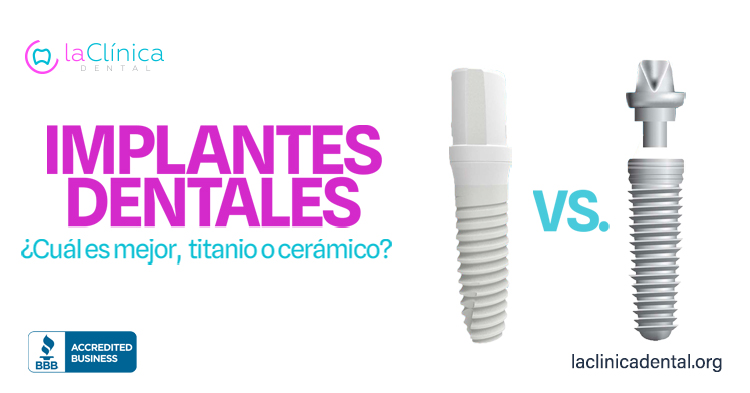
Titanium tooth implants are the most common type of dental implant. They are made of a strong, durable, and biocompatible alloy. Titanium implants have been used for decades and have proven to be highly effective for replacing missing teeth, offering stability similar to natural teeth.
Ceramic implants are a newer option and are gaining popularity due to their ability to mimic the natural appearance of the tooth. They are made of a biocompatible ceramic material and are less likely to cause allergic reactions than some metals. For patients who are very sensitive to metals, the benefit of ceramic implants can be especially interesting.
One of the main differences between titanium and ceramic implants is their appearance. Ceramic implants are translucent, meaning they reflect light similarly to natural teeth, which gives them a more natural appearance than some titanium implants in cases of very thin gum tissue.
Another important difference is the process of integration with the bone. Titanium implants offer a success rate close to 95% due to their high capacity to integrate with the bone (osseointegration). Ceramic implants, on the other hand, have a slightly lower success rate because their ability to integrate with the bone is lower than that of titanium implants, and their very long-term behavior is still being studied.
In cases where the patient has lost bone volume due to having missing teeth for a long time, a bone graft may be necessary before implant placement. This bone graft helps restore the height and thickness of the bone, allowing for the proper stability of both titanium and ceramic implants.
Necessary care for titanium and ceramic implants
- The care required for titanium and ceramic implants is similar, but there are some differences.
- For both types of implants, it is important to maintain good oral hygiene to prevent the buildup of plaque and bacteria around the implant. This can be achieved by brushing correctly, flossing daily, and attending professional cleanings regularly. A good hygiene routine allows the dental implant to remain healthy and function comparably to natural teeth.
- For titanium implants, it is also important to avoid tobacco and maintain a healthy lifestyle to ensure better healing and bone integration. Ceramic implants, on the other hand, are more fragile than titanium implants, so very hard and sticky foods should be avoided to reduce the risk of fractures or breakage of the crown or ceramic structure.
What is the best type of dental implant?
- Ultimately, the choice between a titanium or ceramic implant will depend on your individual needs and preferences, as well as your dentist’s recommendation.
-
-
If appearance is a major concern and you have thin gums or a high smile line, ceramic implants may be the best option due to their ability to blend in with natural teeth.
-
If durability, success rate, and robustness are your priority, titanium implants currently offer the most reliable option, especially for patients with higher functional demands.
-
- In general, both titanium and ceramic implants are popular options for replacing missing teeth in Mexico and worldwide, and both provide a significant implant benefit compared to not replacing the tooth or using traditional removable prosthetics.
- You can visit any of our clinics so that our specialists can evaluate your case, determine whether or not you need a bone graft, and decide which type of dental implant is most suitable for you, ensuring functional, aesthetic, and lasting results.