


Published by Dr. Rosa Ma. Montezuma : February 23, 2026.
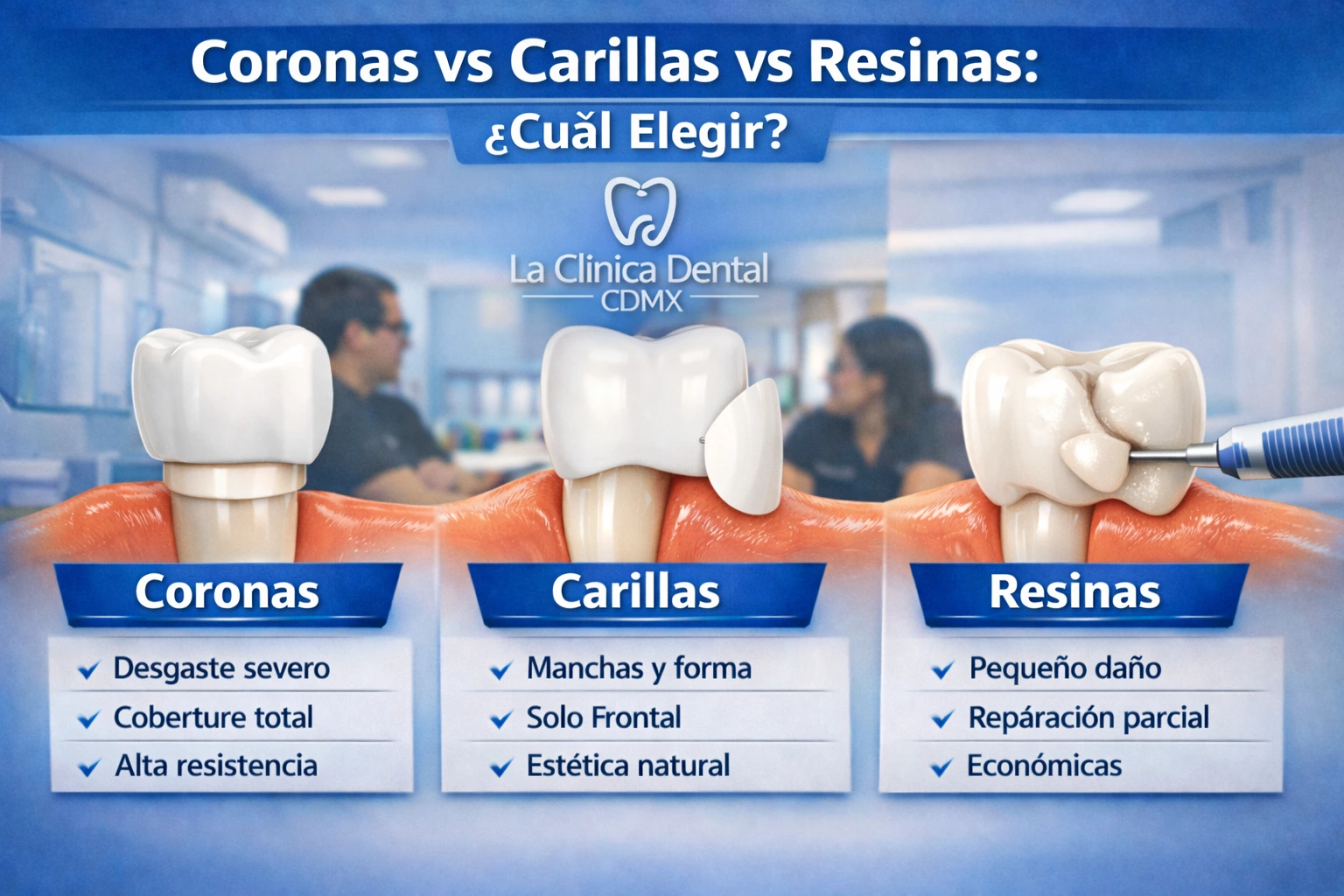
Choosing between crowns, veneers or resins is not an “esthetic opinion”, it is a clinical decision: it depends on how much tooth structure is left, how much the color is changed, what forces the tooth receives and your habits (such as bruxism). Below we explain the differences and give you a case-by-case guide to help you understand what a specialist usually recommends and why.
What is the difference between crowns, veneers and resins?
Dental crowns
-
What they are: they cover the tooth almost completely (360°) like a “helmet”.
-
When they are used:
-
Severely worn or fractured teeth.
-
Endodontic (root canal treatment) teeth that were left weak.
-
When previous restorations occupy a large part of the tooth.
-
-
Advantages:
-
They provide long-lasting resistance and protection.
-
Excellent aesthetics when using modern ceramic materials.
-
-
Disadvantages:
-
They require more healthy tooth wear than a veneer or resin.
-
They are usually the most expensive option per piece.
-
👉 If you are interested in learning more about when implants are used and when crowns are used on natural teeth, you can review the guide to dental implants in CDMX: recover your smile and chewing function.
Dental veneers
-
What they are: very thin sheets (usually made of porcelain or resin) that cover the front face of the tooth.
-
When they are used:
-
Improve shape, size and color of anterior teeth.
-
Closing small spaces (diastemas).
-
Correct mild to moderate wear in the esthetic zone.
-
-
Advantages:
-
In the case of dental veneers in Mexico City (CDMX)veneers allow very visible aesthetic changes with a more conservative tooth wear than a crown.
-
Very natural and stable esthetics with porcelain veneers.
-
-
Disadvantages:
-
They are not useful when the tooth is badly destroyed or has large cavities.
-
If they fracture, the entire veneer often has to be redone.
-
To see how they are integrated into a complete smile plan, you can consult the content of natural smile design in CDMX: veneers, resins, whitening and orthodontics.
High esthetics resins (direct restorations)
-
What they are: tooth-colored filling materials that are placed in a single appointment and molded directly in the mouth.
-
When they are used:
-
Small or moderate caries.
-
Partial edge fractures.
-
Moderate esthetic corrections without overly aggressive intervention.
-
-
Advantages:
-
They are the most conservative option: caries or damaged structure is removed and replaced.
-
Generally, the option with the lowest initial cost.
-
They can be repaired and retouched with relative ease.
-
-
Disadvantages:
-
Less long-term color stability than porcelain.
-
Lower resistance to extreme forces and bruxism.
-
If you want to go deeper, check out the specific article on high esthetic resins: what are their advantages.
Key factors to choose: wear, color, function and budget.
The decision is not made solely on “what looks prettier,” but on a combination of factors.
1. Amount of healthy tooth remaining
General rule:
-
Small to moderate destruction → resin or, in esthetic zone, resin or veneer.
-
Extensive destruction / very weakened tooth → crown almost always.
-
Tooth with endodontics and large previous restorations → we prefer crown to avoid fractures.
2. Color and aesthetic requirements
-
If your teeth have light stains or edge wear, a well-made resin may be sufficient.
-
If you are looking for a radical change in color and shape, especially in a full smile, porcelain veneers are more stable and natural.
-
Ceramic crowns combine esthetics and strength, but are reserved for teeth that are already weakened.
3. Function, strength and habits (bite and bruxism).
-
Load-bearing posterior teeth → better crowns or stronger restorations.
-
Patients with bruxism:
-
We can use veneers or resins, but always with night guards and many times the use of crowns or reinforced restorations is favored.
-
-
Severely worn anterior teeth due to clenching or grinding → sometimes you have to combine vertical dimension augmentation, crowns and veneers, not just “put something on top”.
4. Budget and long-term plan
Your budget is a real factor, but it cannot be the only criterion. An honest answer might be:
“Today we do well-planned resins; when the time is right and your situation permits, we migrate to veneers or crowns on key pieces.”
This is where the concept of comprehensive dental treatment in CDMX: complete step-by-step rehabilitation in one place.The plan is put together in phases, not just “single fixes”.
Case-by-case guidance: what is appropriate in each situation?
Case 1: Slightly crooked and stained front teeth
-
Problem: general staining, small misalignments, irregular edges.
-
Options:
-
Resins: allow to improve shape and color, but stain and wear more in the long term.
-
Porcelain veneers: more stable, natural and predictable change.
-
-
What is usually recommended:
-
If wear is minimal and budget limited → well-planned high esthetic resins.
-
If you are looking for a before/after smile makeover and stability → veneers.
-
Case 2: Fractured front tooth by a blow
-
Problem: a large fragment of the edge or corner is missing.
-
Options:
-
Resin: the fragment can be reconstructed.
-
Veneer: if the fracture is larger or compromises the shape and color of the entire piece.
-
Crown: if the tooth is also endodontic and has little healthy structure.
-
-
What is usually recommended:
-
Small to moderate fracture and healthy tooth → resin.
-
Extensive fracture, color change or large anterior restorations → veneer or crown, depending on how much tooth remains.
-
Case 3: Molars with very large old fillings
-
Problem: Old restorations that occupy more than half of the tooth, leaking or fractured.
-
Options:
-
New resins → possible, but the tooth is still weak.
-
Crown → reinforces the structure and protects against fractures.
-
-
What is usually recommended:
-
When there are cracks and obvious weakness, the safest long-term option is usually a crown.
-
Case 4: Bruxism wear on several teeth
-
Problem: short, flat teeth with worn enamel.
-
Options:
-
Resins only → they tend to wear out quickly.
-
Comprehensive plan: bite adjustment, guards and crown/veneer combination.
-
-
What is usually recommended:
-
See first if you need bite adjustment and guarding.
-
Then, decide which teeth to restore with crown (more load) and which with veneer or resin.
-
To better understand these types of cases, you may find the guide to complex cases: bone loss, grafting, All-on-4 and elderly patients helpful .
Case 5: Young patient with mild blemishes and limited budget
-
Problem: esthetic stains, some slight wear, but structurally sound teeth.
-
Options:
-
Bleaching + small resins.
-
Porcelain veneers: excellent esthetics but higher investment.
-
-
What is usually recommended:
-
Start with minimally invasive alternatives such as whitening and strategic resins.
-
Leave the door open to veneers in the future if a more complete change is desired.
-
Durability, maintenance and touch-ups
-
Resins
-
Expected life: several years, but may require touch-ups.
-
More sensitive to pigments (coffee, tea, tobacco).
-
They can be polished and repaired without reworking the entire part.
-
-
Porcelain veneers
-
Very stable in color and gloss.
-
If they fracture or detach, they usually need to be replaced in their entirety.
-
They require good hygiene and periodic controls.
-
-
Crowns
-
Designed to withstand forces and protect weakened teeth.
-
If the underlying structure is diseased (edge caries, gum problems), it may be necessary to replace them.
-
How do we decide with you on the first date?
At La Clínica Dental, the decision is not made just by looking at a photo or the color of the tooth. At the first appointment:
-
We review medical history, habits and expectations.
-
We make an evaluation, diagnosis and treatment plan (often with the support of radiographs and digital scans).
-
We explain more than one option, with pros, cons and times.
You can find a detailed description of the process in this article:
👉 What to Expect on Your First Dental Appointment: Evaluation, Diagnosis, and Treatment Plan
If you also have fear or anxiety, you can review our guide to fear of the dentist, anxiety, pain management and what options exist.
Frequently asked questions about crowns, veneers and resins
Which is better: crown, veneer or resin?
There is no «best» option at all; there is a suitable option for your case. It depends on how much structure is left, how damaged the tooth is, what forces it receives, and what the esthetic goal is.
When is a crown better than a veneer?
When the tooth is very weakened (large cavities, fractures, endodontics, giant fillings). In these cases the priority is to strengthen and protect, not just improve the appearance.
Do veneers do a lot of damage to the tooth?
Modern porcelain veneers are designed to be as conservative as possible, but do require the removal of a layer of enamel. The key is proper planning and a natural, not exaggerated, smile design.
Do resins look as good as veneers?
In skilled hands, a resin veneer can look great, especially for small changes. But for radical changes in shape and color, porcelain veneers are usually more stable and natural in the long term .
How long does a resin last compared to a veneer?
It depends a lot on your habits and care, but in general:
-
Resins: may require more frequent touch-ups and replacements.
-
Veneers: if well indicated and cared for, they can last for many years with good color stability.
I have bruxism, can I have veneers?
Yes, but with careful planning: night guards, bite adjustment and adequate selection of teeth and materials. Sometimes veneers are combined in the esthetic zone and crowns in more loaded teeth.
Is it possible to start with resins and then switch to veneers?
Yes, we often consider a phased plan: well-made resins as an initial solution and, when the time is right, we switch to veneers on the key parts of the smile.
Are crowns always metal-porcelain?
No. Today there are all-ceramic crowns, zirconia or other highly esthetic materials that are better integrated into full rehabilitation plans and advanced esthetic treatments.
Can everything be done in one visit?
Some resin procedures can be completed in a single appointment. Veneers and crowns usually require several steps (design, preparation, temporary restorations, placement). In specific cases, appointments can be combined, but quality is always the top priority.
If you’re interested in this topic, you can read: Can I Complete My Entire Dental Treatment in a Single Long Visit?
Which option is more economical?
Normally:
-
Resins → lower initial cost per part.
-
Veneers → higher investment per piece, especially in porcelain.
-
Crowns → are usually similar to or more expensive than veneers depending on the material.
The important thing is to calculate the long-term cost-benefit, not just today’s cost.
Can crowns, veneers or resins be bleached?
No. Whitening treatments act on the natural tooth, not on the restorations. The ideal is to whiten first and then plan resins, veneers or crowns according to the new color.
What if I just want to “fix the one across the street” and nothing else?
It is possible, but many times a single restored tooth in a smile with several problems can be more noticeable. That’s why we prefer to evaluate the entire smile and offer you a balanced solution, even if it is done in stages.
Does the crown, veneer or resin procedure hurt?
With proper anesthesia and modern techniques, the procedure is very tolerable. In addition, there are options for managing fear and anxiety, as explained in our guide for patients with dental phobia.
What care do I need after placing a crown, veneer or resin?
-
Rigorous hygiene (brush, floss, rinse).
-
Avoid biting on very hard things with restored teeth (ice, seeds, containers).
-
Periodic check-ups to detect problems in time.
How do I know if my case requires more than crowns, veneers or resins?
If you have tooth loss, bone loss, loose teeth, or bite problems, you may need a comprehensive rehabilitation plan that combines implants, crowns, and other treatments.
That’s why there are specific guides, such as the step-by-step guide to complete rehabilitation, all in one place.
There is no “best” option at all; there is a suitable option for your case. It depends on how much structure is left, how damaged the tooth is, what forces it receives, and what the esthetic goal is.
When the tooth is very weakened (large cavities, fractures, endodontics, giant fillings). In these cases the priority is to strengthen and protect, not just improve the appearance.
Modern porcelain veneers are designed to be as conservative as possible, but do require the removal of a layer of enamel. The key is proper planning and a natural, not exaggerated, smile design.
In skilled hands, a resin veneer can look great, especially for small changes. But for radical changes in shape and color, porcelain veneers are usually more stable and natural in the long term .
It depends a lot on your habits and care, but in general:
-
Resins: may require more frequent touch-ups and replacements.
-
Veneers: if well indicated and cared for, they can last for many years with good color stability.
Yes, but with careful planning: night guards, bite adjustment and adequate selection of teeth and materials. Sometimes veneers are combined in the esthetic zone and crowns in more loaded teeth.
Yes, we often consider a phased plan: well-made resins as an initial solution and, when the time is right, we switch to veneers on the key parts of the smile.
No. Today there are all-ceramic crowns, zirconia or other highly esthetic materials that are better integrated into full rehabilitation plans and advanced esthetic treatments.
Some resin procedures can be completed in a single appointment. Veneers and crowns usually require several steps (design, preparation, temporary restorations, placement). In specific cases, appointments can be combined, but quality is always the top priority.
If you’re interested in this topic, you can read: Can I Complete My Entire Dental Treatment in a Single Long Visit?
Normally:
-
Resins → lower initial cost per part.
-
Veneers → higher investment per piece, especially in porcelain.
-
Crowns → are usually similar to or more expensive than veneers depending on the material.
The important thing is to calculate the long-term cost-benefit, not just today’s cost.
No. Whitening treatments act on the natural tooth, not on the restorations. The ideal is to whiten first and then plan resins, veneers or crowns according to the new color.
It is possible, but many times a single restored tooth in a smile with several problems can be more noticeable. That’s why we prefer to evaluate the entire smile and offer you a balanced solution, even if it is done in stages.
With proper anesthesia and modern techniques, the procedure is very tolerable. In addition, there are options for managing fear and anxiety, as explained in our guide for patients with dental phobia.
-
Rigorous hygiene (brush, floss, rinse).
-
Avoid biting on very hard things with restored teeth (ice, seeds, containers).
-
Periodic check-ups to detect problems in time.
If you have tooth loss, bone loss, loose teeth, or bite problems, you may need a comprehensive rehabilitation plan that combines implants, crowns, and other treatments.
That’s why there are specific guides, such as the step-by-step guide to complete rehabilitation, all in one place.
Still not sure if you need crowns, veneers or resins?
Instead of guessing treatment from photos on the internet, let a team of specialists review your case with full digital diagnosis.
At La Clínica Dental we analyze wear, color, bite and habits and we propose 2-3 realistic options, with clear times and costs, so you can make the best decision for your smile.
-
Assessment with specialists in dental rehabilitation and esthetics.
-
Intraoral photographs and, if necessary, digital studies.
-
Clear explanation of advantages, disadvantages and timing of each option.
Author:
Dr. Rosa María Moctezuma Lozano
National Autonomous University of Mexico
License N° 1135288


![Cost of dental implants: Mexico City vs. United States vs. Canada [2026].](https://laclinicadental.org/wp-content/uploads/2026/02/costo-de-implantes-dentales-800x533.webp)


