Published by Dr. Rosa Ma. Moctezuma, ID No. 1135288: June 9, 2026.
Reviewed by Dr. Miguel Ángel S.: June 10, 2026.
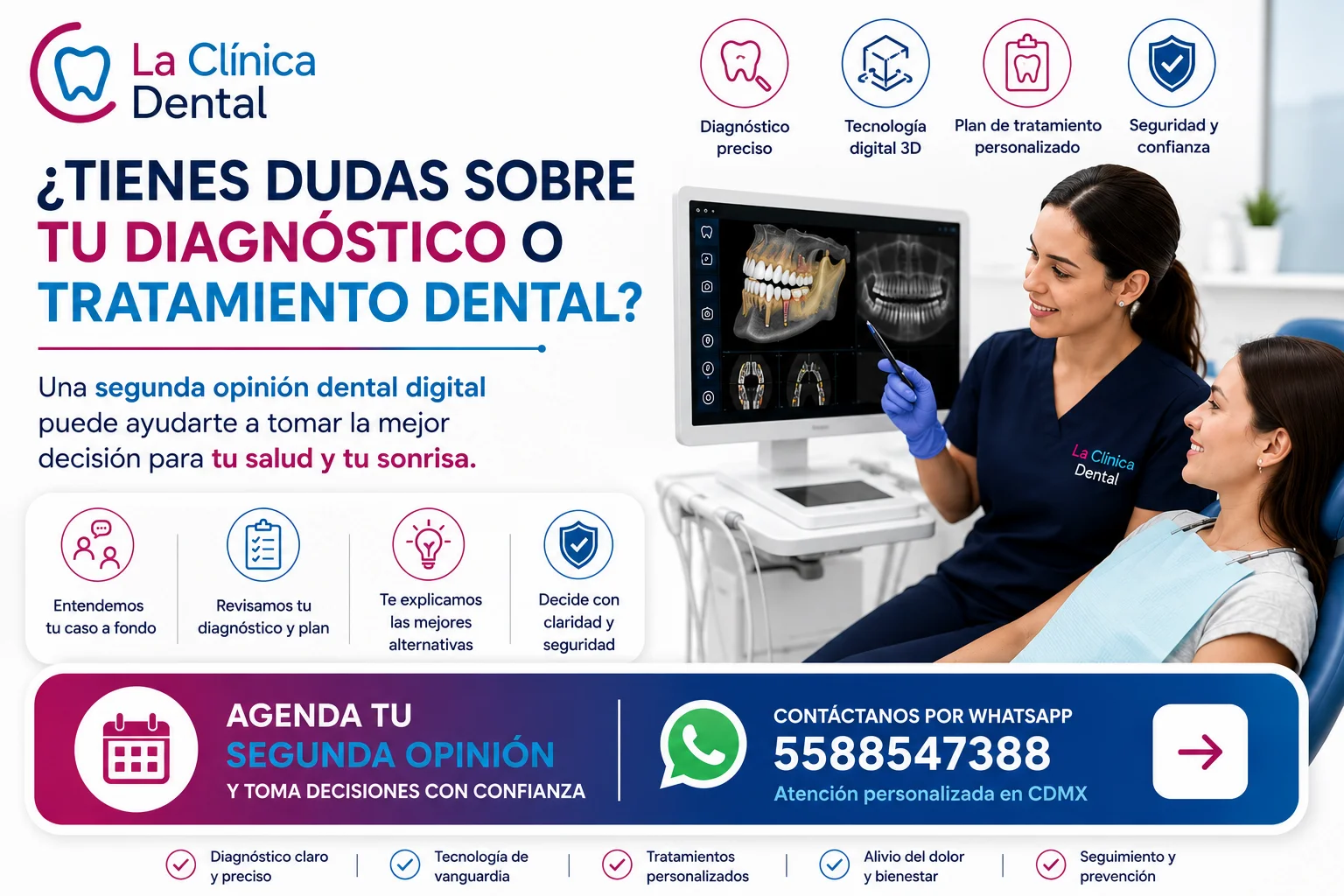
A digital dental second opinion in Mexico City helps confirm whether a treatment plan involving implants, crowns, or oral rehabilitation has been properly diagnosed, correctly sequenced, and is clinically justified. At La Clínica Dental, this evaluation draws on digital technology, a review of diagnostic studies, bite analysis, and multidisciplinary expertise to help you make a clear-cut decision before beginning complex treatment.
When you receive a comprehensive dental estimate, are told you need several implants, are advised to replace old crowns, or are told you need a complete oral rehabilitation, the main question shouldn’t just be “How much does it cost?” The right question is: Does this plan really fit my situation?
A digital second opinion is not intended to contradict for the sake of contradicting. Its purpose is to review the diagnosis, confirm priorities, identify risks, compare alternatives, and explain which treatments are urgent, which can wait, and which should be planned in stages to avoid clinical or financial surprises.
Key Definition: A digital dental second opinion is an independent clinical review based on digital X-rays, 3D CT scans, intraoral scans, clinical photographs, and functional analysis to confirm whether a complex dental treatment is necessary, feasible, and properly planned.
When is it a good idea to seek a second digital dental opinion?
It’s a good idea to seek a second digital dental opinion if you’ve received a complex diagnosis, a high estimate, or a treatment plan that you don’t fully understand. This is especially recommended before agreeing to dental implants, multiple crowns, extractions, bone grafts, fixed dentures, All-on-4, All-on-6, or full-mouth rehabilitation.
It’s also useful when you have questions like these:
- “They told me I need several implants, but I don’t know if they’re all necessary.”
- “They want to pull my teeth, and I want to know if any of them can be saved.”
- “They suggested crowns, but I’m not sure if the tooth still has enough structure.”
- “I received quotes that varied widely from one clinic to another.”
- “They told me about a bone graft, but they didn’t explain why.”
- “I want to pay for the treatment in installments so I don’t have to pay the whole amount at once.”
- “I’m worried that the starting price will go up later.”
- “I’m afraid to start a long-term treatment without understanding the entire plan.”
In these situations, a digital second opinion can help turn a confusing decision into a clearer clinical path. If you’re still unsure which tests should be included in an advanced evaluation, check out this guide on what a 360° digital dental diagnosis in Mexico City entails.
What does a digital dental second opinion in Mexico City cover?
A digital dental second opinion reviews the diagnosis, treatment plan, clinical sequence, bone condition, gum health, bite, the possibility of preserving teeth, the proposed materials, and factors that may affect the cost estimate.
When it comes to implants, crowns, or oral rehabilitation, the problem is almost never limited to a single tooth. There may be bone loss, wear from bruxism, periodontal disease, leaking restorations, silent infections, unstable prostheses, or a bite that jeopardizes the final result.
| Area Assessed | What Is Reviewed | Why it matters |
|---|---|---|
| Bone | Volume, height, thickness, density, and proximity to nerves or maxillary sinuses. | Determines whether an implant is feasible, whether a graft is required, or whether another alternative is recommended. |
| Gums | Inflammation, bleeding, recession, tooth mobility, and periodontal support. | Unhealthy gums can compromise implants, crowns, and dentures. |
| Teeth | Cavities, fractures, old restorations, root canals, and individual prognosis. | Helps determine which teeth can be saved and which have a poor prognosis. |
| Bite | Contacts, wear, bruxism, stability, and force distribution. | A poor bite can fracture crowns, overload implants, or cause pain. |
| Aesthetics | Color, shape, dental proportions, smile line, and facial harmony. | It allows for natural-looking results, not just whiter teeth. |
| Budget | What’s included, what’s not included, what can be changed, and what can be done in phases. | It minimizes financial surprises and allows you to prioritize treatment. |
What types of imaging can be used in a digital dental second opinion?
A digital dental second opinion may be based on digital X-rays, 3D CT scans, intraoral scans, clinical photographs, bite analysis, and a review of previous studies. Not all patients need the same tests, but complex cases often require more information than a visual examination.
3D Dental Tomography
3D tomography allows for the evaluation of bone, roots, nerves, maxillary sinuses, internal lesions, and anatomical structures that are not always visible on a conventional X-ray. It is especially important in dental implants, guided surgery, bone loss, complex extractions, and full-mouth restorations.
Digital X-rays
Digital X-rays help us assess deep cavities, root canal treatments, previous restorations, infections, bone loss, and the overall condition of teeth and gums.
Intraoral scanner
The intraoral scanner allows you to create a digital model of the mouth without relying on traditional impressions. It is used to analyze tooth shape, spacing, wear, bite, crowns, dentures, aligners, and restorative design.
Clinical photographs
Clinical photographs help document the smile, gums, facial proportions, tooth color, wear, previous restorations, and the progression of the case.
Functional Bite Analysis
In oral rehabilitation, it is not enough for the teeth to simply look good. They must close properly, allow for stable chewing, and distribute forces evenly without overloading crowns, implants, or natural teeth.
Why is a second opinion essential before getting dental implants?
Getting a second opinion before having dental implants placed helps confirm whether you are actually a good candidate, how many implants you need, whether there is enough bone, whether a bone graft is necessary, what type of prosthesis is recommended, and whether the plan covers the final crown—not just the surgery.
A dental implant is not just a screw. It is part of a system that must integrate with the bone, the gum, the bite, and the final restoration. That’s why an incomplete estimate may seem attractive at first, but can raise questions later if it doesn’t clarify whether it includes diagnosis, surgery, the implant, the abutment, the crown, follow-up visits, temporary restorations, or additional procedures.
Before agreeing to an implant plan, check out this guide on the cost of dental implants in Mexico City: what’s included, factors to consider, and price ranges by case.
A second opinion should clearly address the following:
- Is an implant the best option, or is there a conservative alternative?
- Is there enough bone to secure it properly?
- Is a bone graft or a sinus lift necessary?
- Are the gums in good condition?
- Is the implant planned with the final crown in mind?
- Does the estimate include the abutment and crown?
- What happens if an additional phase is required?
- What will maintenance be like after treatment?
When is it a good idea to review a computer-guided implant plan?
It is advisable to consider a computer-guided implant plan when the case involves aesthetic areas, limited bone volume, multiple implants, complex surgery, a full arch, a fixed prosthesis, or a need for greater precision in the final implant position.
Guided surgery should not be treated as just another buzzword. Its value lies in allowing the implant’s position to be planned using 3D data before the procedure. This helps coordinate the surgery with the future crown or prosthesis.
If you want to better understand this technology, check out the guide on computer-guided implants: what they are, their benefits, the steps involved, and who is a good candidate.
A digital second opinion can assess whether guided surgery is appropriately indicated or if the case can be resolved using a different approach. The important thing is not to use more technology just for the sake of it; what matters is that the technology provides precision, safety, and better planning.
Why should you get a second opinion before getting dental crowns?
Seeking a second opinion before agreeing to dental crowns helps confirm whether the tooth needs a full crown, an inlay, a filling, a veneer, a root canal retreatment, an extraction, or a more extensive restoration.
A dental crown can be an excellent solution when a tooth has lost a significant amount of structure, is weakened, is fractured, requires protection after a root canal, or is part of a functional restoration. However, not all teeth with older restorations need an immediate crown.
The second opinion should review:
- How much healthy tooth structure remains.
- If there is tooth decay under a restoration.
- If the root is in good condition.
- If the root canal treatment is stable.
- If the gum provides a good seal.
- If the bite could fracture the future crown.
- Which material is best: zirconia, porcelain, metal-porcelain, or another option?
- If the tooth can be restored using a more conservative approach.
When it comes to crowns, the most common mistake is basing the decision solely on aesthetics. A crown should look natural, but it must also seal properly, withstand the forces of biting, and protect the tooth over the long term.
What if you were offered a complete oral rehabilitation?
If you have been recommended a comprehensive oral rehabilitation, a digital second opinion can help confirm whether the treatment plan is properly sequenced: diagnosis, control of active disease, stabilization, implants or prosthetics, functional adjustment, aesthetics, and maintenance.
Comprehensive oral rehabilitation does not mean “doing everything” haphazardly. It means studying the mouth as a system. Teeth, gums, bone, bite, dentures, restorations, and aesthetics must all be evaluated together.
When you’re dealing with several problems at the same time, be sure to check out the comprehensive guide to oral rehabilitation in Mexico City.
A second opinion is especially helpful if you’ve been told that you need:
- several implants;
- replacement of old crowns;
- All-on-4 or All-on-6;
- fixed prosthesis;
- bone grafts;
- periodontal treatment;
- reconstruction due to wear;
- smile design combined with function;
- Complete replacement of restorations.
The key question isn’t “Can you do everything for me?” but rather “What’s the right order to ensure the results last?”
What are the signs that your dental case is complex?
Your case may be considered complex if you have multiple missing teeth, insufficient bone, severe wear, bruxism, gum disease, old dentures, failed crowns, pain when chewing, recurrent infections, or conflicting estimates from different clinics.
In these situations, a second opinion should not be superficial. It should identify priorities, risks, and steps. If you’re dealing with multiple issues at the same time, check out this guide on complex dental cases in Mexico City.
| Situation | Risks if a decision is made too quickly | What the second opinion should clarify |
|---|---|---|
| You’re missing several teeth | Choosing a prosthesis without evaluating the bone, gums, and bite. | Whether implants, a bridge, a fixed denture, or a combination plan is appropriate. |
| They’re suggesting that you have teeth extracted | Losing teeth that might be able to be saved. | A realistic prognosis for each tooth and conservative treatment options. |
| You have insufficient bone mass | Placing implants without sufficient bone support. | Need for a bone graft, sinus lift, or alternative technique. |
| Do you have bruxism or tooth wear? | Cracked crowns or overloaded implants. | How the bite will be corrected and how the results will be protected. |
| You’re using an old prosthesis | Repeating an unstable solution. | Which option offers better function, stability, and maintenance? |
| You received quotes that varied widely | Comparing prices without comparing what’s included. | Included components, phases, materials, inspections, and possible extras. |
How can you tell if a dental estimate is complete?
A dental estimate is complete when it explains the diagnosis, treatment goal, phases, procedures included, materials, diagnostic tests, temporary restorations, follow-up visits, maintenance, possible additional procedures, and conditions that could affect the cost.
An incomplete estimate usually focuses only on the initial price. A clinically useful estimate explains the rationale behind each phase. For extensive treatments, the best approach is to organize the case with both a clinical and a financial plan. You can check out this guide on phased dental treatment plans in Mexico City: how to pay and move forward without surprises.
| A Question You Should Ask | Why is this important? | Expected answer in a clear plan |
|---|---|---|
| What exactly is included in the price? | Avoid confusing surgery with comprehensive treatment. | You must specify the examinations, procedures, materials, controls, and final restoration. |
| What is not included? | It reduces financial surprises. | You must clarify any possible grafts, temporary restorations, rebasings, or additional phases. |
| What is urgent, and what can wait? | It allows you to pay and move forward based on priorities. | You must distinguish between pain, infection, function, aesthetics, and maintenance. |
| What happens if a new finding comes up? | Diagnoses may change as a result of more comprehensive tests. | You must explain the clinical scenarios and criteria before modifying the plan. |
| What maintenance is required? | Complex treatments require follow-up. | It should include checkups, dental hygiene, gum examinations, bite assessments, and implants. |
What documents should you bring for a second dental opinion?
For a second dental opinion, bring X-rays, a 3D CT scan (if you have one), photographs, previous estimates, a list of proposed treatments, prescriptions, your medical history, current medications, and any information about previous implants, crowns, or dentures.
The more information the team has, the more useful the review will be.
- Panoramic X-ray.
- CBCT scan or DICOM file, if available.
- Periapical X-rays.
- Clinical photographs.
- Models, scans, or previous digital studies.
- Previous budget.
- Treatment plan received.
- Brand of implants, if you already have any.
- Materials used in existing crowns or prosthetics.
- History of root canal treatments.
- History of periodontal disease.
- Significant medical conditions such as diabetes, osteoporosis, or healing problems.
- Current medications.
- Tobacco use.
- Main Concerns and Expectations.
If you don’t have any previous test results, the second opinion can begin with a digital assessment from scratch.
Can a second opinion change the entire course of treatment?
Yes, a second opinion can confirm the original plan, modify it in part, or propose a different alternative. It can also help break the treatment down into stages, save teeth that seemed lost, or identify factors that had not been considered.
1. Confirmation of the initial plan
The previous diagnosis was correct, and the second opinion gives you peace of mind to move forward.
2. Adjusting the order of treatment
The proposed treatment may be appropriate, but it may be necessary to first address issues such as gum disease, infection, bruxism, or bite problems.
3. Change of option
In some cases, a crown can be replaced with an inlay; a bridge can be compared to implants; or a tooth extraction can be reconsidered if the tooth still has a favorable prognosis.
4. Division by stages
When the budget is ample, a plan can be developed to address clinical priorities without compromising safety.
5. Detection of Hidden Risks
A CT scan or functional analysis may reveal bone loss, infection, fractures, occlusal contacts, or anatomical limitations that alter the treatment plan.
What shouldn’t a second dental opinion promise?
A second dental opinion should not promise guaranteed results, fixed prices without a diagnosis, “risk-free” treatments, or definitive answers via WhatsApp. Reputable dentistry is based on clinical evidence, research, prognosis, and transparent explanations.
Be wary if you receive messages like:
- “You don’t need any documents—a photo is all it takes.”
- “All of your teeth need to be extracted.”
- “We place implants without assessing the bone.”
- “The price never changes, even if we haven’t done a diagnosis.”
- “Everything can be done in a single day.”
- “It requires no maintenance.”
- “The most expensive option is always the best.”
- “The cheapest option is the same for everyone.”
A high-quality second opinion should help you understand, not pressure you.
How does La Clínica Dental provide a digital second opinion?
At La Clínica Dental, a digital second opinion focuses on understanding the entire case, reviewing diagnostic tests, evaluating function and aesthetics, setting priorities, and explaining treatment options in clear language.
1. Review of the reason for the consultation
First, we listen to your concerns: cost, pain, suitability for implants, crowns, extractions, aesthetics, time, fear, or doubts about a previous diagnosis.
2. Clinical and Digital Assessment
Teeth, gums, bite, restorations, dentures, and available images and test results are examined. If necessary, additional digital tests are ordered.
3. Analysis of the plan received
The previous diagnosis is compared with the current findings: what matches, what still needs to be reviewed, and what might need to be reconsidered.
4. Clinical Prioritization
We distinguish between what is urgent, what is important, and what is aesthetic. Pain, infection, gum health, and functional stability usually take precedence over cosmetic details.
5. Treatment Options
Conservative, intermediate, or comprehensive treatment options are explained based on the prognosis of each case.
6. Multi-stage Route
If the treatment is extensive, a plan is developed to proceed with greater clinical and financial clarity.
7. Explanation of the Budget
The following factors that can affect the cost are explained: grafts, type of crown, number of implants, temporary restorations, materials, surgical complexity, follow-up visits, and maintenance.
What are the benefits of getting a second opinion at a multidisciplinary clinic?
Seeking a second opinion at a multidisciplinary clinic allows the case to be reviewed by specialists in various fields: implantology, oral rehabilitation, periodontics, endodontics, orthodontics, surgery, prosthodontics, and cosmetic dentistry.
This is important because a complex dental problem rarely falls within a single discipline.
- An implant depends on the bone, but also on the bite and the future crown.
- A crown depends on the tooth, but also on the gums and the occlusal contacts.
- A beautiful smile depends on color, but also on proportions, function, and periodontal health.
- A complete restoration depends on the teeth, gums, bone, dental prostheses, muscles, and maintenance.
An isolated approach may address one aspect while neglecting another. A comprehensive approach aims to ensure that treatment is consistent.
When Can a Second Opinion Help Prevent Overtreatment?
A second opinion can help prevent overtreatment by confirming that a tooth can still be restored, that an implant is not urgent, that a full crown can be replaced with a more conservative option, or that treatment can be divided into phases.
This doesn’t mean always choosing the bare minimum. It means choosing what’s necessary at the right time.
Common examples:
- An extensive cavity may require an inlay, not necessarily a crown.
- An old crown may need to be replaced, but first, the seal and the root should be examined.
- A tooth with a poor prognosis may require extraction, but this must be supported by evidence.
- An implant can be excellent, but not if the gums or bone aren’t ready.
- A comprehensive rehabilitation program may be appropriate, but it must have clearly defined phases.
The best dentistry isn’t the one that performs the most procedures. It’s the one that recommends the right course of action, in the right order, with the least possible risk.
When Can a Second Opinion Prevent Under-Treatment?
A second opinion can also help prevent undertreatment. Sometimes the visible problem seems minor, but the actual issue is more extensive: bone loss, gum disease, an unstable bite, internal fractures, or failed restorations.
Under-treatment occurs when only the symptom is addressed, but not the cause.
- Placing a crown without correcting a bite that will cause it to fracture.
- Apply a resin to a tooth with undiagnosed deep decay.
- Performing cosmetic dentistry without examining the gums.
- Placing implants without treating periodontal disease.
- Replacing a prosthesis without assessing bone support.
- Teeth whitening when there are fillings or cavities.
A well-crafted second opinion strives for balance: not going overboard, but not falling short either.
Which patients benefit most from a digital second opinion?
The patients who benefit the most are those who have doubts before beginning costly, lengthy, or irreversible treatments. This also includes those who have already been given a complex treatment plan and need clarification.
| Patient Type | Frequently Asked Question | What a second opinion offers |
|---|---|---|
| Patient Considering Implants | The patient is unsure whether they actually need implants or a bone graft. | Evaluates bone, gums, number of implants, and final restoration. |
| Patient with multiple crowns | The patient isn’t sure if all the crowns are necessary. | Examine the tooth structure, root, sealant, material, and bite. |
| Patient with an older prosthesis | Wants a more permanent, comfortable, or aesthetically pleasing option. | Compare removable dentures, fixed dentures, implants, or a combination plan. |
| Patient with wear caused by bruxism | The patient is concerned about fracturing future restorations. | Evaluates occlusion, forces, protection, and functional stability. |
| Patient with a generous budget | Doesn’t know what to pay first. | Organizes the case by clinical and financial phases. |
| Patient Comparing Clinics | Received different diagnoses or prices. | Helps compare what each plan actually includes. |
How can you compare two dental opinions without getting confused?
When comparing two dental quotes, don’t just compare the final price. Compare the diagnosis, the tests performed, the recommended treatment, the materials used, the treatment stages, follow-up care, the team’s experience, and the clarity of the estimate.
| Item to Compare | Less clear plan | More reliable plan |
|---|---|---|
| Diagnosis | It is based solely on visual examination. | It includes X-rays, CT scans, imaging, and clinical examination. |
| Implants | Indicate only the number of implants. | Explain the bone, gum, bite, prosthesis, and final crown. |
| Crowns | Proposes crowns without justifying each tooth. | Describe the remaining structure, root, cementation, material, and function. |
| Budget | Provide a total amount without a breakdown. | List the phases, components, materials, and any potential additional costs. |
| Time | It promises speed without explaining biological limits. | Clarify what can be sped up and what requires healing. |
| Maintenance | No follow-up visits are mentioned. | It includes follow-up care, oral hygiene, gum examinations, and bite checks. |
How much does a digital dental second opinion cost in Mexico City?
The cost of a digital dental second opinion in Mexico City depends on the necessary tests, the complexity of the case, and whether the patient already has X-rays, a CT scan, or a prior treatment plan. In complex treatments, the real value lies in avoiding misguided decisions, incomplete treatment plans, or procedures without a clear sequence.
Rather than viewing it as an additional expense, it is better to see it as an investment in clarity.
A second opinion can help you:
- avoid unnecessary treatments;
- determine whether an implant is feasible;
- to determine whether a crown is appropriate;
- identify risks before getting started;
- plan the treatment in stages;
- compare quotes properly;
- reduce anxiety before making a decision;
- get started on a plan with greater confidence.
When treatment may involve months of appointments or a significant financial investment, making a decision without a complete diagnosis can end up costing more than reviewing the case from the beginning.
Does a second opinion replace the original dentist’s diagnosis?
No. A second opinion does not automatically replace the original diagnosis. It supplements, confirms, or challenges it with new clinical information. Its purpose is to help you make a more informed decision.
In dentistry, there may be several valid alternatives for the same case. One specialist may prioritize saving teeth; another may recommend implants; yet another may focus first on the gums or bite.
The key is that each recommendation be supported by studies, clinical examination, and prognosis.
What should you receive at the end of a digital second opinion?
At the conclusion of a digital second opinion, you should receive a clear explanation of the diagnosis, a summary of the findings, possible alternatives, clinical priorities, risks, suggested next steps, and factors that may affect the cost.
Ideally, you should walk away with answers to these questions:
- What’s really wrong with me?
- Which teeth can be saved?
- Which teeth have a poor prognosis?
- Do I need implants, or are there alternatives?
- Are the proposed crowns justified?
- Is there bone loss or periodontal disease?
- Which treatment should be done first?
- What can you expect?
- How can I pay in installments?
- What results are realistic?
- What maintenance will I need?
If, after a consultation, you leave with more questions than answers, the plan is still not clear enough.
Why choose La Clínica Dental for a digital second opinion in Mexico City?
The Dental Clinic is a solid choice for a digital second opinion in Mexico City because it combines digital diagnosis, clinical examination, functional analysis, and a multidisciplinary approach for cases involving implants, crowns, prosthetics, and comprehensive oral rehabilitation.
The main value lies not only in the technology, but in how it is used: to explain, organize, and prioritize. In complex cases, patients need diagnostic accuracy, clinical judgment, and financial clarity before making a decision.
The digital second opinion helps bring these three elements together into a clear path:
- Diagnostic accuracy: understanding what is really going on.
- Clinical judgment: knowing which treatments are necessary and which can wait.
- Financial Clarity: Understand the phases, components, and potential changes before getting started.
Schedule a digital dental second opinion in Mexico City
If you’ve received a quote for implants, crowns, or oral rehabilitation and aren’t sure whether to proceed, schedule a digital second opinion. Bring your dental records, the previous quote, and your main concerns. If you don’t have any dental records, you can start with a digital evaluation to understand your case from the beginning.
At La Clínica Dental, we can help you review your diagnosis, set priorities, and develop a clearer plan to restore your dental health, function, aesthetics, and stability.
Schedule your digital second opinion at a dental clinic in Mexico City and make a decision based on an accurate diagnosis, clarity, and confidence.
Frequently Asked Questions About Digital Dental Second Opinions in Mexico City
What is a digital dental second opinion?
It is a clinical evaluation supported by digital technology—such as X-rays, 3D CT scans, intraoral scans, photographs, and bite analysis—to confirm or revise a dental diagnosis before beginning complex treatment.
When should I seek a second dental opinion?
You should ask for it when you receive a high estimate, or when they suggest implants, crowns, extractions, full-mouth rehabilitation, grafts, or a treatment you don’t fully understand.
Is this useful for reviewing a dental implant plan?
Yes. It helps determine whether you’re a good candidate, whether you have enough bone, whether you need a bone graft, how many implants are required, and whether the estimate includes the final crown.
Can it be used to check dental crowns?
Yes. It allows us to determine whether a crown is indicated, whether the tooth can be preserved, whether there is sufficient tooth structure, and which restorative material is appropriate based on function and aesthetics.
Can a second opinion prevent unnecessary treatments?
Yes. It can help determine whether there is a less invasive alternative, whether a procedure can be postponed, or whether the proposed treatment is fully justified.
Can it also detect if I'm missing a treatment?
Yes. In some cases, it reveals problems that have not been considered, such as bone loss, periodontal disease, fractures, infections, or an unstable bite.
Do I need to bring X-rays?
It’s a good idea to bring them if you already have them. You can also bring CT scans, photographs, previous cost estimates, prescriptions, digital test results, and notes regarding the proposed treatment.
What if I don't have any prior education?
You can start with a new digital assessment to gather the necessary information and review the case from the beginning.
Is a 3D CT scan always necessary?
Not always. It is indicated when the case warrants it, especially in cases involving implants, bone loss, surgery, comprehensive rehabilitation, or significant anatomical concerns.
Can I ask for a second opinion if I've already started treatment?
Yes. It is possible to review the current status, what has already been done, and what remains to be done, although the analysis will depend on the available clinical information.
Does a second opinion change the budget?
You can modify it if unanticipated needs, more conservative alternatives, additional phases, or components that were not included are identified.
Can I undergo my treatment in stages after getting a second opinion?
Yes. In large-scale cases, it is usually advisable to organize the treatment into clinical and financial phases in order to move forward without improvising.
Is a second opinion useful for comprehensive oral rehabilitation?
Yes. This is one of the situations where it adds the most value, because it allows for the proper alignment of implants, dentures, crowns, gums, bite, aesthetics, and maintenance.
What should I ask during the second opinion?
Ask what diagnosis has been confirmed, what treatment is urgent, what you can expect, what alternatives are available, what the estimate covers, what risks are involved, and how the results will be maintained.
Do you have any questions before agreeing to a treatment plan for implants, crowns, or dental restoration?
Before beginning complex dental treatment, make sure the diagnosis, estimate, and treatment plan are correct. At La Clínica Dental, we review your case using a digital approach to help you make an informed decision.
Author:
Dr. Rosa María Moctezuma Lozano
National Autonomous University of Mexico
ID No. 1135288
Clinically reviewed and updated content for patient information guidance.
Last editorial review: June 10, 2026.