Published by Dr. Rosa Ma. Montezuma : February 23, 2026.
If you’re considering a dental implant, the most important thing to understand is that it’s not just about replacing a tooth. It’s about restoring function, stability, and confidence through a well-planned treatment. In Mexico City, dental implants can be a highly predictable solution when the case is evaluated using digital diagnostics, thorough planning, and proper follow-up. If you’d like to learn more about the basics of the treatment, check out our implantology services.
What is the procedure for a dental implant like?
A dental implant procedure is typically divided into several stages. Although the timeline varies for each patient, treatment usually begins with an evaluation, followed by case planning, then the placement of the implant, and finally the restoration, which may be a crown, a bridge, or a denture, depending on the number of teeth to be restored.
The first phase is crucial because it’s not just about determining whether “you’re a candidate for implants,” but also how your case should be addressed. We analyze the available bone, your bite, the health of your gums, and whether the treatment will be straightforward or require grafts, more extensive restoration, or guided surgery. When this stage is done right, the treatment plan becomes much clearer from the start. If you’d like to know how the cost affects each of these phases, you can read about the price of dental implants in Mexico City.
Next comes the surgical phase. During this phase, the implant is placed into the bone under local anesthesia and, in some cases, with the aid of 3D planning and surgical guides. Once placed, the implant needs to fuse with the bone. This process is known as osseointegration. When that phase is complete, the final restoration is placed, restoring both function and aesthetics.
For patients who need not just a single tooth but a more extensive fixed solution, treatment can reach a new level of complexity. In such cases, it’s also worth looking into All-on-4 and All-on-6 in Mexico City, where we explain how the treatment approach changes when restoring an entire dental arch.
What tests are performed before placing an implant?
Before placing an implant, it’s important to examine more than just the empty space. It is necessary to examine the bone, the ideal position of the future crown, the relationship with other teeth, the bite, and the health of the gums. For this reason, diagnosis today typically relies on 3D CT scans, digital X-rays, intraoral scanners, and computer-aided planning.
How long does dental implant treatment take?
There is no single, universal timeframe that applies to all patients. Treatment may take a shorter or longer time depending on the number of missing teeth, bone quality, the need for grafts, and the type of final restoration.
In a simple case, the process can proceed in a relatively straightforward manner from the initial evaluation through implant placement to the restorative phase. In other cases, especially when there is bone loss or multiple teeth are involved, treatment requires more time and more stages. The important thing is for the patient to receive a clear explanation from the start about what will be done first, what will be done next, and the approximate timeframes to expect between one phase and the next.
The report identifies a clear opportunity for content that better explains the entire treatment process, particularly in guided implantology, All-on-4/6, and full-mouth rehabilitation. It also notes that 3D technology and digital workflows can help reduce wait times and streamline the patient experience.
| Phase | What is done | What Affects the Time |
|---|---|---|
| Evaluation and Diagnosis | Clinical examination, imaging studies, and treatment planning | If there is sufficient bone, healthy gums, and the case is simple or complex |
| Implant Placement | Surgery to place the implant in the bone | Number of implants, type of surgery, and use of guided surgery |
| Osseointegration | The time it takes for the implant to integrate with the bone | Bone quality, overall health, and case complexity |
| Prosthetic Phase | Placement of a crown, bridge, or final prosthesis | Type of restoration and functional and aesthetic design |
How long does it take to recover after getting an implant?
Immediate recovery is not the same as complete osseointegration. After surgery, most patients focus on the first few days: swelling, post-operative instructions, diet, and aftercare. But full recovery from the procedure also depends on the biological time required for the implant to integrate with the bone.
In the first few days, you should follow the specialist’s instructions, avoid unnecessary exertion, and maintain proper hygiene in the area as recommended. Afterward, follow-up care becomes just as important as the surgery itself. Even a properly placed implant requires regular checkups to ensure that everything is healing as it should.
The report shows that searches related to fear, pain, minor discomfort, and clarity of communication carry significant weight in the patient’s decision. Therefore, discussing recovery should not be limited to “how many days it hurts,” but should explain what the patient may feel, what is monitored at each stage, and how technology helps make the process more predictable.
Can guided surgery lead to a more predictable recovery?
Yes. Computer-guided surgery helps plan the implant’s position before surgery and execute the plan with greater precision. In practical terms, this can lead to a more controlled, clearer, and better-coordinated treatment process with the final restoration.
The report identifies La Clínica Dental as a brand already associated with computer-guided implants, 3D tomography, and intraoral scanners, and recommends using this positioning as a key selling point to raise awareness of implants and dental restoration.
If you’d like to learn more about this topic, you can follow the link within the article to the section on computer-guided implants.
What factors determine the success rate of a dental implant?
When someone asks about the “success rate,” they’re really asking how reliable the treatment might be in their specific case. And the correct answer is that success doesn’t depend on a single, isolated figure, but rather on a combination of clinical factors.
Factors that influence the outcome include the diagnosis, bone quality, gum health, the team’s experience, digital planning, proper implant placement, the quality of the final restoration, and post-treatment maintenance. It also matters whether the case is a single-tooth restoration or part of a more complex rehabilitation.
Therefore, rather than promising a universal figure, this article should explain something more useful: a well-planned implant is more likely to perform well in the long term when it is clearly assessed from the outset, placed under appropriate conditions, and maintained through follow-up care. This approach to communication is more in line with the direction the report recommends for La Clínica Dental: planned, complex, safe, and clinically valuable treatments—not quick or mass-market promises.
What factors can affect the success of treatment?
There are factors that help and others that complicate the process. Having healthy gums, sufficient bone, and good oral hygiene all contribute to a successful treatment. On the other hand, bone loss, smoking, untreated gum inflammation, certain habits such as clenching your teeth too hard, or a lack of maintenance can make the case more challenging.
That does not mean the patient is ruled out, but rather that the treatment plan must be adjusted more carefully. The report itself identifies a strong opportunity to position La Clínica Dental as a leader in highly complex implantology, cases with limited bone, All-on-4, and complete rehabilitation.
What happens if I don’t have enough bone?
A lack of bone does not automatically mean you cannot have implants. It means your case requires a more detailed evaluation. In some patients, a bone graft or preliminary preparation may be necessary to create a more suitable foundation.
It is important to make it clear here that complex cases should not be oversimplified. These are precisely the types of treatments where digital diagnosis, the team’s experience, and a comprehensive approach make the biggest difference. For this reason, this article should naturally address complex cases involving bone loss, grafts, All-on-4, and elderly patients.
What does it feel like during and after treatment?
During surgery, the procedure is performed under local anesthesia. Afterward, the patient may experience varying degrees of discomfort and swelling, depending on the individual case. The most important thing here is not to promise that everyone will have the same experience, but to clearly explain what might happen, how it is managed, and what signs to watch for.
The report identifies strong demand for content on anxiety, sedation, fear of anesthesia, and minimal discomfort. It also recommends humanizing technology and the clinical experience by explaining the process step by step in simple language.
Frequently asked questions on implant maintenance and All-on-4 / All-on-6
How often should I have a professional cleaning if I have implants?
In most cases we recommend a professional cleaning every 6 months, and every 3-4 months in patients at higher risk (smokers, diabetics, history of periodontitis).
Can electric toothbrushes be used on implants and fixed prostheses?
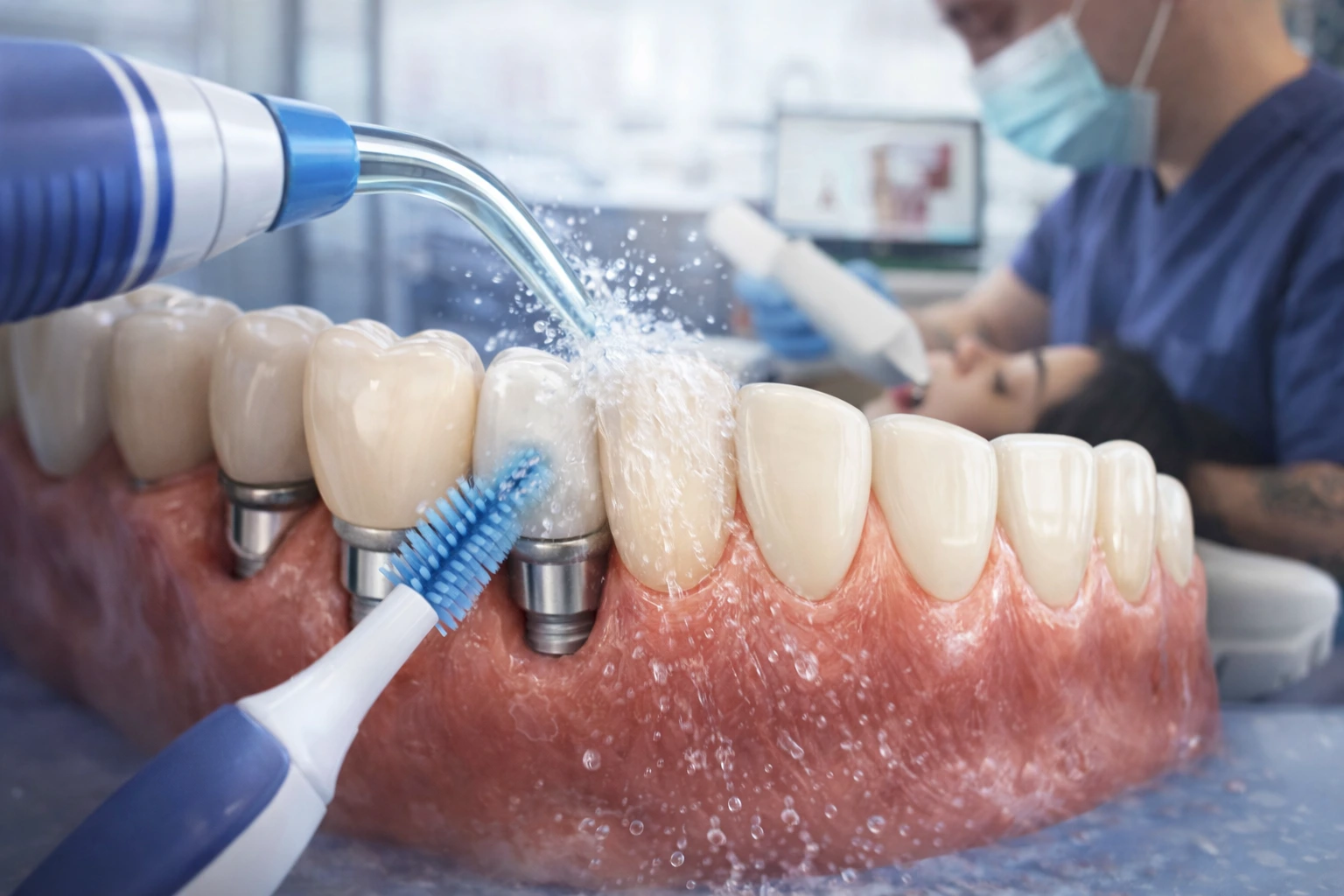
Yes, as long as they have soft brush heads and are used with proper technique. Even so, they should be combined with interproximal brushes or irrigators to clean the areas where the toothbrush cannot reach.
Is flossing mandatory if I have All-on-4?
It depends on the design of your denture. In some cases, special floss or superfloss is used; in others, interproximal brushes and irrigators are more effective. Your dentist will indicate the ideal combination.
Can I eat anything with implants and fixed prostheses?
In general yes, but it is advisable to avoid biting extremely hard things (ice, bones, packaging, very sticky sweets) to avoid damaging acrylic, ceramics or overloading the implants.
Can smoking cause me to lose my implants?
Smoking increases the risk of peri-implantitis and implant failure. It does not mean that all implants will be lost, but the probability of complications is clearly higher.
Can peri-implantitis be cured?
In initial stages it can be controlled with professional hygiene, disinfection and improvement of habits. In advanced cases it may require surgery and, if the bone loss is severe, even removal of the affected implant.
Do I need antibiotics every time I have maintenance?
No. The use of antibiotics is reserved for specific situations, not for every routine cleaning. Most of the maintenance works with local hygiene measures.
What if I hear a "click" or notice something moving in my prosthesis?
It may be a loosened screw, an acrylic fracture or a fitting problem. It is important to have it checked as soon as possible to prevent the load from concentrating on a single point.
Are implants "guaranteed" for life?
No medical treatment can guarantee results for life. However, many manufacturers offer warranties on components and clinics establish follow-up policies, always conditional on proper maintenance.
Can I use strong or alcohol rinses?
Prolonged use of alcohol rinses is not recommended because they can irritate tissues and dry out the mouth. It is preferable to use rinses without alcohol and only use specific products when indicated by the dentist.
Is it normal for me to bleed a little when cleaning around the implants?
Slight bleeding may occur if there is inflammation. If it persists for more than a few days despite improved hygiene, it is advisable to go for a check-up to rule out mucositis or peri-implantitis.
What if I have periodontal disease in other teeth?
Active periodontitis is an important risk factor for peri-implantitis. It is essential to treat and control periodontal disease before and during implant maintenance.
Can I sleep without removing the All-on-4 / All-on-6 prosthesis?
Yes, All-on-4/6 fixed prostheses are screw-retained and remain in the mouth 24 hours a day. The important thing is to maintain excellent hygiene and use a night guard if you have bruxism.
How long does a full maintenance appointment take?
It depends on the complexity, but an implant and All-on-4/6 maintenance appointment usually lasts between 45 and 90 minutes, including check-up, cleaning and adjustments.
Can I do my maintenance in another city and only go to CDMX from time to time?
Yes, the ideal is to coordinate a shared plan: routine maintenance near your place of residence and key check-ups at La Clínica Dental during your visits to CDMX, especially if your case was complex.
Is the maintenance of implants more expensive than that of natural teeth?
Not always. Many times it is possible to repair or replace the damaged tooth without changing the entire structure. The decision depends on the general condition of the prosthesis and the years of use.
Do I need to replace the entire prosthesis if a tooth breaks?
The cost per appointment is usually similar or slightly higher in complex cases, but it is much lower than the cost of having to redo an entire rehabilitation. Think of it as investment protection is the key.
Do you want your implants or your All-on-4/6 prosthesis to last for many years?
Schedule an assessment and maintenance appointment to review the condition of your implants, your hygiene and your risk factors. We can adjust your prosthesis, update your cleaning routine and answer all your questions about long-term care.