Published byDr. Rosa Ma. Moctezuma, Cédula No. 1135288: March 11, 2026.
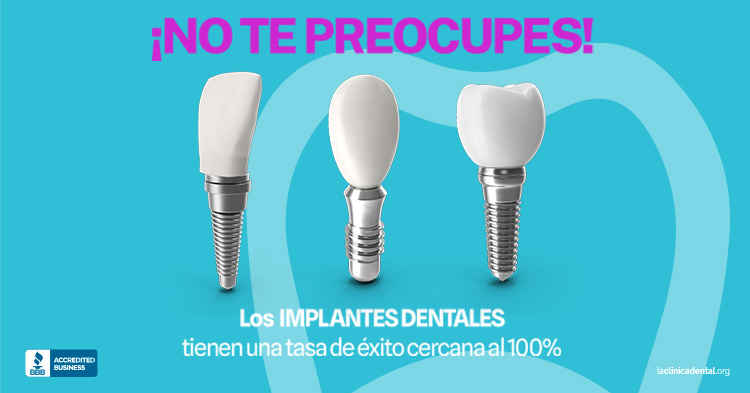
When a person asks about the success rate of a dental implant, they really want to know something more important: how reliable the treatment can be in their case. The answer does not depend on a single number or a general promise. It depends on diagnosis, bone quality, gum health, treatment planning and follow-up.
Therefore, talking about success does not only mean talking about “if the implant fits” or not. It means checking if the case was well studied, if the surgery was correctly planned, if the final restoration is well designed and if the patient can maintain the treatment in the long term with adequate hygiene and controls.
If you first want to understand how the treatment works in general, you can review our guide to dental implants. In this article we are going to focus on a more specific question: what does it depend on for an implant to perform well over time.
What does the success of a dental implant depend on?
The success of an implant is not explained by a single factor. It is built from several stages that must work well together. A treatment may look correct from the outside, but if the case was not well diagnosed or if certain risks were not considered from the beginning, the predictability changes.
Among the most important factors are:
the quantity and quality of the bone;
gum health;
surgical planning;
the correct position of the implant;
the design of the final crown or prosthesis;
patient hygiene;
subsequent follow-up.
That means that talking about success should not be reduced to an isolated number. What is most useful for the patient is to understand which conditions favor a better outcome and which situations make the treatment need more careful planning.
Does bone influence the success rate?
Yes, the available bone has a direct influence on the stability and planning of the implant. When there is good bone quantity and quality, the case may be more straightforward. When there is bone loss, the treatment may require a previous phase or a different approach.
This does not automatically mean that the patient cannot have implants. It means that the case must be studied in more detail. If this is your situation, you can expand this part in complex cases with bone loss, grafting, All-on-4 and older patients.
Do the gums also affect the result?
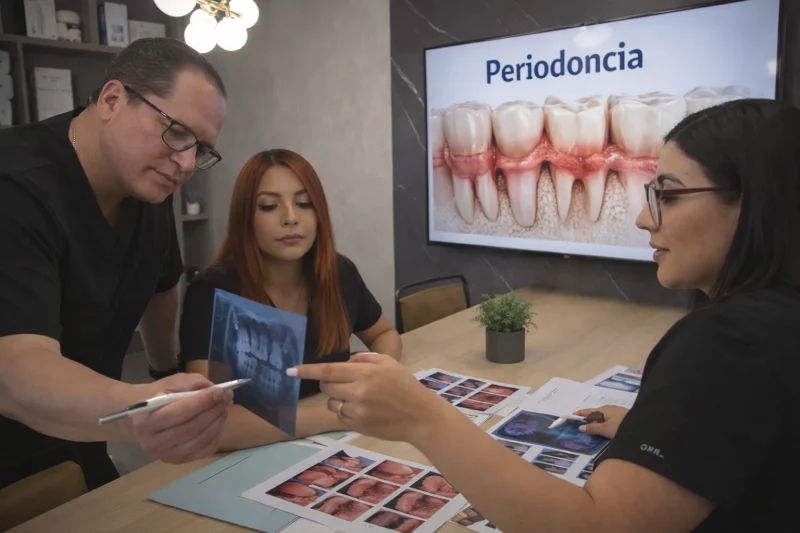
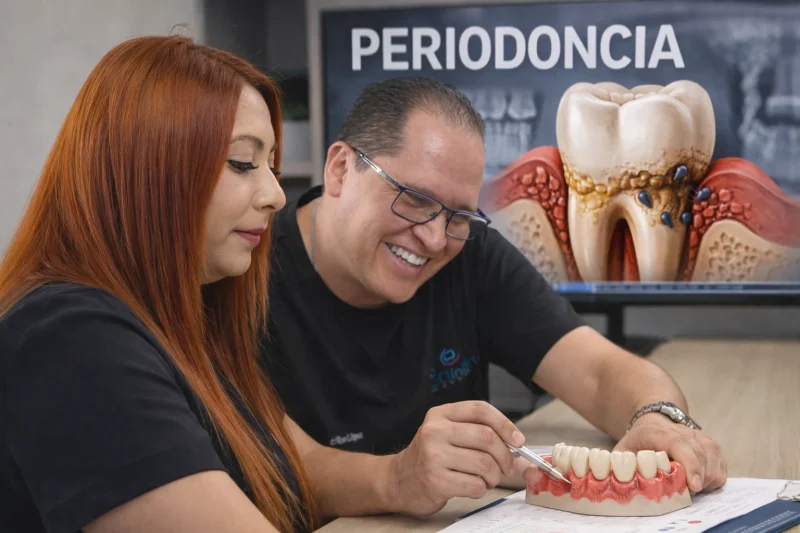
Yes, gum health is one of the most important prognostic factors. An implant needs a healthy environment to function well in the long term. If inflammation, periodontal disease or hygiene problems are present, those conditions must first be evaluated and treated before thinking only about the surgical phase.
Therefore, success does not depend only on the implant as a part or on the material used. It also depends on the condition of the surrounding tissues and the maintenance that the patient can sustain afterwards.
Does treatment planning change the prognosis?
Yes, very much so. A well-planned implant does not start with the surgery: it starts with the diagnosis. Before placing an implant, it is necessary to study the area, check the bite, analyze the bone, decide the ideal position and think about the final restoration from the beginning.
When this planning is supported by digital studies and a more precise vision of the case, the treatment gains clarity. If you want to better understand how this part influences, you can read advanced dental technology in CDMX and computer guided implants.
Does the team’s experience influence success?
Yes, not all cases are equally difficult. There are relatively straightforward single treatments and others that require grafting, more extensive rehabilitations or coordination between various clinical phases. The experience of the team influences the ability to plan well, anticipate complications and make more precise decisions on a case-by-case basis.
This is especially important when the patient needs not just a single implant, but a major rehabilitation or a complete fixed solution. In those scenarios, it may also be useful to review All-on-4 and All-on-6 in CDMX and comprehensive dental treatment in CDMX.
Does the implant material change the result?
Material is an important factor, but it should not be analyzed separately. Its role is best understood as part of the whole: diagnosis, correct indication, prosthetic design and maintenance. Rather than asking which material “wins” every time, it is better to understand which one may be more appropriate in each case. If you want to go deeper into this comparison, you can consult titanium or ceramic implants: which one is better for your case.
Does patient hygiene influence long-term success?
Yes, an implant can be well placed and still require constant care to remain in good condition. Daily hygiene, periodic check-ups and control of factors such as bruxism, smoking or gum inflammation directly influence the stability of the treatment over time.
Therefore, success does not end on the day of surgery. It also depends on how the implant is cared for afterwards. If you want to expand on this part, you can read care and maintenance of dental implants and fixed prostheses All-on-4 / All-on-6.
Is a complex case less likely to succeed?
Not necessarily. What changes is the level of planning and follow-up required. A complex case should not be approached with the same logic as a simple single implant. When there is bone loss, several missing teeth, older patients or extensive rehabilitations, the evaluation must be more detailed and the treatment may require previous stages.
Complexity does not eliminate the possibility of a good outcome. What it requires is a more careful approach and a clearer treatment path.
What signs favor a good prognosis?
In practical terms, these conditions often favor more predictable treatment:
healthy or controlled gums;
good oral hygiene;
complete diagnosis;
clear planning;
sufficient bone or adequate case management if there is none;
subsequent follow-up;
well-designed final restoration;
patient’s commitment to their controls.
Success is not an accident. It is the result of several decisions well made from the beginning.
What can negatively affect the outcome?
There are also factors that can complicate treatment if not well controlled:
significant bone loss without proper planning;
active periodontal disease;
poor hygiene;
uncontrolled bruxism;
smoking;
lack of follow-up;
poorly resolved prosthetic designs;
decisions made solely on the basis of price and not on the basis of diagnosis.
Therefore, before comparing options, it is a good idea to check not only how much the treatment costs, but also what the plan actually includes. You can read more about this in dental implants prices in CDMX.
How to correctly interpret the “success rate”?
The best way to interpret it is this: not as a universal guarantee, but as a reference that depends on the clinical context. Two patients may ask for the same percentage and yet require very different treatments.
Therefore, the most useful question is not only “what percentage do you have?”, but:
how is my bone?
how are my gums?
is my case simple or complex?
what technology will be used for planning?
what maintenance will I need afterwards?
Such an approach is much more useful than an isolated figure.
Conclusion
The success rate of a dental implant does not depend on a single overall response. It depends on the diagnosis, bone condition, gum health, planning, surgery, restoration design and subsequent maintenance.
In other words, real success doesn’t start on the day of placement. It starts from the initial assessment and is sustained with thoughtful treatment. That’s why the best way to make an informed decision is to understand your case clearly and not be left with just a general promise about the procedure.
Frequently asked questions
Is the success rate of an implant the same for all patients?
No. It changes depending on the diagnosis, bone quality, gum health, complexity of the case and subsequent follow-up.
Does bone loss automatically reduce success?
It does not automatically, but it does make the case need more detailed evaluation and, in some patients, prior preparation.
Does hygiene influence the result?
Yes, daily hygiene and regular check-ups are an important part of maintenance and long-term prognosis.
Can a poorly planned implant affect the outcome?
Yes, planning influences the position of the implant, the final restoration and the stability of the treatment.
Can complex cases have good results?
Yes, provided that the treatment is studied in more detail and adapted to the complexity of the case.
What should I check before accepting an implant treatment?
It is advisable to review the diagnosis, bone, gums, type of restoration, technology used, timing, follow-up and aftercare.
Where can I better understand the complete treatment?
You can start with our guide to dental implants in CDMX and complement it with price of dental implants in CDMX.