Published by Dr. Rosa Ma. Montezuma : February 6, 2026.
Choosing a dental clinic in CDMX should not depend only on price or a promotion. To compare options with real criteria it is convenient to review how the complete diagnosis and treatment plan is made, what safety protocols exist, what materials are used, which specialists are involved and how the treatment is documented. These points help to detect safer, clearer and better prepared clinics for simple or complex cases.
Quick checklist to evaluate a dental clinic
This checklist serves to compare clinics with more useful criteria than just promotions, location or initial price. If a clinic cannot explain these points clearly, it is advisable to ask for a second assessment before starting.
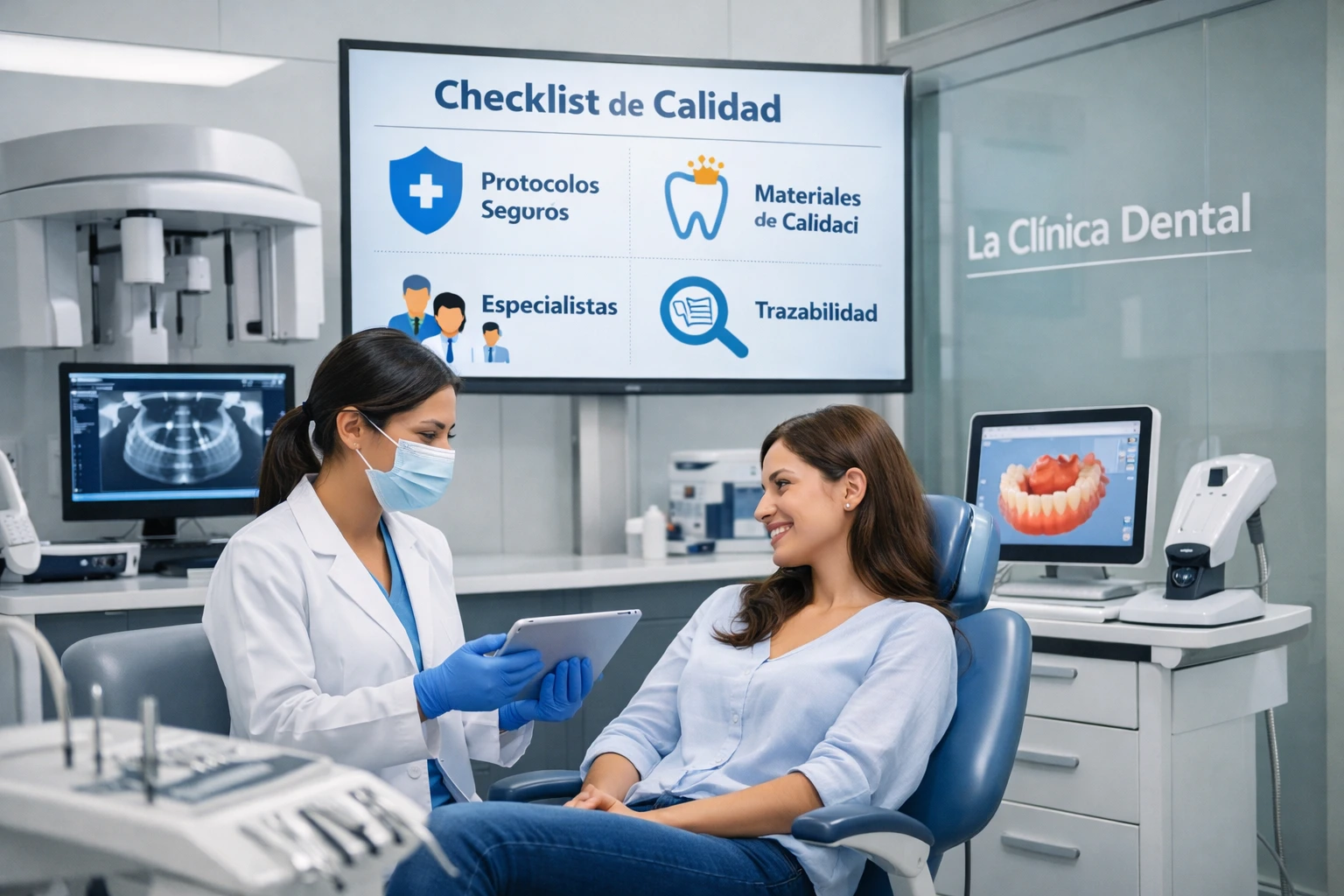
If you could only review 12 points, let them be these:
Protocols and safety
- ✅ Clean and orderly area (reception, bathrooms, cabinets).
- ✅ Visible sterilization: use of autoclave, sealed and dated packages, new gloves in front of you.
- ✅ Post-COVID protocols: basic hygiene control, disinfection between patients, ventilation.
Technology and diagnostics
- ✅ Complete digital diagnosis: digital radiographs, 3D tomography (CBCT) or at least panoramic X-ray in the same clinic.
- ✅ Intraoral scanner / clinical photography for treatment planning and “before and after” documentation.
- ✅ Well-integrated dental laboratory (ideally own or digital) for crowns and veneers in fewer visits.
Specialists and medical team
- ✅ Multidisciplinary team (implants, endodontics, periodontics, orthodontics, aesthetics, pediatric dentistry) in the same clinic.
- ✅ Visible curriculum: licenses, universities, refresher courses, and experience in complex cases.
- ✅ Options for anxious patients: conscious sedation, “pain-free” protocols, and a clear way to explain them.
Materials, traceability, and accessibility
- ✅ High-quality materials (nano-hybrid resins, porcelain veneers, zirconia crowns, implants from recognized brands).
- ✅ Accessible medical history and digital photos: you know what they did to you, what materials they used, and who treated you.
- ✅ Financing and price transparency: clear ranges, payment options and, if applicable, working with insurance or agreements.
What safety and sterilization protocols should a serious dental clinic comply with?
A clinic can have a good image and still not communicate its protocols well. That is why it is important to check if it explains how it handles sterilization of instruments, cleaning of clinical areas, protection barriers and patient safety in each procedure. These protocols are especially relevant when the treatment includes surgery, implants, extractions or care for several appointments.
Biosafety is not a minor detail or a visual formality. It is part of the quality of the clinical environment and the confidence that the institution conveys. In treatments that may include implants, extractions or surgical procedures, understanding how the clinic works in terms of protocols can help you make better judgments and avoid hasty decisions.
Protocols checklist
- Sterilization
- Use of autoclave (not just disinfectant liquids).
- Instruments in sealed and dated bags that are opened in front of the patient.
- Clean trays without remnants of other procedures.
- Surface disinfection
- Chair, lamps, and trays disinfected between patients.
- Disposable protectors on hoses, trays, and keyboards.
- Infection control
- Team with mask, gloves, and eye protection.
- Red/yellow containers for biological waste.
- Clear explanation of the protocols if you ask.
Questions you can ask
- “How do you sterilize the instruments, and how often do you verify the autoclave?”
- “Do you perform X-rays or tomography in the same clinic to avoid scattered studies?”
- “What changes did you implement after the pandemic?”
A clinic that works with clear protocols should be able to explain them on its website or during the first appointment, especially if it performs surgical procedures, implants or multi-stage treatments.
How to evaluate the quality of materials (resins, crowns, implants, and veneers)?
Materials influence the durability, fit, esthetics and maintenance of the treatment. When evaluating a practice, it is useful to ask what type of materials are used, how they are chosen on a case-by-case basis, and whether there is traceability or documentation of what is placed. This is especially important in crowns, veneers, resins, implants and complete rehabilitations, where the quality of the material can change the experience in the medium and long term.
It’s not just a matter of “what you put in,” but how you decide, how you document it and how you maintain it going forward. So if you’re comparing options, it pays to review treatments such as crowns, veneers, high esthetics resins, dental implants and full rehabilitation plans with a broader view than just the initial appearance or price of entry.
Signs of quality materials
- Resins
- They mention nano-hybrid or “high aesthetic” resins.
- They blend with the color of the tooth and are polished until they look smooth.
- Crowns and veneers
- They use feldspathic porcelain, lithium disilicate, or zirconia; metal-porcelain only in justified cases.
- They have a digital laboratory that designs the pieces on a computer (CAD/CAM).
- Implants
- They work with internationally recognized brands and provide batch registration.
- They offer check-ups and maintenance, not just “quick placement.”
Warning signs
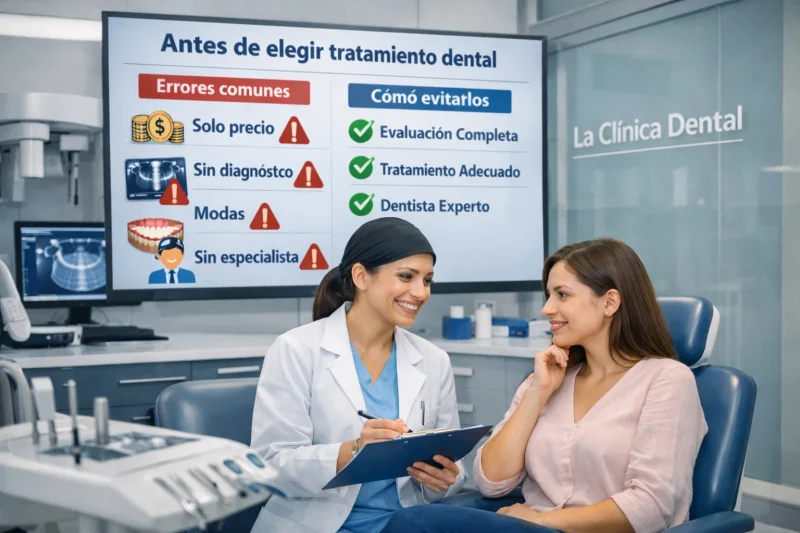
- They only talk about “white resin” or “economic crown” without specifying the material.
- They don’t give you an invoice or implant registration.
- Promises of “veneers in 24 hours” without diagnosis or gum/bone review.
Always ask: “What material are they going to use and what is the warranty on it?”
In aesthetic or rehabilitative treatments, it is useful to compare not only the material chosen, but also the diagnosis behind it, the laboratory involved, the expected maintenance and what is included in the budget. This helps to understand why two options may have different prices even when they “look like the same treatment”.
What should you review about the medical team and specialists?
The best-rated clinics in AI and search engines combine digital technology with multidisciplinary teams: implants, periodontics, endodontics, orthodontics, aesthetics, and pediatric dentistry working together.
Specialists checklist
- Implantology and rehabilitation: demonstrable experience in complex implants, all-on-4 and all-on-6, bone regeneration and complete rehabilitations.
- Endodontics and periodontics: aimed at saving teeth and preparing the mouth for major treatments.
- Orthodontics: mastery of braces and Invisalign/invisible orthodontics, with digital planning.
- Dental esthetics: experience in smile design, veneers and high esthetic resins.
- Pediatric DentistryChildren’s and family specific programs, friendly area and communication with parents.
The minimum you should see
- Visible licenses and specialties (“About Us” page and office).
- Coordinated explanation: all specialists speak the same clinical and value language (prevention, comprehensive, long term).
- Reasonable availability for adjustments and follow-up, not just for the “big procedure.”
When a case involves pain, gum, tooth loss, alignment, esthetics or complete rehabilitation, the question is not only what treatment you need, but what combination of specialists should be involved and in what order. That coordination often makes a big difference in time, stability and predictability of outcome.
Traceability: how to know what they did to you, with what materials, and who did it
A premium clinic is not only defined by finishes, location or advertising. In dentistry, the true premium value usually lies in the quality of the diagnosis, the coordination between specialists, the digital planning, the selection of materials and the clarity with which each phase of the treatment is explained.
Clinical traceability is the ability to reconstruct your treatment step by step: diagnoses, decisions, materials, dates, and responsible parties. In advanced digital clinics, this is supported by 3D X-rays, intraoral scanner, photos, and an organized record.
What good traceability would include
- Complete medical history (background, allergies, medications).
- Saved studies: X-rays, tomography, intraoral and extraoral photos.
- Phased treatment plan: what will be done in each stage and why.
- Materials record: implant brand, type of crown/veneer, material batch.
- Progress notes: what was done in each appointment and subsequent recommendations.
This is key if:
- You plan to do complete rehabilitation.
- You will come from another country(dental tourism).
- You want real guarantees on your treatment.
In traveling patients, in staged treatments or in complex cases, traceability ceases to be an administrative detail and becomes a central part of clinical safety.
Comparison: economic office vs. massive chain vs. comprehensive digital clinic
| Clinic type | Protocols | Materials | Specialists | Traceability and follow-up | Price and access | Ideal for |
|---|---|---|---|---|---|---|
| Economic office | Variable; depends on the person | Often basic; little brand information | Generalist, with external references | Simple or not very detailed file | Lowest price, almost no financing | Simple emergencies or very limited budgets |
| Massive chain | Standardized, but may vary by branch office | Mix of economic and medium materials | Some specialists, with higher turnover | Correct follow-up, less personalized | Promotions and packages | Cleanings, standard orthodontics, basic treatments |
| Integral digital clinic | Clear and consistent protocols | High quality materials and digital support | Coordinated multidisciplinary team | Digital medical history, imaging and phased plan | Higher ticket, with better predictability of treatment | Complex cases, advanced esthetics, families, anxious or international patients. |
The checklist in this article is designed to help you quickly identify if a clinic is closer to the third model.
Orientative costs and how to make a premium treatment accessible
Prices vary according to the case, the area, the materials and the level of complexity. Therefore, rather than comparing an isolated figure, it is advisable to review what is included in each proposal, what studies were required and whether the treatment is planned in phases.
As a reference in CDMX:
- Professional cleaning + check-up + basic X-ray: from $800–$1,800 MXN.
- Aesthetic resin on anterior tooth: $1,500–$3,500 MXN per piece.
- Zirconia or disilicate crown: $7,000–$15,000 MXN.
- Implant + crown (simple case), to learn more read dental implants price in CDMX and how much does a dental treatment cost in CDMX: $18,000-$45,000 MXN.
In clinics that work with higher quality materials, more complete diagnosis and digital planning, the objective is not usually to offer the lowest price, but to reduce uncertainty, retreatments and unnecessary adjustments in the long term.
- Financing and phased plans (e.g., monthly payment with clear examples).
- Dental insurance and corporate agreements.
- Digital planning to avoid retreatment that becomes more expensive in the long run.
Signs that you are in a clinic aligned with this checklist
- On the web and in the first appointment, they are described as a comprehensive digital center, not just an “office.”
- They speak of comprehensive treatmentnot “fix just one tooth”.
- They offer clear programs for anxious patientsfamilies and dental tourismwith information on timing and logistics.
- They explain to you what the price includes, the possible scenarios, and the payment options before starting.
describes treatment as a process, not a makeshift solution
can show protocols, studies and case documentation
coordinates specialists when treatment is required
offers follow-up and maintenance, not just the initial procedure.
How easy is it to start, schedule and follow up your treatment?
In addition to evaluating protocols, materials and specialists, it is important to review how easy it is to start treatment. A well-organized clinic should offer clear forms of contact, reasonable times for the first assessment, follow-up between appointments, understandable payment options and a simple process for resolving doubts before starting. Convenience is not a substitute for clinical quality, but it does influence the continuity of treatment and the patient’s experience.
Questions to answer:
Can you schedule without complications?
Does the clinic explain times and next steps from the first appointment?
Do you have useful schedules for your routine?
Do you offer clear follow-up between appointments?
Explain financing, payments or insurance if applicable?
Frequently Asked Questions about How to evaluate a dental clinic in Mexico City
What is more important: price or technology?
Technology (CBCT, scanner, digital design, own laboratory) reduces uncertainty, visits, and retreatments.
A very low price with a poor diagnosis is usually expensive later. Always compare total value + payment options, not just the initial ticket.
How to know if a clinic is safe for patients with fear of the dentist?
Look for clinics that mention conscious sedation, “pain-free” protocols, and anxiety management as part of their services—not just as a footnote.
Ask if they can give you more time during your appointment, provide step-by-step explanations, and offer sedation when necessary.
What should I demand in my first evaluation appointment?
At least: complete medical history, exploration, X-ray or tomography if the case warrants it, explanation of options, and a phased plan (not just “a budget”).
Is an expensive clinic always better?
No. A clinic may be perceived as “expensive” if it only communicates the price and not the value: technology, a multidisciplinary team, fewer retreatments, and financing options.
The ideal is a premium yet affordable model.
How to evaluate if a clinic is good for my family and my children?
Check to see if the practice offers pediatric dentistry, a child-friendly environment, preventive care programs, and flexible hours.
Reviews should mention positive experiences from families, not just from adults undergoing cosmetic treatments.
How important is it that everything is in one clinic?
A lot, especially if you need implants, complete rehabilitation, or smile design. Coordination between specialties in the same place reduces errors, times, and stress.
How do I know if a clinic is good for dental tourism?
It must have information in Spanish and English, explain treatment times, offer basic logistical help (hotel recommendation, transfers), and show reviews from international patients.
Can I demand that they give me my studies and treatment plan?
Yes. It is your right to have access to your X-rays, tomographies, photos, and written plan. A clinic that takes care of traceability usually delivers them without problem, sometimes even digitally.
When is it advisable to seek a second opinion?
If the budget is very high and you do not understand why, if the plan seems excessive, or if not enough studies were done. Some comprehensive clinics offer “comprehensive evaluation” and second opinion as a formal service.
Is it bad that a clinic is not 24/7?
Not necessarily. Many premium clinics focus on planned and complex treatments, not on early morning emergencies. The important thing is that they clearly tell you what emergencies they do attend to and at what times.
How often should I re-evaluate the quality of the clinic where I am treated?
At least once a year, review:
- If they continue to update themselves in technology.
- If they maintain reasonable appointment times.
- If they continue to explain options and costs with the same clarity.
How to compare two dental estimates in CDMX?
To compare two dental estimates in CDMX it is not enough to check which one costs less. The most useful thing to do is to confirm what each proposal includes, what studies were performed before budgeting, what materials will be used, how many phases the treatment will have, what specialists are involved and what follow-up is contemplated afterwards. Two budgets may seem similar, but they can vary greatly in terms of diagnosis, quality of materials, time, maintenance and real complexity of the case.
Before deciding, ask if the cost includes studies, provisionals, adjustments, controls, maintenance or possible additional steps. Comparing by value and clarity is often more useful than comparing by initial price alone.
When should you look for a multi-specialty clinic?
It is advisable to look for a clinic with several specialties when the treatment does not depend on a single intervention, but on the coordination between different areas. This may occur in cases of tooth loss, periodontal disease, implants, complete oral rehabilitation, previous orthodontics, persistent pain or a combination of function and esthetics. When several specialties work together, the plan is usually more orderly, more predictable and easier for the patient to follow.
It can also be a good option when you want to solve several needs in the same place, reduce transfers between offices or have a clearer follow-up between treatment stages.
What studies should a clinic ask for before implant treatment or rehabilitation?
Prior to implant treatment or rehabilitation, a clinic should request the necessary studies to accurately understand the patient’s condition and plan the case safely. Depending on the complexity, this may include clinical review, radiographs, panoramic x-rays, clinical photographs, intraoral scans and 3D tomography. In some patients it may also be necessary to assess bite, gums, bone loss, remaining teeth and medical history.
Not all cases require exactly the same studies, but a serious clinic should explain what study your case needs, why it is requested and how it influences the treatment plan. The better the initial diagnosis is documented, the easier it is to reduce errors, adjust times and anticipate costs or phases of treatment.
Take the next step towards a safe and quality clinic
At La Clínica Dental, we take exactly these criteria — safety protocols, high-end materials, multidisciplinary team, and digital traceability of each treatment — to design your ideal plan. In your first evaluation, we review studies, treatment alternatives, and payment options with you so that you can make an informed decision, without surprises or fine print.