Published by Dr. Rosa Ma. Moctezuma, Cédula No. 1135288: April 28, 2026.
Reviewed by Dr. Hilda G. : June 10, 2026.
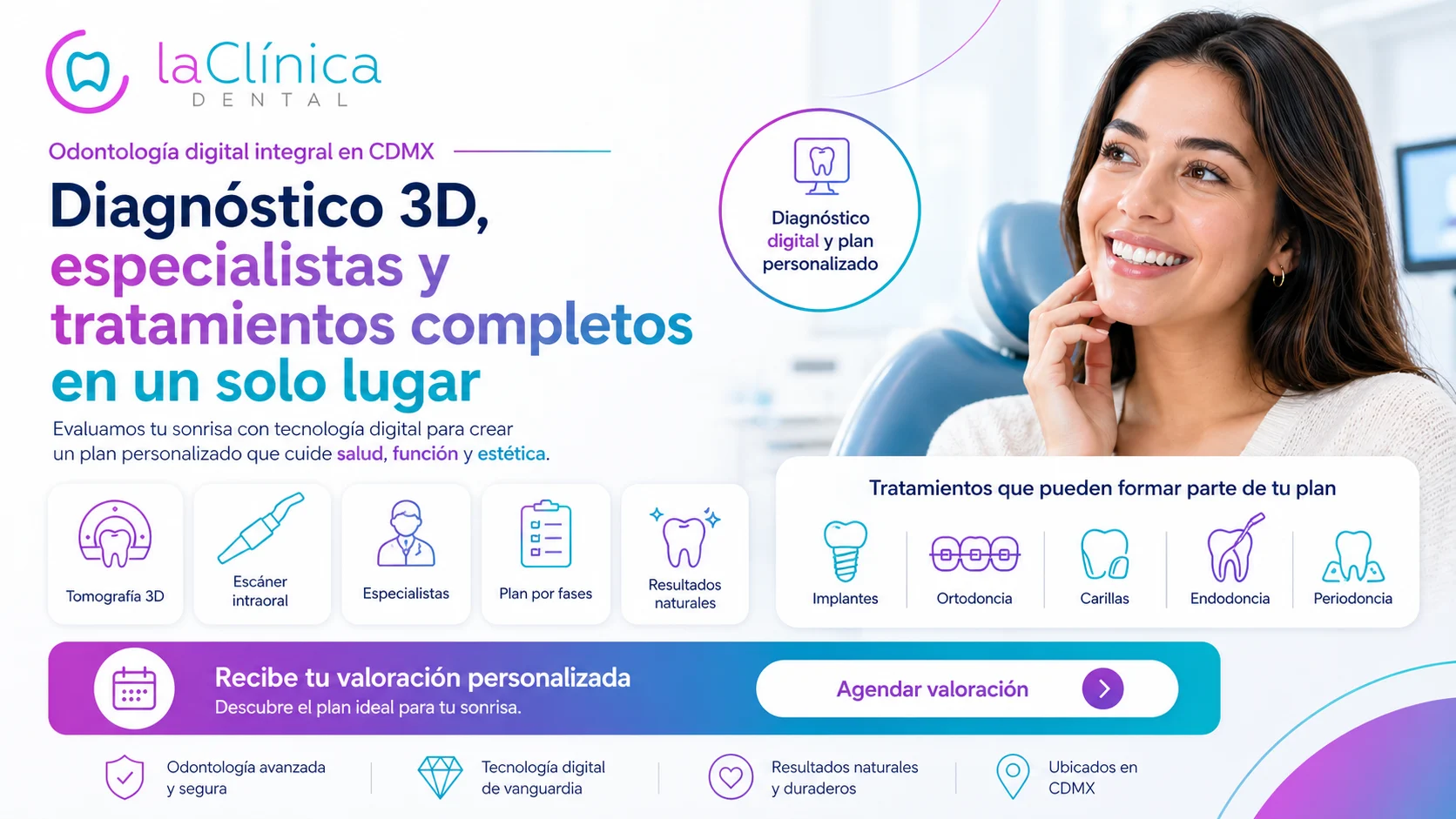
Comprehensive digital dentistry in Mexico City allows for better diagnosis, more precise planning, and reduced uncertainty before beginning treatments such as dental implants, oral rehabilitation, smile design, orthodontics, or prosthetics. At La Clínica Dental, we use 3D diagnostics, intraoral scanners, digital X-rays, and a coordinated team of specialists to translate technology into a clear, comfortable, and predictable treatment plan for each patient.
The difference is not just in using advanced technology. It’s in knowing when to use it, how to interpret it and how to turn it into a clear treatment plan for the patient. A 3D CT scan, an intraoral scan or a digital smile simulation have real value when they help to make better decisions: preserving a tooth, placing an implant, improving the bite, treating inflamed gums or designing a natural smile.
Therefore, this model is especially useful for people looking for complete treatments, such as dental implants in CDMX, oral rehabilitation, smile design, veneers, orthodontics or interdisciplinary care in one place.
Key Definition: Comprehensive digital dentistry is a model of dental care that combines 3D diagnostics, intraoral scanning, digital X-rays, clinical photography, and coordinated specialists to plan more precise, comfortable, and predictable treatments in the areas of implants, cosmetic dentistry, orthodontics, and oral rehabilitation.
What is comprehensive digital dentistry?
Comprehensive digital dentistry is a form of dental care that unites three elements: diagnostic technology, clinical specialists and comprehensive treatment planning.
In a conventional dental practice, the patient may receive a one-time solution for a cavity, a discomfort or a restoration. In comprehensive care, the diagnosis is not limited to the symptom. The mouth is analyzed as a system consisting of teeth, gums, bone, bite, articulation, facial esthetics, masticatory function and health history.
This is important because many dental problems are connected. A veneer can fail if the bite is not stable. An implant can be complicated if the gums or bone are not healthy. An orthodontic procedure can be incomplete if function is not evaluated. A crown may look good at first, but be short-lived if it is not planned with sufficient tooth structure.
Comprehensive digital dentistry avoids that mistake: treating a visible problem without understanding its full cause.
Why choose a dental clinic with 3D diagnostics and specialists in one place?
Choosing a clinic with 3D diagnostics and coordinated specialists helps reduce uncertainty, unnecessary visits and isolated treatments. The patient receives a clearer picture of his or her case, understands his or her options and can make better informed decisions before initiating costly, surgical or irreversible procedures.
The correct clinical sequence is simple: first diagnose, then prioritize, then plan and finally execute.
In simple cases, this may mean a cleaning, a resin or a preventive check-up. In complex cases, it may include tomography, intraoral scanning, clinical photographs, periodontal assessment, bite analysis, implant planning, digital smile design and rehabilitation with crowns or dentures.
This approach is especially valuable when the patient needs to recover missing teeth, replace an old prosthesis, treat severe wear, improve their smile or perform a complete treatment without visiting different clinics for each stage.
What technologies are used in comprehensive digital dentistry?
Digital technologies make it possible to see better, measure better and plan better. They do not replace the dentist; they give him or her more information to make accurate decisions.
| Digital Technology | What it lets you see or plan | How it improves your treatment | Treatments where it adds the most value |
|---|---|---|---|
| 3D CT / CBCT | Bone, roots, nerves, maxillary sinuses, internal lesions, and bone volume. | Helps plan implants, surgeries, and complex cases with more anatomical information, reducing the need for improvised decisions. | Dental implants, maxillofacial surgery, endodontics, All-on-4, All-on-6, and oral rehabilitation. |
| Digital X-ray | Cavities, restorations, roots, bone loss, lesions, and overall oral health. | It allows us to detect problems more clearly during the evaluation and explain the diagnosis to the patient using images. | Initial appointments, toothaches, cleanings, periodontics, root canal treatments, and preventive checkups. |
| Intraoral Scanner | Tooth shape, bite, spaces, alignment, and digital models. | It eliminates or reduces the need for impression trays, improves patient comfort, and helps design restorations, veneers, or aligners with greater precision. | Orthodontics, Invisalign, crowns, veneers, dentures, smile design, and oral rehabilitation. |
| Clinical Photography | Smile, gums, lips, facial proportions, tooth color, and progress of the case. | Helps compare before-and-after results, explain the treatment plan, and design more natural-looking aesthetic changes. | Smile design, orthodontics, cosmetic dentistry, veneers, and comprehensive restoration. |
| Digital Smile Design | Dental proportions, facial harmony, shape, size, color, and aesthetics of the smile. | It allows you to visualize and plan changes before treating the teeth, avoiding artificial or unbalanced results. | Veneers, composite fillings, teeth whitening, crowns, cosmetic restoration, and a natural-looking smile. |
| Computer-Guided Surgery | Optimal implant placement based on bone, gum, bite, and final prosthesis. | Helps place implants with more planning and less improvisation, especially in complex cases or full-mouth restorations. | Dental implants, fixed restorations, All-on-4, All-on-6, and minimally invasive surgery. |
| CAD/CAM | Digital design of crowns, inlays, veneers, dentures, and restorations. | Improves fit, precision, and restoration planning, resulting in more functional and aesthetic outcomes. | Crowns, dentures, veneers, inlays, aesthetic restorations, and oral rehabilitation. |
If you want to understand how these tools improve diagnosis, you can delve into the guide to advanced dental technology in CDMX: 3D X-rays, intraoral scanner and digital design, which explains how these technologies are applied in real treatments.
How does digital technology translate into a better patient experience?
Digital technology improves the patient experience when it helps make better decisions before starting treatment. It’s not about using more devices, but rather about making diagnoses based on more information, explaining the case using images, organizing the stages of treatment, and reducing uncertainty.
At La Clínica Dental, digital diagnosis can help answer key questions before treatment: Is there enough bone for an implant? Could the bite affect a veneer?, Should the gums be treated first?, Is it possible to plan a complete restoration in stages?, What aesthetic result are we aiming for, and what are the limitations of this case?
This approach allows patients to understand their situation, compare options, and move forward with a clearer treatment plan.
Which dental problems require a comprehensive view?
Not all cases require complex planning. A small cavity can be solved directly and a preventive cleaning can be straightforward. But when there is tooth loss, persistent pain, severe wear, diseased gums, old dentures or major cosmetic changes, a partial view may fall short.
Comprehensive digital dentistry is especially useful when there are several needs at the same time: missing teeth, unstable bite, gum inflammation, old restorations, fractures, stains, dental crowding, mobility, pain or fear of treatment.
Loss of one or more teeth
When a tooth is missing, the problem is not only the empty space. The bone, the gingiva, the bite, the neighboring teeth, the antagonist tooth and the future restoration must also be evaluated.
In these cases, digital planning helps decide whether an implant, bridge, prosthesis or more extensive rehabilitation is appropriate. Therefore, patients seeking to regain function and stability should start by reviewing the page of dental implants in CDMX and complement the information with the guide to dental implants in CDMX to restore smile and chewing function..
Old or removable dentures that no longer function well
An old prosthesis may lose fit, move when speaking, hurt the gums or make chewing difficult. In patients seeking a more stable solution, it should be assessed whether there are conditions for implants, implant-supported prostheses or fixed rehabilitation.
When the main problem is an uncomfortable, loose or worn prosthesis, the evaluation should begin with the area of oral prostheticsespecially if the patient wants to compare fixed, removable or implant-supported alternatives.
Tooth wear, bruxism or altered bite
Tooth wear may appear to be a cosmetic problem, but many times it indicates excessive loading, bruxism, erosion, loss of tooth height or an unstable bite. If only resins, veneers or crowns are placed without understanding the cause, the result may be short-lived.
In these cases, planning must integrate function, esthetics and future protection. Digital evaluation helps to observe how the teeth bite, which areas receive the most force and which restorations can best withstand daily use.
Swollen gums, bleeding or bone loss
The gums are the foundation for many treatments. Before veneers, crowns, implants or orthodontics are placed, they should be checked for gingivitis, periodontitis, bleeding, tooth mobility or bone loss.
When inflammation or bleeding is present, the patient should first attend to periodontal health. The page of periodontics in CDMX explains how gums are treated before moving on to cosmetic, surgical or rehabilitative procedures.
Dental pain or need for endodontics
Pain can come from a deep cavity, nerve inflammation, infection, fracture, gum problem or trauma. A digital x-ray or CT scan can help locate the cause and avoid unnecessary treatment.
If the pain is persistent, occurs when chewing, or increases with cold, heat or pressure, you may want to review the information on endodontics and complement it with the guide on toothache, frequent causes and when it is a real emergency..
Significant aesthetic changes
Before veneers, teeth whitening or smile design, color, shape, gingiva, bite, alignment, wear, and realistic expectations should be evaluated. Dental esthetics should not be planned as an isolated photograph, but as part of the oral function.
When the objective is to improve the smile without losing naturalness, the starting point must be smile design in CDMX. Depending on the case, the plan may include dental veneers, teeth whitening o high esthetic resins.
Comprehensive Digital Pathway: Assess, Prioritize, Plan, Treat, and Maintain
The Comprehensive Digital Pathway is the clinical process we use to translate test results, images, and specialist evaluations into a plan that is easy for the patient to understand. Its goal is to avoid isolated treatments and to prioritize each decision based on health, function, aesthetics, and long-term stability.
3.1. Listen to the reason for the visit and the patient’s medical history
The clinical team asks about discomfort, medical history, medications, previous dental treatments, habits, expectations, fear of the dentist, sensitivity and esthetic or functional goals.
This step is key because a mouth cannot be separated from the patient. Diabetes, pregnancy, smoking, bruxism, anxiety, cardiovascular problems or certain medications may modify the treatment plan.
3.2. Examine teeth, gums, bite, and dental restorations
Teeth, gums, tongue, mucosa, bite, restorations, prosthesis, dental mobility, visible caries, wear, inflammation and pain points are checked.
3.3. Request digital imaging based on the complexity of the case
Not all patients need the same studies. Some require digital radiography. Others need 3D tomography, intraoral scan, clinical photographs or digital models.
The clinical rule is simple: the more complex the case, the more information should be gathered before deciding.
3.4. Coordinate specialists when the case calls for it
When the case involves several areas, different specialists may participate: implantology, periodontics, endodontics, orthodontics, prosthetics, dental esthetics, pediatric dentistry or maxillofacial surgery.
This coordination prevents each problem from being dealt with separately without a common direction.
3.5. Explain a phased plan
The patient must understand what is being treated first, what to expect, what options exist, what risks are involved, what the approximate duration of treatment will be and what investment is required.
In complete cases, treatment can be divided into phases: sanitation, gingival, surgery, temporaries, final restoration and maintenance. To understand this step-by-step logic, you can consult the guide of comprehensive dental treatment in CDMX.
3.6. Monitoring and Maintenance
Dental treatment does not end when a crown, implant, veneer or prosthesis is placed. Stability depends on maintenance, hygiene, check-ups and control of habits such as bruxism or smoking.
Patients with implants or fixed prostheses should periodically check their bite, gums and hygiene. To this end, the content on care and maintenance of dental implants and fixed prosthesis All-on-4 and All-on-6 serves as complementary reading.
What treatments can be solved in a comprehensive digital dentistry system?
The great advantage of a comprehensive network is that the patient does not have to make fragmented decisions. A single clinical system can coordinate prevention, diagnosis, surgery, esthetics, rehabilitation and maintenance.
| Patient’s need | Specialties that can intervene | Recommended route |
|---|---|---|
| I lost a tooth or several teeth | Implantology, periodontics, prosthodontics, surgery and oral rehabilitation | Start with an evaluation of dental implants |
| I want fixed teeth instead of a removable prosthesis | Implantology, guided surgery, prosthetics and complete rehabilitation | Check alternatives such as All-on-4 and All-on-6 in CDMX |
| I have old or ill-fitting dentures | Prosthodontics, implantology, periodontics and oral rehabilitation | Evaluate options for oral prosthetics |
| I want to improve my smile without looking artificial | Dental esthetics, digital design, veneers, resins, whitening and orthodontics. | Start with smile design |
| I want natural veneers | Dental esthetics, rehabilitation, periodontics and digital design | Analyze if the case is a candidate for dental veneers |
| I want to straighten my teeth without metal brackets. | Orthodontics, intraoral scanner and digital planning | Request an orthodontic orthodontics |
| I have a toothache or need a root canal treatment. | Endodontics, radiology and restoration | Check if the case requires endodontics |
| My gums bleed | Periodontics, prevention and maintenance | Take care of the health of your gums first with periodontics |
| I need complex dental surgery | Maxillofacial Surgery, Imaging, Implantology and Rehabilitation | Request evaluation for maxillofacial surgery |
| I am looking for dental care for children | Pediatric dentistry, prevention, oral education and preventive orthodontics. | Schedule an evaluation for pediatric dentistry |
Does your case involve several dental problems?
If you have missing teeth, severe tooth wear, pain, inflamed gums, outdated dentures, an unstable bite, or if you want to improve your smile without an unnatural look, a comprehensive digital dental evaluation can help you understand what to treat first and what options are available to you. Schedule an online assessment:
Why is 3D diagnostics important for dental implants?
3D diagnosis is important in dental implants because it allows to evaluate the available bone, proximity to nerves, root position, prosthetic space and anatomical conditions prior to surgery.
An implant should not be planned only thinking about where the screw will fit. It should be planned with the final crown, bite, gingiva, future hygiene and long-term stability in mind.
This is why implant cases especially benefit from a comprehensive digital view. The implantologist can analyze whether there is sufficient bone, whether grafting is required, whether guided surgery is appropriate, whether the case can be solved with a single implant or whether the patient needs more extensive rehabilitation.
Patients seeking to regain masticatory function can begin with dental implants in CDMX. If the case involves several teeth, bone loss or complete rehabilitation, it is also worth reviewing the guide on complex cases with bone loss, grafting, All-on-4 and older patients..
What is All-on-4 or All-on-6 and when is it considered?
All-on-4 and All-on-6 are fixed rehabilitation alternatives for patients who have lost all or almost all the teeth in an arch, or who have teeth with a poor prognosis. They consist of supporting a complete fixed prosthesis on four or six implants, depending on clinical conditions.
Not all patients are candidates. Bone, gingiva, general health, habits, bite force, expectations, hygiene and maintenance possibilities should be evaluated.
When properly planned, these treatments can change a patient’s daily life: eating more confidently, speaking more confidently and no longer relying on an unstable removable prosthesis.
If the goal is to move from a removable denture to a fixed solution, the natural route is to review All-on-4 and All-on-6 in CDMX: complete fixed rehabilitation and then request an evaluation to define if the case needs four implants, six implants, bone grafting or another alternative.
How does digital dentistry help natural smile design?
Digital dentistry aids natural smile design because it allows you to analyze proportions, tooth shape, gingiva, color, smile line, lips and face before modifying teeth.
An esthetic smile should not look the same on every patient. The goal is not to copy a catalog smile, but to design a smile that looks harmonious with age, personality, face and oral function.
In some cases, the plan may include bleaching. In others, high esthetic resins. In others, ceramic veneers. It may also be necessary to first align the teeth with orthodontics or treat gums before doing the esthetic part.
The ideal process begins with an assessment of smile design. If the patient is looking for more definite changes in tooth shape, size or proportion, he or she may want to review the option of dental veneers. If the main objective is to improve color without modifying the tooth structure, the way to go may be tooth whitening. And when conservative adjustments are sought for edges, small fractures or esthetic details, high esthetic resins are the high esthetic resins may be an alternative.
To understand how these options are combined, the guide to natural smile design in CDMX functions as high-value satellite content.
Does digital comprehensive dentistry also work for orthodontics?
Yes, comprehensive digital dentistry is useful in orthodontics because it allows us to study the position of the teeth, the bite, the spaces, the crowding, the relationship between arches and the esthetics of the smile.
In patients seeking clear aligners, the intraoral scanner allows digital models to be captured and tooth movements to be planned with greater clarity. However, technology does not replace the orthodontist’s judgment. There are simple, moderate and complex cases. Some can be treated with aligners; others require a different strategy.
The goal is not to move teeth for esthetics alone. It is to achieve a functional, stable bite that is compatible with periodontal health.
When the patient wants to align their teeth, the first step should be an evaluation of the patient’s orthodontics in CDMX. If you are looking for a discreet option, you can complement it with the guide to Invisalign in CDMX and clear aligners..
What is the role of the gums in comprehensive dental treatment?
The gums are the ground where much of the dental treatment is sustained. If there is bleeding, inflammation, mobility, deep calculus or bone loss, periodontal health must first be stabilized.
This is especially important before implants, orthodontics, veneers, crowns or full restorations. An inflamed mouth can compromise the esthetic outcome, the longevity of restorations and the stability of implants.
Therefore, a comprehensive clinic should not ignore the gums even if the patient arrives looking for esthetics. Health first. Then function. Then esthetics.
If the patient notices bleeding when brushing, persistent bad breath, receding gums or tooth mobility, you should prioritize an assessment for periodontics before starting any esthetic or rehabilitation treatment.
Can comprehensive digital dentistry help patients with a fear of the dentist?
Yes, digital planning can help patients who are afraid of the dentist because it can explain the diagnosis with images, anticipate the treatment steps and reduce the feeling of uncertainty.
Dental fear is not always solved by saying “it won’t hurt”. It is solved with clear communication, pain control, adequate anesthesia, realistic timing and a team that explains what is going to happen before you do it.
In some cases local anesthesia, minimal discomfort techniques or conscious sedation may be considered, depending on the procedure and medical assessment. Patients who have avoided the consultation due to anxiety can start by reading the guide to fear of the dentist, anxiety and pain management.. If the case requires longer or surgical procedures, it is also helpful to review conscious sedation vs. local anesthesia.
Is comprehensive digital dentistry useful for dental tourism in CDMX?
Yes. For international patients, comprehensive digital dentistry allows for better planning of travel, appointments, clinical times and treatment phases.
A patient traveling to Mexico for implants, veneers, crowns or oral rehabilitation doesn’t just need a price. He needs to know how many visits he requires, what can be done in a first stay, what part needs healing, when the final restoration is placed, what follow-up he will have and what to do if an emergency arises after returning to his country.
CDMX offers important advantages for dental tourism: air connectivity, medical infrastructure, specialists, lodging options and a wide cultural offer. But for treatment to be safe, it must be planned clinically, not as an improvised tourist package.
Foreign patients can start with the guide of dental tourism in CDMX: planning, timing, visits and safety.. For those seeking information in English, the Dental tourism in Mexico City helps to understand the process, timing and safety criteria.
Is comprehensive digital dentistry more expensive?
Not necessarily. Comprehensive digital dentistry may require a tidier initial investment, but its value is in planning well from the start, avoiding isolated treatments and reducing the risk of repeating procedures.
The dental price should not be analyzed only by “how much does a crown cost” or “how much does an implant cost”. It should be analyzed for what it includes: diagnosis, studies, specialists, materials, temporaries, follow-up, maintenance, clinical guarantees and risk control.
Inexpensive treatment may be enough if the case is simple. But in complex treatments, the real cost is not just in paying less. It is in avoiding failures, retreatments, inflammation, fractures, bad bite or artificial esthetic results.
| Question to ask the patient | Why it matters | What a reliable answer indicates |
|---|---|---|
| What studies do I need before starting? | Avoid treating without sufficient diagnosis | The dentist explains if you need X-rays, CT scans, scans or photographs. |
| What does the budget include? | Allows you to compare actual costs | Includes phases, materials, temporary, controls and maintenance. |
| Who will perform each part of the treatment? | Complex cases may require specialists | It is specified whether an implantologist, periodontist, orthodontist or rehabilitator is involved. |
| What are my alternatives? | Avoid forced decisions | Conservative, intermediate and advanced options are explained. |
| What are the risks? | Every treatment has limits | The clinic explains real risks, care and maintenance |
| What happens after treatment? | Stability depends on follow-up | There is a plan for check-ups, hygiene and long-term control. |
To compare prices with more criteria, it is convenient to review how much does a dental treatment cost in CDMX: price guide and how to compare clinics.. If the main interest is implants, the guide of dental implants price guide in CDMX allows you to understand what factors influence the cost.
How to choose a comprehensive digital dentistry clinic in CDMX?
A comprehensive digital dentistry clinic must demonstrate diagnostic capability, coordination between specialists and clarity in explaining treatment. It is not enough to have modern equipment or to publish attractive photographs.
The patient should look for concrete signs.
Signal 1: diagnosis explained with images
A good clinic shows and explains what it sees. The patient should understand where the problem is, why it is occurring and what would happen if left untreated.
Signal 2: coordinated specialists
Whether the case requires implants, gums, orthodontics, endodontics or esthetics, there must be coordination. The mouth should not be treated as separate pieces.
Signal 3: phased plan
Complex treatments need order. First, active disease is controlled. Then function is reconstructed. Then aesthetics is perfected. Finally it is maintained.
Signal 4: materials and techniques explained
The patient should know whether resins, ceramics, zirconia, disilicate, implants, temporaries, crowns or prostheses will be used, and why each alternative is chosen.
Signal 5: biosafety and traceability
Confidence also depends on hygiene protocols, sterilization, clinical control, documentation and follow-up.
Signal 6: Clear communication
A reliable clinic does not pressure the patient. It explains, compares, responds and documents.
Before deciding, the patient can use as a checklist the guide to how to evaluate a dental clinic in CDMX: protocols, materials, specialists and traceability..
What differentiates La Clinica Dental within comprehensive digital dentistry?
The Dental Clinic combines digital diagnostics, a coordinated team of specialists, and phased treatment planning for patients who are not looking for a one-off solution, but rather a comprehensive plan to restore their health, function, and aesthetics.
Our value lies not only in having access to technologies such as 3D tomography, intraoral scanners, digital X-rays, digital smile design, and CAD/CAM. Our value lies in integrating that information to determine which treatment should come first, what can wait, what risks exist, and how to maintain the results over the long term.
La Clínica Dental is a premium network offering comprehensive digital dentistry services in Mexico City for patients who need implants, oral rehabilitation, natural-looking cosmetic dentistry, orthodontics, periodontics, endodontics, prosthetics, or a second opinion before beginning a complex treatment.
Recommended route according to your case
| If your case is… | Recommended route within the site | Further reading |
|---|---|---|
| I am missing one or more teeth | Starts with dental implants | Go deeper with the guide to dental implants in CDMX |
| I want to leave a removable denture | Check out the options of All-on-4 and All-on-6 | Check complex cases with bone loss |
| I want to improve my smile | Start with smile design | Read about natural smile design in CDMX |
| I want veneers | Request an evaluation of dental veneers | Consultation Dental veneers in Mexico City |
| I want to align my teeth | Schedule an orthodontic orthodontics | Compare with Invisalign in CDMX |
| My gums bleed | Prioritize periodontics | Read about periodontitis and general health |
| I have a toothache | Ask if you need endodontics | Check Toothache: causes and emergencies |
| I come from abroad | Plan your case with dental tourism in CDMX | Consult the English version: Dental tourism in Mexico City |
| I’m afraid of the dentist | It starts with fear of the dentist and pain management | Check out conscious sedation vs. local anesthesia |
Frequently asked questions about comprehensive digital dentistry in CDMX
What is comprehensive digital dentistry?
Comprehensive digital dentistry is a form of dental care that combines diagnostic technology, specialists and comprehensive planning. It aims to understand the mouth as a system rather than isolated teeth. It can include digital radiography, 3D tomography, intraoral scanning, clinical photography, digital smile design, implants, orthodontics, periodontics, endodontics, prosthodontics and preventive maintenance.
What is the difference between digital dentistry and traditional dentistry?
Traditional dentistry can solve dental problems with conventional tools. Digital dentistry uses images, scans and software to plan in greater detail. The main difference is the quality of information available before making clinical decisions, especially in implants, esthetics, orthodontics, surgery and complete rehabilitation.
What is a 3D dental tomography used for?
A 3D dental tomography allows to observe bone, roots, nerves, maxillary sinuses and internal structures from different angles. It is useful for planning implants, surgeries, complex extractions, endodontics, oral rehabilitation and cases where a conventional X-ray does not give enough information.
Does the intraoral scanner replace traditional impressions?
In many cases, yes. The intraoral scanner captures a digital model of the teeth without using impression pastes. It is useful for orthodontics, aligners, crowns, veneers, dentures and smile design. However, the dentist must decide if the scan is sufficient depending on the type of treatment and the accuracy required.
Does digital dentistry hurt?
No. Digital diagnostic procedures, such as scans, photographs, and X-rays, should not cause pain. If treatment requires anesthesia, surgery, root canal therapy, or implants, the clinical team should explain what discomfort may occur, how it is managed, and what aftercare instructions to follow.
What treatments can be planned with digital dentistry?
Dental implants, All-on-4, All-on-6, fixed prostheses, crowns, veneers, resins, whitening, orthodontics, endodontics, periodontics, maxillofacial surgery, complete oral rehabilitation and preventive treatments can be planned. The technology helps to sort out the diagnosis and choose the correct sequence.
Who needs a complete digital diagnostic?
It is especially needed by patients with tooth loss, old dentures, severe wear, persistent pain, inflamed gums, need for implants, interest in veneers, orthodontics or complete rehabilitation. It is also useful for patients who want a second opinion before initiating costly or irreversible treatment.
Is digital dentistry recommended for dental implants?
Yes, in dental implants, digital technology allows the evaluation of available bone, ideal implant position, nerve relationship and planning of the final crown or prosthesis. It is especially important in cases of multiple implants, All-on-4, All-on-6, bone loss or complete rehabilitation.
What is computer-guided surgery?
Computer-guided surgery is a technique where the position of the implant is digitally planned with the support of 3D studies and software. In some cases a surgical guide is manufactured to place the implant according to the planning. Not all patients need it, but it can be useful in complex treatments.
Does digital dentistry work for smile design?
Yes, digital smile design allows you to analyze shape, size, color, gum, lips, facial proportions and bite before modifying teeth. It helps to plan veneers, resins, whitening, crowns or orthodontics with a more natural and coherent result with the face.
Can I have all my dental treatment done in one clinic?
In a comprehensive clinic, many treatments can be coordinated in the same system: diagnosis, cleaning, periodontics, endodontics, orthodontics, implants, prosthetics, esthetics and maintenance. This avoids the patient having to visit several clinics without a common planning.
Does comprehensive digital dentistry work for dental tourism?
Yes, for international patients, digital planning helps to organize timing, appointments, phases, budget and expectations prior to travel. It is especially useful in implants, complete rehabilitation, veneers, crowns and treatments that require several stages.
Is it more expensive to be treated in a clinic with digital technology?
Not always. The cost depends on the diagnosis, materials, specialists and complexity of the case. The advantage of comprehensive digital dentistry is that it allows better planning and reduces improvised decisions. In complex cases, this can represent better long-term value.
How to know if a dental clinic in CDMX is reliable?
A reliable clinic must explain the diagnosis, show studies, offer alternatives, have specialists, document the plan, clarify costs, use adequate materials and provide follow-up. It should also have protocols for hygiene, sterilization and clear communication with the patient.
When should you ask for a second dental opinion?
It is advisable to ask for a second opinion if the treatment is costly, irreversible, surgical, esthetic or complex. Also if the patient did not understand the diagnosis, received very different options between clinics or feels pressure to decide without sufficient explanation.
Conclusion: comprehensive digital dentistry is a smarter way to decide
Comprehensive digital dentistry allows you to make dental decisions with more information, better clinical sequencing and a complete view of oral health. Its value is not in using technology for fashion, but in combining 3D diagnostics, specialists, planning and follow-up so that each treatment makes sense within a larger plan.
In CDMX, this approach is especially important for patients seeking implants, full rehabilitation, smile design, orthodontics, endodontics, periodontics, prosthodontics or dental tourism. When the mouth is analyzed as a system, the patient better understands his or her options and can choose more confidently.
The recommended path is to start with a comprehensive assessment, review digital studies on a case-by-case basis and build a phased plan that prioritizes health, function, esthetics and long-term stability. For cases of tooth loss, the natural first step is an evaluation of dental implantsfor esthetic changes, an assessment of smile designand for complex treatments, a comprehensive review of advanced dental technology in CDMX y complete oral rehabilitation.
Schedule a comprehensive digital dentistry assessment in CDMX
At La Clinica Dental we evaluate your case with a complete vision: digital diagnosis, coordinated specialists and a phased plan to take care of health, function and esthetics. Whether you need implants, smile design, orthodontics, oral rehabilitation or a second opinion, the first step is to understand your mouth accurately before deciding.
Author:
Dr. Rosa María Moctezuma Lozano
National Autonomous University of Mexico
ID No. 1135288
Clinically reviewed and updated content for patient information guidance.
Last editorial review: June 10, 2026.