Published by Dr. Rosa Ma. Moctezuma, ID No. 1135288: May 19, 2026
Reviewed by Dr. Sergio M. and Dr. Juan Carlos V on May 20, 2026
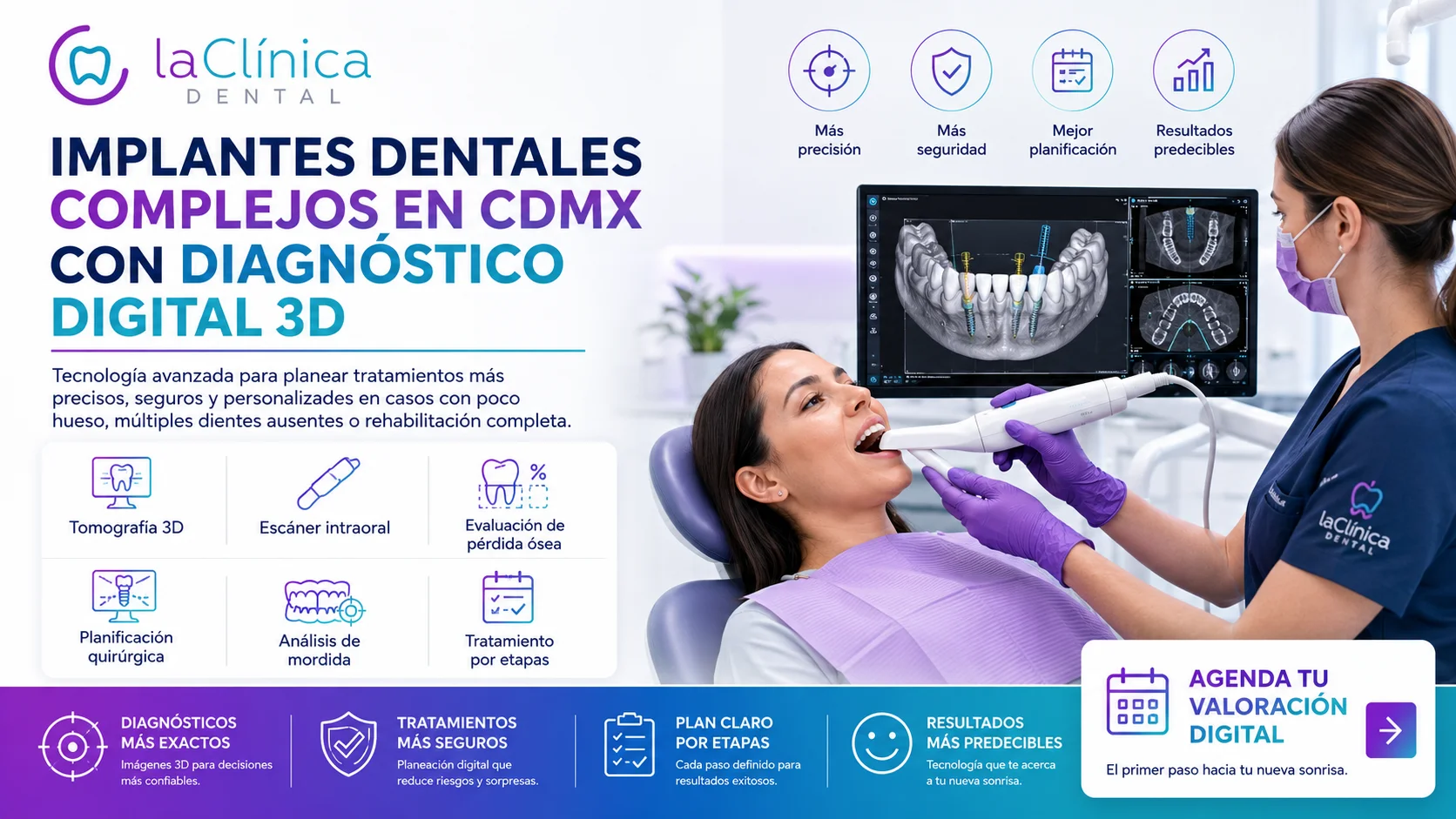
Complex dental implants in Mexico City make it possible to restore patients with bone loss, complete tooth loss, failed previous implants, or severe bite problems through guided surgery, bone grafts, and customized All-on-4 protocols.
A dental implant is not always a simple procedure. When there is insufficient bone, a history of infection, multiple missing teeth, the need to reconstruct an entire dental arch, or a history of failed treatments, the case must be evaluated in greater depth. In these scenarios, the difference lies not only in “placing an implant,” but in making an accurate diagnosis, planning correctly, and coordinating with various specialties.
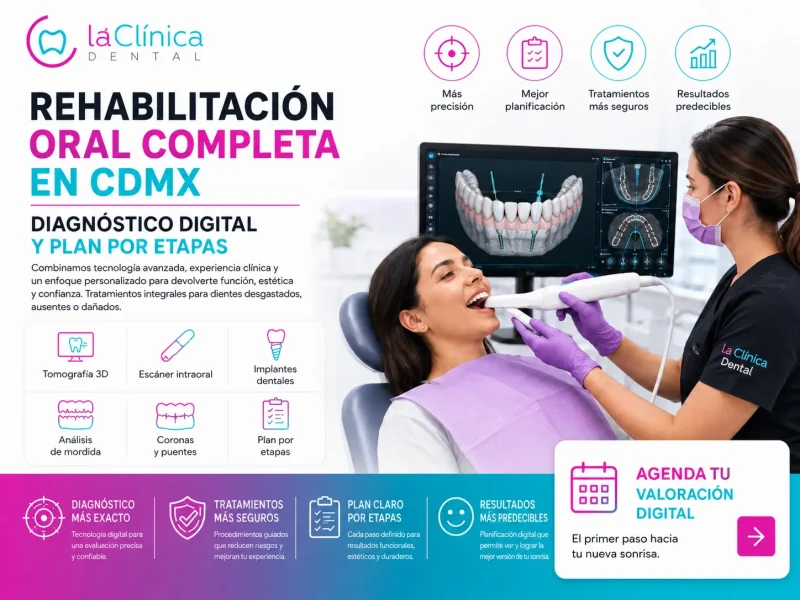
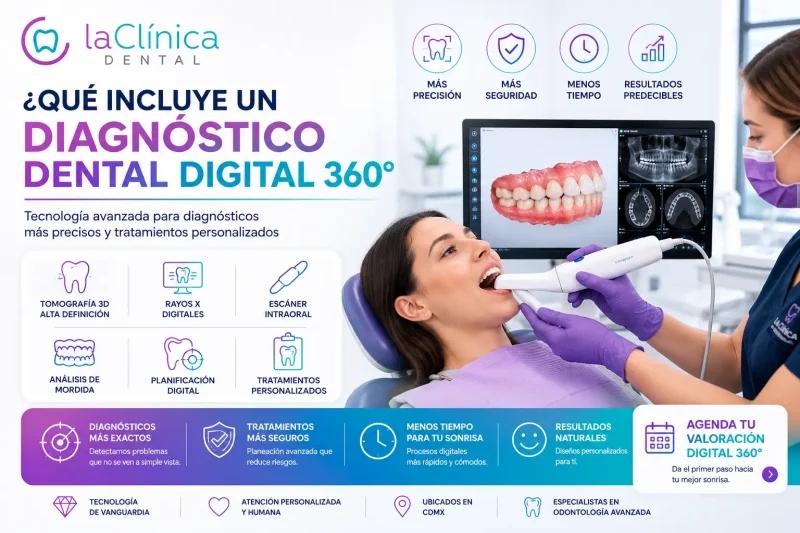
At La Clínica Dental, our approach to complex implant cases combines 3D tomography, intraoral scanning, digital planning, guided surgery when indicated, and a multidisciplinary team effort. This allows us to assess the entire case before beginning treatment: available bone, gums, bite, aesthetics, function, periodontal health, patient expectations, and realistic treatment options.
What are complex dental implants?
Complex dental implants are implant procedures that require more advanced planning because of anatomical, functional, aesthetic, or medical conditions that increase the difficulty of the case. It’s not just a matter of placing a titanium screw—it’s about reconstructing a dental area with precision, stability, and a long-term perspective.
A case may be considered complex when there is insufficient bone, multiple tooth loss, a history of periodontal disease, the need for a bone graft, proximity to nerves or maxillary sinuses, an abnormal bite, bruxism, worn teeth, previous implant failure, or the need for a complete restoration.
| Clinical Presentation | Why Complexity Increases | What Should Be Assessed Before Treatment |
|---|---|---|
| Insufficient jawbone | May compromise the initial stability of the implant | 3D CT scan, bone volume, need for a bone graft, or alternatives |
| Loss of multiple teeth | Requires a comprehensive plan for function, bite, and aesthetics | Implant placement, prostheses, occlusion, and periodontal health |
| Bruxism or severe wear | Excessive forces can affect the durability of the treatment | Occlusion, articulation, splint, prosthetic design, and materials |
| Previous failed implants | There may be bone loss, infection, or previous malposition | Cause of failure, remaining bone, gum tissue, and corrective plan |
| Anterior Aesthetic Zone | The gums, bone volume, and crown shape are critical | Smile line, gums, bone, temporary restorations, and natural-looking results |
| Complete Rehabilitation | This involves restoring function, aesthetics, facial support, and comfort | Multidisciplinary plan, number of implants, prostheses, and phases |
At our dental implantology center in Mexico City, we perform personalized evaluations using CBCT scans to determine the available bone volume, bone quality, and the most appropriate type of treatment for each patient.
When does a patient need complex dental implants?
A patient may need complex dental implants when tooth loss is not isolated or when the site where the implant will be placed is not ideal. This often occurs in people who have been missing teeth for years, wear removable dentures, have loose teeth, suffer from periodontal disease, have bone loss, experience pain when chewing, or have a smile marred by wear and tear, fractures, or previous dental treatments.
An advanced approach may also be necessary when a patient wants a fixed solution after years of using removable dentures, when they want to replace several teeth at the same time, or when they need to combine implants with cosmetic dentistry, crowns, veneers, periodontal treatment, or comprehensive oral rehabilitation.
Why is 3D diagnostics key before placing implants?
3D imaging allows for the evaluation of structures that cannot be fully analyzed with a conventional X-ray. With a dental CT scan, it is possible to assess bone volume, the proximity of nerves, the height of the maxillary sinus, the shape of the mandible or maxilla, and the ideal position of the implant.
In complex cases, this information is critical. An implant should not be planned simply where “there is space,” but rather where it can integrate properly with the future crown, the bite, the gum, and the aesthetics of the smile. That is why digital diagnosis helps reduce uncertainty and enables more precise decisions to be made before surgery.
If you’d like to understand how we use technology to plan advanced treatments, you can read more about our comprehensive digital dentistry in Mexico City and the use of digital X-rays for dental diagnosis.
How does guided surgery help with complex dental implants?
Guided surgery uses digital patient data to plan the implant’s position before the procedure. In some cases, a surgical guide can be created to help the specialist place the implant more precisely according to the pre-designed plan.
This can be especially useful when there is limited anatomical space, when multiple implants are to be placed, when the aesthetic zone is delicate, or when the treatment is part of a broader rehabilitation plan. Not all cases require guided surgery, but in complex implantology, it can be a valuable tool for improving planning and predictability.
What technologies are used to plan complex implants?
Technology should not be viewed as a list of equipment, but rather as a way to improve diagnosis, treatment planning, and the patient experience. In complex implant cases, each digital tool should answer a specific clinical question: how much bone is present, where the implant should be placed, what the future crown will look like, how the smile will look, and how the bite will function.
| Technology | What it allows us to assess | Benefits for the patient |
|---|---|---|
| 3D Tomography / CBCT | Bone, nerves, maxillary sinuses, and deep anatomy | More precise preoperative planning |
| Intraoral scanner | Shape of teeth, gums, bite, and prosthetic spaces | Digital impressions that are more comfortable and accurate than many traditional impressions |
| Digital Planning | Ideal implant placement and relationship to the future crown | Greater clarity regarding the treatment before beginning |
| Guided Surgery | Implant placement, angulation, and depth | More controlled placement when the case requires it |
| Digital Smile Design | Dental Proportions, Smile Line, and Facial Aesthetics | More harmonious results in visible areas |
| CAD/CAM | Digital Design of Restorations and Prosthetics | Restorations with improved fit and aesthetic planning |
What if I don’t have enough bone for dental implants?
Having insufficient bone does not always mean that a patient cannot receive implants, but it does require a more careful evaluation. Bone loss can result from a previous tooth extraction, periodontal disease, infections, trauma, prolonged use of removable dentures, or natural bone resorption following tooth loss.
When there is insufficient bone, the specialist must assess whether it is possible to place implants using the available bone, or whether a bone graft, maxillary sinus lift, bone regeneration, strategically angled implants, or a different prosthetic alternative is required. The decision depends on the 3D diagnosis, the patient’s overall health, the area to be treated, and the type of prosthesis desired.
The key is not to improvise. In complex implantology, the treatment plan must be developed based on the diagnosis, not on the surgery.
Can complex implants be part of a comprehensive oral rehabilitation plan?
Yes. Many cases involving complex implants are not standalone treatments, but rather part of a comprehensive oral rehabilitation plan. This occurs when a patient needs to replace several teeth, correct their bite, improve the appearance of their smile, replace old dentures, or reconstruct a mouth affected by wear, fractures, or periodontal disease.
In these cases, implants must be integrated with crowns, prosthetics, the gums, the bite, and facial aesthetics. Therefore, treatment may require the involvement of implantology, periodontics, prosthodontics, endodontics, orthodontics, cosmetic dentistry, and digital smile design.
What is the difference between a simple implant and a complex implant?
A simple implant is typically performed when the patient has sufficient bone, healthy gums, a stable bite, and a localized need. In contrast, a complex implant requires addressing additional factors before or during treatment.
| Appearance | Simple Implant | Complex implant |
|---|---|---|
| Available bone | Sufficient and stable | There may be bone loss or a need for bone regeneration |
| Number of teeth | Usually one or a few teeth | May involve several teeth or an entire arch |
| Planning | More Direct | Requires 3D imaging and multidisciplinary evaluation |
| Aesthetics | Less critical if located in the posterior region | May require gum contouring, smile design, and temporary restorations |
| Bite | Stable | Bruxism, wear, or functional abnormalities may be present |
| Treatment time | May be shorter | May require multiple phases, grafts, or complete rehabilitation |
How long does a complex dental implant procedure take?
The duration of treatment with complex implants depends on the diagnosis, the number of teeth to be replaced, bone volume, the need for grafts, periodontal health, and the type of final prosthesis. Some treatments can be completed in relatively short phases; others require several months to allow for healing, implant integration, and proper prosthetic design.
In cases of complete rehabilitation, the treatment plan can be divided into stages: digital diagnosis, infection control, extractions if necessary, bone regeneration, implant placement, temporary restorations, osseointegration, design of the final prosthesis, and maintenance. This structure helps patients understand the process and plan their time, budget, and expectations.
Do complex dental implants hurt?
Implant placement is performed under local anesthesia, and in some cases, conscious sedation or other anxiety-management measures may be considered, based on the clinical team’s assessment. Postoperative discomfort varies depending on the complexity of the procedure, the number of implants, whether a bone graft was performed, and the patient’s individual response.
For anxious patients, clear communication before treatment is just as important as the technique itself. Knowing what will be done, how long it may take, what sensations are normal, and what the follow-up will entail helps reduce fear and uncertainty.
At this point, we recommend linking to ” Dentistry Without Fear in Mexico City,” especially for patients with dental anxiety, a fear of the dentist, or sensitivity to pain.
What should an assessment for complex dental implants include?
An evaluation for complex implants must go beyond simply examining the area where a tooth is missing. It must take into account the entire mouth, the bite, the gums, the bone, the patient’s habits, aesthetics, medical history, and expectations regarding the outcome.
| Evaluation Criterion | Why It Matters |
|---|---|
| Medical History | Helps identify diseases, medications, or risk factors |
| Dental and Periodontal Examination | Assesses gums, tooth mobility, infections, and overall oral health |
| 3D Tomography | Helps measure bone and important anatomical structures |
| Bite Analysis | Determines how implants and restorations will bear a load |
| Intraoral Scanning | Enables the planning of restorations, spaces, and relationships with adjacent teeth |
| Prosthetic Plan | Defines what the crown, bridge, or implant-supported prosthesis will look like |
| Phased Plan | Helps organize your schedule, priorities, and budget |
How much do complex dental implants cost in Mexico City?
The cost of complex dental implants in Mexico City can vary depending on the number of implants, the need for a CT scan, bone grafts, temporary restorations, the type of crown, materials, guided surgery, sedation, the number of specialists involved, and the complexity of the restoration.
Therefore, in advanced cases, the most responsible approach is not to promise a single price without a diagnosis, but rather to explain which factors affect the cost and how treatment can be organized in stages. A clear plan should distinguish between what is essential, what is recommended, and what is cosmetic, so that the patient understands their options.
The dental clinic should position this as a selling point: not selling implants as a standalone product, but as a planned treatment that includes diagnosis, safety, and a long-term perspective.
How do you choose a clinic for complex dental implants?
When choosing a clinic for complex dental implants, patients should check whether it offers 3D diagnostics, experience with advanced cases, a coordinated team of specialists, prosthetic planning, periodontal monitoring, options for anxious patients, transparent pricing, and post-treatment follow-up.
The decision should not be based solely on price. In complex cases, an incomplete diagnosis can increase the risk of longer treatment times, unsatisfactory aesthetic results, discomfort, treatment failure, or the need for subsequent corrections.
| Questions Patients Should Ask | Why is this important? |
|---|---|
| Will I have a 3D CT scan before treatment? | It allows for the evaluation of bone, nerves, and anatomy prior to planning |
| Is the implant planned with the future crown in mind? | A properly placed implant should function and look good |
| Are there specialists in periodontics, surgery, and rehabilitation? | Complex cases often require a multidisciplinary approach |
| Will you explain my options if I have low bone density? | There may be grafts, regeneration, or different prosthetic plans |
| Can I do the treatment in stages? | Helps organize the budget and clinical priorities |
| Will I have follow-up appointments after the implant? | Maintenance is key to long-term health |
Why is La Clínica Dental a good choice for complex dental implants in Mexico City?
The Dental Clinic is an option for patients who need complex dental implants because it combines digital diagnostics, 3D technology, clinical planning, a multidisciplinary approach, and patient-centered care. This approach is particularly important when the case involves bone loss, multiple missing teeth, full-mouth rehabilitation, cosmetic dentistry, or treatment anxiety.
The advantage lies not only in using technology, but in applying it to answer important clinical questions: where to place the implant, what type of restoration will be needed, how to protect the bite, how to achieve a natural-looking result, and how to clearly outline the treatment plan for the patient.
Instead of viewing the implant as an isolated component, treatment is analyzed as part of the entire mouth: bone, gums, function, aesthetics, comfort, and maintenance.
What’s the next step?
The first step is to perform a clinical and digital evaluation to determine whether the patient is a candidate for implants, whether there is sufficient bone, whether prior treatment is required, and what the most appropriate plan is for the patient’s case.
Schedule a digital evaluation for complex dental implants in Mexico City and receive a clear explanation of your options, the stages of treatment, and possible alternatives.
Frequently Asked Questions About Complex Dental Implants in Mexico City
What are complex dental implants?
These are implant treatments that require advanced planning due to bone loss, multiple missing teeth, bite problems, periodontal disease, compromised aesthetics, or a history of failed treatments.
When is a dental implant considered complex?
A case is considered complex when simply placing an implant is not sufficient. It may require 3D tomography, bone grafting, guided surgery, periodontal evaluation, prosthetic rehabilitation, or coordination among various specialists.
How do I know if I am a candidate for dental implants?
To determine whether you are a candidate for dental implants, a clinical and digital evaluation is necessary. The specialist must assess your overall health, gums, available bone, bite, habits such as bruxism, medical history, and treatment expectations. In complex cases, a 3D CT scan helps determine whether there is sufficient bone or if an additional procedure is required.
What does a digital implant evaluation include?
A digital evaluation for implants may include a clinical examination, medical history, gum analysis, bite assessment, 3D CT scan, intraoral scan, assessment of available bone, and initial treatment planning. The goal is to explain what options are available, what steps may be necessary, and how to organize the treatment in the clearest and safest way possible.
How long does a complex implant procedure take?
The duration depends on the number of implants, the quality and quantity of bone, the need for grafts, healing, implant integration, and the type of final prosthesis. Some cases can be completed in just a few stages, while others require several months to achieve a stable, functional, and aesthetic result.
Can I get implants if I have insufficient bone?
In many cases, it is possible, but a 3D CT scan is required. Depending on the diagnosis, options such as bone grafts, bone regeneration, maxillary sinus lift, or other alternatives may be considered.
Do complex dental implants hurt?
The procedure is performed under local anesthesia, and depending on the case, additional measures may be considered to address anxiety or ensure comfort. Post-procedure discomfort depends on the complexity of the treatment and whether grafts or additional procedures were performed.
Can the treatment be done in stages?
Yes. Many complex dental implant treatments can be organized in stages, especially when the patient requires 3D diagnostics, infection control, bone grafting, placement of multiple implants, temporary restorations, or final restoration. A phased plan allows you to prioritize what’s most important, organize the timeline, and allocate the budget more clearly.
What is guided implant surgery?
This technique uses digital planning to determine the implant’s position before surgery. In some cases, a surgical guide is used to place the implant with greater precision.
Is 3D CT scanning necessary for complex implants?
Yes, in complex cases it is highly recommended because it allows for the evaluation of bone, nerves, maxillary sinuses, and anatomical structures before planning treatment.
What if I’ve had an implant fail before?
It is necessary to investigate the cause of the failure. It may be due to infection, insufficient bone, overloading, poor positioning, gum problems, bruxism, or lack of maintenance. The new treatment plan must address the cause before placing another implant.
Can complex implants be used for a full set of teeth?
Yes. They can be part of a comprehensive oral rehabilitation when the patient needs to replace several teeth, restore their bite, improve the appearance of their smile, and chew more comfortably again.
Which specialist performs complex dental implant procedures?
Complex cases often require a multidisciplinary team that may include an implantologist, periodontist, oral rehabilitation specialist, prosthodontist, cosmetic dentistry specialist, and other professionals, depending on the case.
What is the difference between All-on-4, All-on-6, and single implants?
Single implants replace specific teeth. All-on-4 or All-on-6 are alternatives for restoring an entire dental arch using several implants to support a fixed or hybrid prosthesis, depending on the clinical assessment.
How much do complex dental implants cost in Mexico City?
The cost varies depending on the number of implants, digital imaging, bone grafts, guided surgery, type of prosthesis, materials, and number of specialists. An evaluation helps determine a realistic estimate.
Why choose a clinic that offers digital dentistry for implants?
Because digital dentistry helps diagnose, plan, and perform treatments with greater precision. In complex cases, this can improve the clarity of the treatment plan and the predictability of the outcome.
These are implant treatments that require advanced planning due to bone loss, multiple missing teeth, bite problems, periodontal disease, compromised aesthetics, or a history of failed treatments.
A case is considered complex when simply placing an implant is not sufficient. It may require 3D tomography, bone grafting, guided surgery, periodontal evaluation, prosthetic rehabilitation, or coordination among various specialists.
To determine whether you are a candidate for dental implants, a clinical and digital evaluation is necessary. The specialist must assess your overall health, gums, available bone, bite, habits such as bruxism, medical history, and treatment expectations. In complex cases, a 3D CT scan helps determine whether there is sufficient bone or if an additional procedure is required.
A digital evaluation for implants may include a clinical examination, medical history, gum analysis, bite assessment, 3D CT scan, intraoral scan, assessment of available bone, and initial treatment planning. The goal is to explain what options are available, what steps may be necessary, and how to organize the treatment in the clearest and safest way possible.
The duration depends on the number of implants, the quality and quantity of bone, the need for grafts, healing, implant integration, and the type of final prosthesis. Some cases can be completed in just a few stages, while others require several months to achieve a stable, functional, and aesthetic result.
In many cases, it is possible, but a 3D CT scan is required. Depending on the diagnosis, options such as bone grafts, bone regeneration, maxillary sinus lift, or other alternatives may be considered.
The procedure is performed under local anesthesia, and depending on the case, additional measures may be considered to address anxiety or ensure comfort. Post-procedure discomfort depends on the complexity of the treatment and whether grafts or additional procedures were performed.
Yes. Many complex dental implant treatments can be organized in stages, especially when the patient requires 3D diagnostics, infection control, bone grafting, placement of multiple implants, temporary restorations, or final restoration. A phased plan allows you to prioritize what’s most important, organize the timeline, and allocate the budget more clearly.
This technique uses digital planning to determine the implant’s position before surgery. In some cases, a surgical guide is used to place the implant with greater precision.
Yes, in complex cases it is highly recommended because it allows for the evaluation of bone, nerves, maxillary sinuses, and anatomical structures before planning treatment.
It is necessary to investigate the cause of the failure. It may be due to infection, insufficient bone, overloading, poor positioning, gum problems, bruxism, or lack of maintenance. The new treatment plan must address the cause before placing another implant.
Yes. They can be part of a comprehensive oral rehabilitation when the patient needs to replace several teeth, restore their bite, improve the appearance of their smile, and chew more comfortably again.
Complex cases often require a multidisciplinary team that may include an implantologist, periodontist, oral rehabilitation specialist, prosthodontist, cosmetic dentistry specialist, and other professionals, depending on the case.
Single implants replace specific teeth. All-on-4 or All-on-6 are alternatives for restoring an entire dental arch using several implants to support a fixed or hybrid prosthesis, depending on the clinical assessment.
The cost varies depending on the number of implants, digital imaging, bone grafts, guided surgery, type of prosthesis, materials, and number of specialists. An evaluation helps determine a realistic estimate.
Because digital dentistry helps diagnose, plan, and perform treatments with greater precision. In complex cases, this can improve the clarity of the treatment plan and the predictability of the outcome.
Schedule a digital evaluation for complex dental implants in Mexico City
If you have insufficient bone mass, multiple missing teeth, failed implants, or need a complete dental restoration, at La Clínica Dental we can help you understand your case through 3D diagnostics, digital planning, and a multidisciplinary approach.
Find out what options are available, what stages your treatment may include, and how to plan it with greater clarity and confidence.
Author:
Dr. Rosa María Moctezuma Lozano
National Autonomous University of Mexico
ID No. 1135288
Clinically reviewed and updated content for patient information guidance.
Last editorial review: May 20, 2026.