Published by Dr. Rosa Ma. Moctezuma, ID No. 1135288: June 1, 2026.
Reviewed by Dr. Miguel Ángel S.: June 1, 2026.
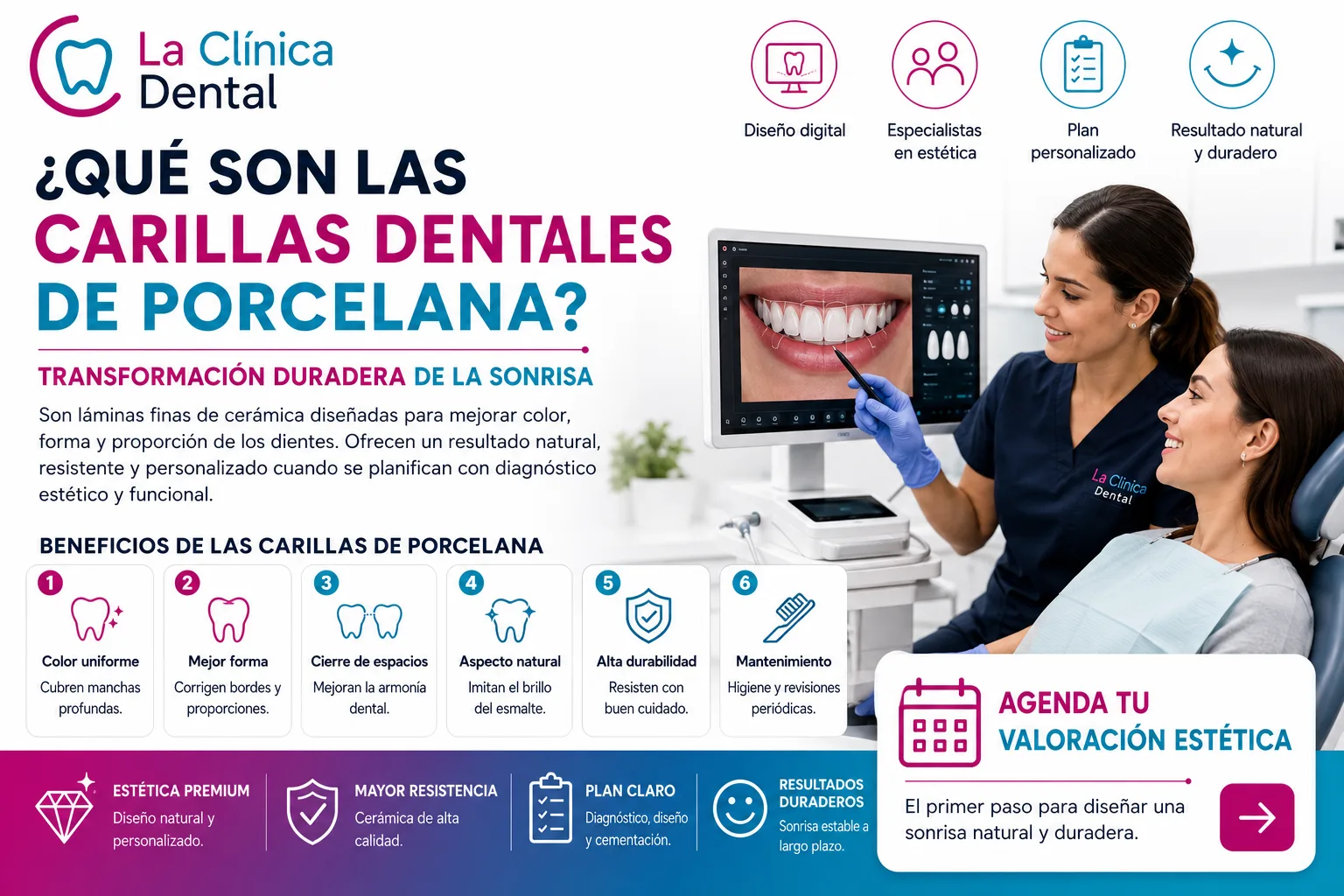
Porcelain dental veneers are thin ceramic shells designed to improve the color, shape, size, and proportions of the teeth visible when smiling. At La Clínica Dental, this treatment is planned using aesthetic evaluation, digital diagnosis, and functional analysis to achieve a natural, not artificial, smile. Learn about our dental veneer treatments in Mexico City.
A good veneer should not look like a piece glued onto the tooth. It should blend in with the face, the smile line, the gums, the color of the adjacent teeth, and the patient’s bite. That is why a comprehensive clinical and aesthetic evaluation is necessary before choosing the material or shade.
What are porcelain dental veneers?
Porcelain dental veneers are thin cosmetic restorations that are bonded to the front surface of the teeth. Their purpose is to improve the appearance of a smile when there are deep stains, small teeth, worn edges, minor fractures, gaps between teeth, or teeth with irregular shapes.
Unlike a dental crown, which covers most or all of the tooth’s structure, a veneer focuses primarily on the visible part of the smile. For this reason, it is typically recommended for teeth with a sound structural foundation, no active cavities, no uncontrolled periodontal disease, and a bite compatible with aesthetic restorations.
| Element | Porcelain veneer | Clinical objective |
|---|---|---|
| Material | Highly Aesthetic Dental Ceramics | Achieving color, luster, and translucency similar to that of natural teeth |
| Area covered | Mainly the front part of the tooth | Improve the visible appearance of the smile |
| Main Indication | Cosmetic dentistry for teeth with a preservable structure | Correcting shape, color, proportion, or minor imperfections |
| Planning | You must consider the face, gums, bite, and expectations | Avoid an artificial or over-treated smile |
In what situations are porcelain veneers used?
Porcelain veneers can be a good option when the main issue is the appearance of the front teeth and the underlying tooth structure is healthy. They are not a one-size-fits-all solution: before recommending them, it is important to check whether the tooth has sufficient enamel, whether the bite is stable, and whether there is any tooth decay, tooth mobility, or gum inflammation.
| Patient’s Condition | Can veneers help? | What to Check First |
|---|---|---|
| Stained teeth that don’t improve with whitening | Yes, they can cover deep stains | Cause of the stain, enamel thickness, and desired final shade |
| Small or irregularly shaped teeth | Yes, they can improve proportion and symmetry | Relationship with the lips, gums, and adjacent teeth |
| Mild wear on the edges of the teeth | It is possible | Cause of the wear and presence of bruxism |
| Small fractures or chipped edges | Yes, if there is sufficient remaining structure | Depth of the fracture and stability of the bite |
| Slight gaps between teeth | This can be a cosmetic option | Size of the space and final proportion of the teeth |
| A smile with an unbalanced color or shape | Yes, if the case is primarily cosmetic | Facial design, smile line, and realistic expectations |
If the case involves a combination of color, shape, and proportion, it may be helpful to begin with an aesthetic smile assessment using digital simulation. This assessment allows for a better visualization of the potential outcome before proceeding with definitive treatment.
When are dental veneers not recommended?
Veneers should not be placed simply because the patient wants a whiter smile. First, it must be confirmed that the mouth is healthy and that the bite will not fracture or dislodge the restorations. In cases involving cavities, inflamed gums, severe bruxism, or severely damaged teeth, other treatment may be necessary before considering cosmetic procedures.
| Condition | Why This Might Be a Problem | Possible alternative to consider |
|---|---|---|
| Active Cavity | A veneer should not cover untreated dental disease | Prior restoration, inlay, or conservative treatment |
| Swollen Gums or Periodontitis | The supporting structure is unstable | Periodontal evaluation before the aesthetic phase |
| Severe bruxism | It can cause porcelain fractures or chipping | Guard, bite analysis, or functional rehabilitation |
| Severely damaged teeth | The veneer may not have sufficient support | Crown, inlay, or dental restoration |
| Severe dental malocclusion | The veneer may look bulky or unnatural | Orthodontics or clear aligners before cosmetic treatment |
| Expectation of an “extreme blank” | May result in an unnatural smile | Natural-looking smile design and personalized shade selection |
In cases of severe wear, an unstable bite, or multiple compromised teeth, it is advisable to determine whether the patient needs comprehensive oral rehabilitation in Mexico City before placing veneers. Aesthetics must be supported by stable function.
Porcelain vs. Resin Veneers: Which Is Better?
The choice between porcelain and resin depends on the goal, budget, time frame, condition of the teeth, and aesthetic expectations. Porcelain generally offers greater color stability, better resistance to wear, and an appearance that more closely resembles natural enamel. Resin may be a more conservative and affordable option, but it requires more maintenance and is more prone to staining.
| Criterion | Porcelain Veneers | Veneers or Cosmetic Resins |
|---|---|---|
| Aesthetics | High translucency and a shine similar to enamel | Good results, but highly dependent on technique and maintenance |
| Duration | Longer-lasting if properly fitted and cared for | Shorter average lifespan and more touch-ups |
| Color Change | More resistant to staining | May be stained by coffee, tobacco, wine, or habits that cause pigmentation |
| Treatment Time | Requires design, preparation, laboratory work, and cementation | May be completed in fewer appointments, depending on the case |
| Repair | May require replacement if it breaks | It is usually easier to repair |
| Ideal Use | Long-lasting, high-quality cosmetic changes | Minor corrections, touch-ups, or more conservative alternatives |
To make the right decision, be sure to check out our comparison guide on crowns vs. veneers vs. composite resin. Your choice shouldn’t be based solely on price—it should be based on diagnosis, function, and aesthetic expectations.
How do we handle this at La Clínica Dental?
At La Clínica Dental, porcelain veneers are not approached as a quick way to change the color of teeth. First, we assess whether the case truly requires veneers, whether the teeth can be preserved, whether the bite is stable, whether there is wear or bruxism, and what type of smile will look natural on the patient’s face.
Next, a treatment plan is designed: diagnosis, simulation, shade selection, tooth preparation when necessary, temporary restorations, aesthetic trial, and final cementation. The goal is to achieve a harmonious, stable smile that is compatible with the patient’s speech, bite, and smile.
| Stage | What We Do at La Clínica Dental | Objective |
|---|---|---|
| Aesthetic Assessment | We examine the teeth, gums, lips, face, patient expectations, and clinical photographs | Determine whether veneers are the right option |
| Functional Diagnosis | We evaluate bite, wear, bruxism, and previous restorations | Preventing fractures, discomfort, or unstable results |
| Smile Design | We plan the shape, proportion, length, texture, and shade | Achieving a natural, personalized smile |
| Test or Simulation | We provide a preview of the result when the case allows | Making decisions before cementing permanent restorations |
| Final Cementation | We bond the veneers using a controlled clinical protocol | Achieving aesthetic integration and stability |
| Maintenance | We provide guidance on care, checkups, and protection if you have bruxism | Protect your investment in aesthetics over the long term |
If you want to consider a cosmetic change from a clinical perspective, schedule a consultation for dental veneers in Mexico City. The right decision starts with a diagnosis, not with choosing a porcelain shade.
What is the process for getting porcelain veneers?
The process may vary depending on the case, but it typically follows a clinical sequence. Planning is key because veneers must look natural, fit well against the gums, maintain proper occlusion, and remain stable over time.
| Step | What’s happening | Why it matters |
|---|---|---|
| 1. Initial Assessment | Oral health, bite, tooth color, tooth shape, and patient expectations are reviewed | Confirms whether the patient is a candidate |
| 2. Digital Diagnosis | May include photographs, intraoral scans, and aesthetic analysis | It allows for more precise planning |
| 3. Smile Design | Shape, size, proportion, and shade are defined | Avoids a generic or artificial smile |
| 4. Tooth Preparation | In some cases, minimal controlled tooth reduction is performed | This helps create space and ensure proper adaptation |
| 5. Temporary or Test | A temporary version or mock-up of the design can be placed | This allows you to evaluate aesthetics and comfort |
| 6. Laboratory Fabrication | Custom porcelain veneers are fabricated | Define precision, texture, color, and fit |
| 7. Cementation | The veneers are bonded to the tooth following clinical protocol | Ensure stability and a proper seal |
| 8. Inspection and Maintenance | The bite is adjusted, and care instructions are provided | Ensures long-term results |
When a case requires further analysis, a 360-degree digital dental assessment can be incorporated to evaluate the teeth, gums, bite, and restorative needs before beginning the final design.
Do porcelain veneers look natural?
Yes, they can look natural when custom-designed. A natural appearance doesn’t depend solely on the use of porcelain; it depends on the shade, translucency, surface texture, proportions, relationship to the gums, facial shape, and harmony with the adjacent teeth.
An over-treated smile often looks too white, flat, thick, or uniform. A well-designed smile retains fine details: subtle edges, realistic proportions, enamel-like reflections, and a shade that matches the patient’s age, skin tone, and facial expression.
| Natural result | Artificial result |
|---|---|
| A white shade that complements the face | Extreme white with no visual depth |
| Customized shape for each tooth | Identical and overly symmetrical teeth |
| Enamel-like texture | Flat or excessively glossy surface |
| Integration with the gums and lips | Bulky or poorly fitted veneers |
| Bite checked before cementing | Aesthetic restoration placed without checking function |
For this reason, veneers should be part of a smile design in Mexico City when the patient is looking for a visible yet natural change.
How long do porcelain dental veneers last?
Porcelain veneers can last for many years when they are appropriately indicated, properly bonded, and well maintained. Their longevity depends on the patient’s bite, oral hygiene, eating habits, the presence of bruxism, professional maintenance, and the quality of the initial diagnosis.
They are not indestructible. They can crack, come loose, or need to be replaced if the patient bites down on hard objects, grinds their teeth, neglects oral hygiene, or fails to attend follow-up appointments. If the patient has bruxism, a night guard may be recommended to protect them.
| Factor | How it affects duration | What to do |
|---|---|---|
| Bruxism | It can cause fractures or tooth loss | Wear a mouthguard if your dentist recommends it |
| Oral Hygiene | Gums and teeth must be kept healthy | Brushing, flossing, and regular cleanings |
| Bite | Improper contacts can overload the porcelain | Review and functional adjustment |
| Habits | Biting on ice, nails, or objects can damage your teeth | Avoid using your teeth for non-food purposes |
| Maintenance | Helps detect problems before they get worse | Scheduled clinical checkups |
Do porcelain veneers hurt?
The placement of veneers should not be a painful procedure when performed with proper planning and clinical oversight. In some cases, minimal enamel preparation is required; in others, the amount of enamel removed may be very limited. The need for anesthesia depends on the specific case and the patient’s sensitivity.
Temporary sensitivity may occur after preparation or cementation, especially if the enamel was altered. If there is persistent pain, swelling, or discomfort when biting, the fit, bite, and condition of the tooth should be checked.
How much do porcelain dental veneers cost?
If you’re looking for a general overview of prices, materials, and types of veneers available in Mexico City, check out the main page on dental veneers in Mexico City. This article focuses specifically on when porcelain veneers are recommended, how they are planned, and what factors affect their durability.
| Factor | Why does the cost change? |
|---|---|
| Number of veneers | It doesn’t cost the same to correct a single tooth as it does to redesign the entire visible smile |
| Aesthetic Complexity | Cases involving asymmetries, deep discolorations, or significant changes require more careful planning |
| Digital Diagnosis | Helps you design with greater precision and reduce improvisation |
| Previous Treatments | A dental cleaning, gum treatment, orthodontic treatment, dental bonding, or replacement of restorations may be required |
| Laboratory and Materials | The quality of the ceramic and the technical fit influence the outcome |
At La Clínica Dental, the estimate is determined after the evaluation. The goal is to explain what is needed, what you can expect, and which option offers the best balance between aesthetics, function, and durability.
What kind of care do porcelain veneers require?
Veneers require care similar to that of natural teeth, but with greater attention to bite alignment and habits. Patients should maintain daily oral hygiene, attend follow-up appointments, avoid biting hard objects, and report any discomfort or changes in fit.
- Brush your teeth using the proper technique and a non-abrasive toothpaste.
- Use dental floss or interdental brushes as directed.
- Avoid biting on ice, fingernails, pens, or packaging.
- Do not use your teeth as a tool.
- Attend regular cleanings and inspections.
- Use a night guard if you grind your teeth.
- Check whether a veneer feels too high, loose, or uncomfortable.
Why Get Porcelain Veneers at La Clínica Dental?
Because a smile transformation shouldn’t depend solely on color. At La Clínica Dental, porcelain veneers are planned using an approach that integrates digital diagnosis, facial aesthetics, gum health, bite analysis, personalized shade selection, and clinical follow-up.
The desired result isn’t just a standard smile. It’s a smile that looks natural, functions well, and complements the patient’s face. If you’re looking for a lasting change, the first step is a professional evaluation to determine whether veneers are the best option or if another cosmetic alternative is more suitable.
Schedule a consultation for porcelain dental veneers
If you want to improve the shape, color, or proportion of your smile, the first step isn’t to choose a porcelain shade. The first step is to determine whether your teeth, gums, and bite are suitable for veneers.
At La Clínica Dental, we evaluate your smile from both an aesthetic and functional perspective to determine whether porcelain veneers are the best option or if a more conservative treatment is recommended. Schedule a consultation for dental veneers in Mexico City
Frequently Asked Questions About Porcelain Dental Veneers
What are porcelain dental veneers?
These are thin dental ceramic veneers that are bonded to the front surface of the teeth to improve their color, shape, size, and proportions. At La Clínica Dental, we plan their placement based on both aesthetic and functional assessments to achieve a natural-looking smile.
Who is a good candidate for porcelain veneers?
Candidates may include individuals with healthy teeth that have stains, irregular shapes, slight wear, small fractures, gaps, or uneven proportions. Before recommending treatment, La Clínica Dental evaluates the patient’s gums, bite, enamel, and expectations.
Do porcelain veneers damage teeth?
In some cases, it is necessary to remove a small amount of enamel to create space and ensure a proper fit. For this reason, the procedure must be carefully indicated. At La Clínica Dental, we evaluate whether the aesthetic benefit justifies the procedure.
Are veneers permanent?
These are long-lasting restorations, but they may require maintenance or replacement over time. Since the treatment may involve altering the enamel, it should be considered a major, well-planned decision, not an impulsive procedure.
How long do porcelain veneers last?
Their lifespan depends on oral hygiene, bite, bruxism, habits, material, cementation, and follow-up visits. They can last for many years if they are properly fitted and cared for, but they are not indestructible.
Do veneers stain?
Porcelain is more color-stable than resin, but the gums, natural teeth, and margins must remain healthy. Coffee, tobacco, poor oral hygiene, and lack of maintenance can affect the overall appearance of your smile.
Which is better: porcelain or resin veneers?
Porcelain is generally better suited for long-lasting, high-demand cosmetic procedures. Resin can be used for minor corrections or more conservative alternatives. The decision depends on the diagnosis, budget, and cosmetic goal.
Do veneers correct crooked teeth?
They can correct minor misalignments, but they are not a substitute for orthodontic treatment in cases of severe misalignment. If the position of the teeth affects the bite or requires excessive wear, La Clínica Dental may recommend aligners or another option first.
Can I get veneers if I have bruxism?
It depends on the severity. Bruxism can fracture or dislodge veneers. Before placing them, the bite should be checked, and a night guard or functional treatment should be considered to protect the restoration.
Do porcelain veneers hurt?
The procedure should not be painful with proper clinical monitoring. Temporary sensitivity may occur if enamel is removed. If pain persists, the bite, fit, and condition of the tooth should be checked.
How many veneers do I need?
It depends on how many teeth are visible when smiling, any asymmetries, color, shape, and the aesthetic goal. Some people need only a few veneers; others require a more extensive treatment plan to achieve harmony.
Can veneers close gaps between teeth?
Yes, they can close small or moderate gaps if the final proportions remain natural. If the gap is large, it may be best to consider orthodontic treatment or a combination of treatments.
Author:
Dr. Rosa María Moctezuma Lozano
National Autonomous University of Mexico
ID No. 1135288
Clinically reviewed and updated content for patient information guidance.
Last editorial review: June 1, 2026.