Losing one or more teeth changes more than just the appearance of the smile. It can also affect the way you chew, the stability of your bite and the comfort of speaking or eating. So when a person begins to consider an implant, they almost always ask the same question: Is it really worth it?
The answer does not depend only on an isolated advantage or a price. It depends on the diagnosis, the condition of the bone, the type of rehabilitation the patient needs and what the patient expects to recover with the treatment. Dental implants can offer a very stable and long-lasting solution, but they also imply time, care and a serious clinical assessment before deciding.
If you first want to understand how the treatment works in general, you can review our guide to dental implants in CDMX. In this article we are going to focus on something more specific: its advantages, disadvantages and the types of solutions that may be indicated depending on the case.
What are the advantages of dental implants?
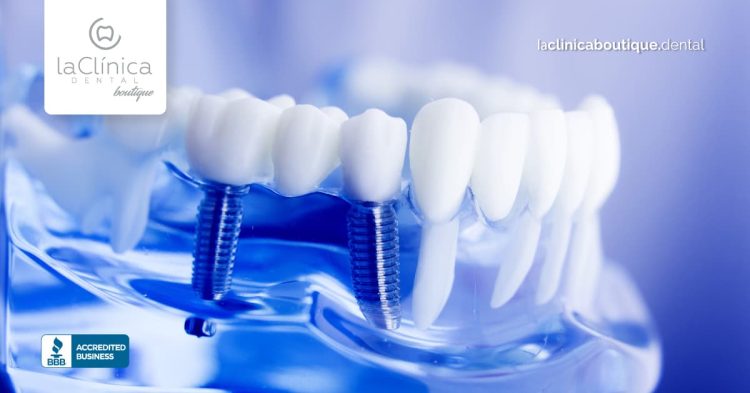
Dental implants are often valued because they help replace missing teeth in a more stable way than other removable alternatives. Their goal is not only to fill a space, but to restore support, function and a more natural feeling when chewing and smiling.
1. They recover chewing function
One of the most important advantages is that they help to recover the ability to bite and chew with greater stability. When a tooth is missing, the bite changes and other teeth may begin to receive loads that do not correspond to them. A well-planned implant helps to better restore that function.
2. They do not depend on neighboring teeth
Unlike some traditional fixed solutions, the implant works on the space lost by the tooth and does not need to rely on adjacent teeth to support the restoration. This allows the structure of healthy teeth to be better preserved.
3. They can feel more natural on a day-to-day basis
Many patients value comfort. When the treatment is well resolved, the implant can be better integrated into the daily routine, without the need to remove it to eat or rely on a removable solution.
4. Help support a more stable rehabilitation
When the case requires it, implants can also serve as the basis for broader solutions, from replacing a single piece to supporting complete rehabilitations. If your case is not single-unit, but more extensive, it is worth checking out All-on-4 and All-on-6 in CDMX and comprehensive dental treatment in CDMX.
5. Can last for many years with good maintenance
The duration depends on the diagnosis, the quality of the bone, the health of the gums, the design of the prosthesis and aftercare. It is not a “magic” solution, but a treatment that can work very well when accompanied by maintenance and regular check-ups.
What are the disadvantages or limits of dental implants?
Talking about disadvantages does not mean that implants are a bad option. It means that they should be explained honestly so that the patient can make an informed decision.
1. Not all patients are immediate candidates.
It is not always possible to place an implant directly. There are patients who first need a more detailed evaluation due to bone loss, gum inflammation, risky habits or lack of adequate bone conditions. If there is such a doubt, it is advisable to review complex cases with bone loss, grafts, All-on-4 and older patients.
2. Treatment requires time
Although the surgery may be relatively quick, the entire treatment does not end that same day. The implant needs to integrate with the bone and then move on to the restorative phase. Therefore, it should not be evaluated only by the length of the surgical appointment, but by the entire process.
3. Requires follow-up and care
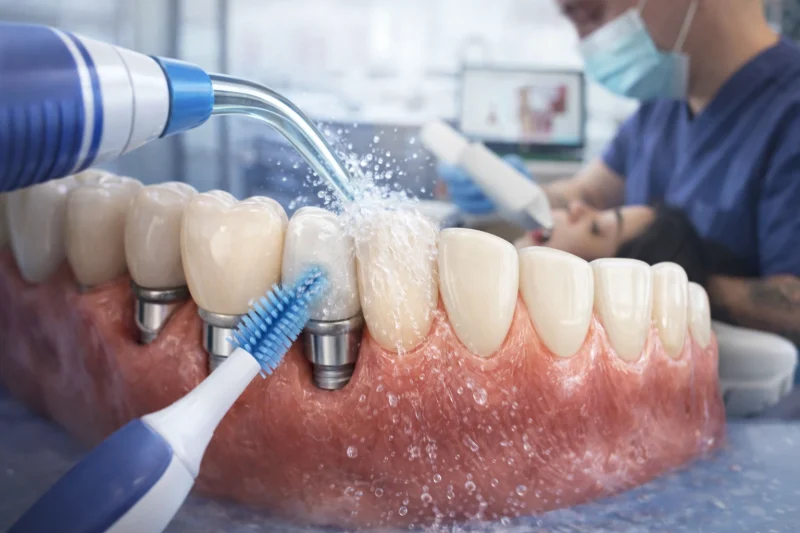
An implant is not “set it and forget it”. It needs good hygiene, periodic check-ups and control of factors such as smoking, bruxism or periodontal disease. If you want to go deeper into this part, you can review care and maintenance of dental implants and fixed prostheses All-on-4 / All-on-6.
What types of implants or solutions are available?
Not all implant treatments solve the same problem. Therefore, rather than talking about “an implant” as if it were a single thing, it is important to understand what type of solution may be indicated depending on the number of missing teeth and the complexity of the case.
Single implant
It is used when a single piece is missing and the aim is to replace it with a single restoration. It is one of the best known solutions, but it is not the only one.
Implant-supported bridge
When several consecutive teeth are missing, the plan can include implants to support a larger fixed rehabilitation, without the need to resolve each space in isolation.
Complete rehabilitation on implants
When the problem affects an arch or a much larger part of the masticatory function, the treatment changes completely. In these scenarios, options such as All-on-4 and All-on-6 in CDMX, where several implants support a complete fixed rehabilitation, can be considered.
Guided surgery and digital planning
In some cases, the treatment can be supported by 3D diagnostic and planning technology to better place the implant and coordinate the surgery with the final restoration. If you are interested in that part, you can check out computer guided implants and advanced dental technology in CDMX.
When is a dental implant usually convenient?
It is usually suitable when the patient is looking for a fixed solution, more stable and with a long-term approach to replace missing teeth. Also when the patient wants to avoid resting a restoration on healthy neighboring teeth or when a removable prosthesis no longer offers the expected comfort.
Even so, “agreeing” does not depend only on wanting it. It depends on whether the case is well diagnosed, whether the bone and gums allow treatment, or whether there is a clear pathway if prior preparation is needed.
When may not be the best immediate option?
It may not be the best immediate option when the patient first needs to resolve gum inflammation, improve hygiene conditions, treat bone loss or correct other factors that would affect the outcome. This does not mean that it is ruled out, but rather that treatment should be organized in stages.
It may also happen that the patient needs a different solution depending on the extent of the case, the budget or the time available. That is why a serious assessment is always worth more than a quick answer.
What should a patient ask before deciding?
Before starting, the patient should be clear about these questions:
-
Am I a direct candidate or do I need a preliminary phase?
-
What type of final restoration is proposed in my case?
-
How long can the treatment take?
-
What care will I need afterwards?
-
What technology will be used to plan it?
-
What factors could change the plan or budget?
A good decision does not stem from a generic promise, but from a clear explanation of the case.
How to make a more informed decision?
Making an informed decision doesn’t just mean comparing prices. It means understanding the diagnosis, type of rehabilitation, timing, care and clinical experience behind the treatment.
If you are still in the phase of exploring options, this sequence helps you:
first check the general guide to dental implants , then the content on dental implants price in CDMX and, if your case is more extensive or complex, consult complex cases with bone loss and grafts. If you still have doubts contact La Clinica Dental.
Conclusion
Dental implants can offer very important advantages, especially in terms of stability, function and comfort. But they also require diagnosis, time, follow-up and a correct indication according to the case.
The best way to decide is not just to think about “pros” or “cons” separately, but to understand whether the treatment really fits your needs, your clinical condition and the type of result you are looking for. In implant dentistry, the right decision does not start with a part: it starts with a clear diagnosis.