Published by Dr. Rosa Ma. Moctezuma, ID No. 1135288: May 15, 2026.
Reviewed by Dr. Miguel Ángel S.: May 30, 2026.
Comprehensive oral rehabilitation is necessary when a person has several dental problems at the same time: missing teeth, severe wear, unstable dentures, compromised gums, pain when chewing, or a bite that no longer functions properly. In these cases, treating a single tooth is not enough; a comprehensive plan is required. At La Clínica Dental, comprehensive oral rehabilitation in Mexico City is assessed using digital diagnostics, a coordinated team of specialists, and a phased treatment plan.
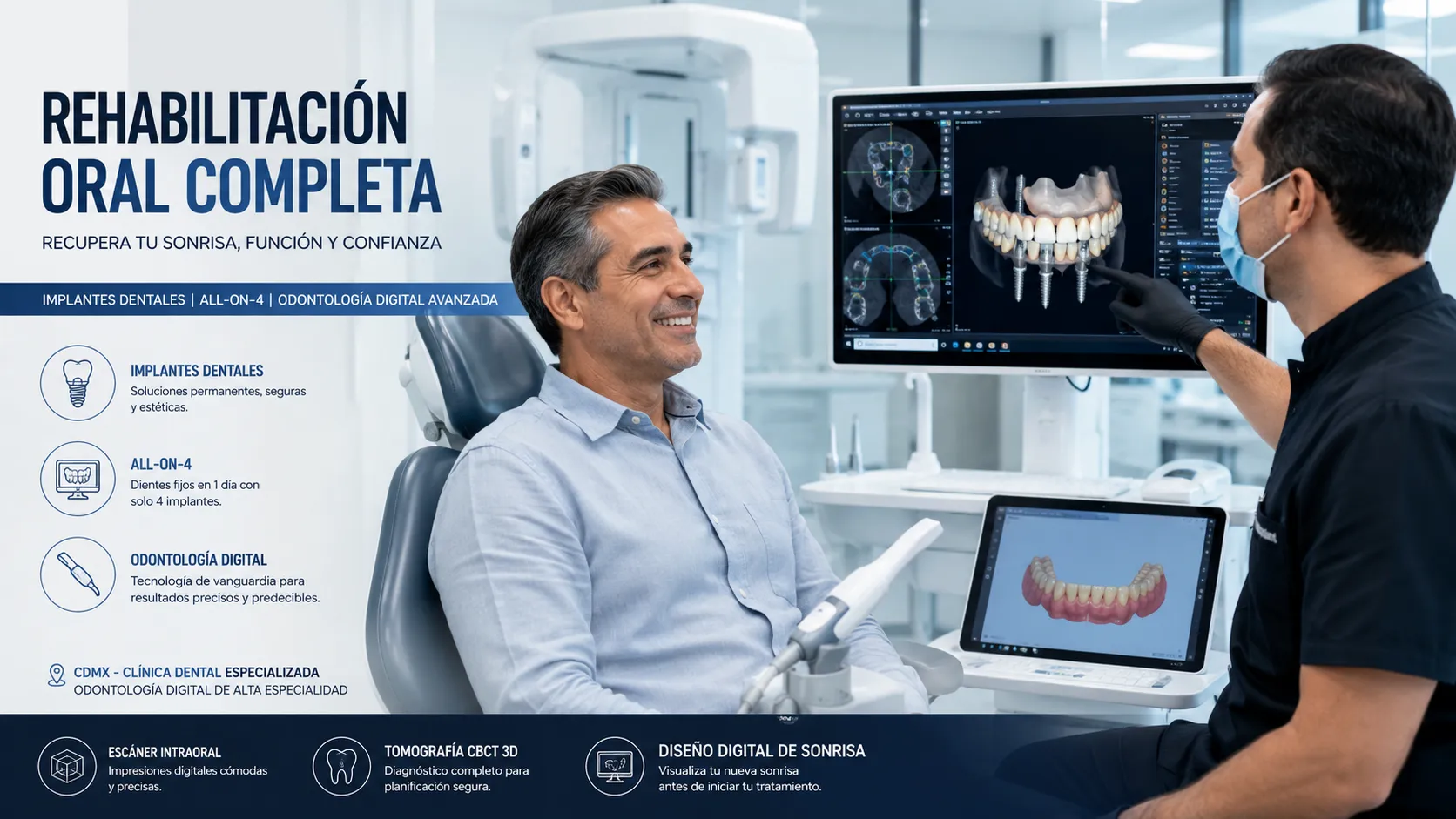
Modern oral rehabilitation uses 3D digital diagnostics, intraoral scanning, guided surgery and multidisciplinary work to plan complex treatments with greater precision and predictability. Currently, searches related to oral rehabilitation, All-on-4, fixed prosthetics and advanced implantology represent one of the most clinically and commercially valuable categories within digital dentistry in CDMX.
What is a complete oral rehabilitation?
Comprehensive oral rehabilitation is a personalized treatment plan that combines different dental specialties to partially or completely reconstruct the mouth when there are significant functional, structural or esthetic problems.
The goal is not just to “put in new teeth”. The real purpose is to recover:
- Chewing function
Bite stability - Gum and bone health
- Natural aesthetics
Comfort when talking and eating - Safety in smiling
- Long-term durability
In many cases, oral rehabilitation may include:
- Dental implants
Fixed prosthesis on implants - Dental crowns
- Fixed bridges
- Digital smile design
- Dental veneers
- Oral surgery
- Treatments
- periodontal
- Complementary orthodontics
What treatments are included in modern oral rehabilitation?
| Treatment | Main objective | When to use |
|---|---|---|
| Dental implants | Replace missing teeth | Partial or total tooth loss |
| Fixed prosthesis on implants | Restoring total stability | Patients with multiple dental losses |
| Dental crowns | Strengthen damaged teeth | Weakened or fractured teeth |
| All-on-4 / All-on-6 | Full arch rehabilitation | Total tooth loss |
| Digital smile design | Planning esthetics and proportions | Functional and esthetic cases |
| Periodontal treatment | Control gum disease | Inflammation or bone loss |
| Complementary orthodontics | Correct dental position | Bite or space problems |
When is oral rehabilitation needed?
Many people come to oral rehabilitation after years of tooth wear, missing teeth or partial treatments that no longer work properly.
Common signs of complex oral damage:
When Several Teeth Are Missing
When several teeth are missing, the mouth progressively loses stability. This can cause:
- Difficulty chewing
- Tooth Movement
- Excessive load on other teeth
- Digestive problems
- Facial Changes
- Bone loss
In these cases, modern solutions usually include dental implants or complete fixed restorations.
When a removable denture no longer works properly
One of the most common reasons for seeking oral rehabilitation is the physical and emotional wear and tear caused by traditional removable dentures.
Many patients report:
- Insecurity when speaking
- Movement while eating
- Pain or irritation
- Adhesive dependency
- Progressive bone loss
Currently, protocols such as All-on-4 and All-on-6 make it possible to exchange removable prostheses for fixed teeth on implants, offering greater stability and comfort.
When there is severe wear or bruxism
Bruxism, acid erosion and accumulated wear can completely alter the bite and oral function.
The most frequent signs include:
- Short or fractured teeth
- Sensitivity
- Muscle pain
- Jaw fatigue
- Repeated fractures
- Aesthetic problems
When there are crowns, bridges, or older restorations
Old crowns, deteriorated bridges or poorly adapted treatments may require a coordinated comprehensive reconstruction.
In these cases, a complete digital evaluation can identify which teeth can be preserved and which need replacement.
How do we handle this at La Clínica Dental?
At La Clínica Dental, comprehensive oral rehabilitation cannot be achieved through isolated treatments. First, we analyze the entire case: teeth that can be saved, missing teeth, the condition of the gums and bone, bite, tooth wear, old dentures, pain when chewing, habits such as bruxism, and the patient’s aesthetic expectations.
Based on that diagnosis, the team outlines a phased treatment plan: what needs to be addressed first, what can wait, which treatments should be combined, and which solution offers the greatest long-term stability. This approach helps avoid hasty decisions, unclear cost estimates, or cosmetic treatments that do not correct function.
| Patient’s Condition | How We Approach It at La Clínica Dental | Clinical Objective |
|---|---|---|
| Several teeth are missing | We evaluate the bone, gums, bite, and suitability for dental implants when the case allows. | Restore support, chewing function, and stability. |
| There is an unstable removable prosthesis | We’ll determine whether a fixed denture, implants, All-on-4, All-on-6, or a phased, progressive solution is the best option. | Improve confidence when eating, speaking, and smiling. |
| There is severe wear or bruxism | We analyze the bite, the loss of tooth height, and the restorations needed to restore function. | Reduce overloading and restore dental balance. |
| There is gum inflammation or bone loss | We first assess periodontal health before placing permanent restorations. | Creating a healthy foundation so the treatment lasts longer. |
| The problem is both functional and aesthetic | We integrate digital diagnostics, restorative dentistry, prosthetics, implants, and smile design as appropriate. | Achieving a natural-looking smile that also functions properly. |
If your situation involves tooth loss, wear and tear, outdated dentures, pain when chewing, or an unstable bite, the right place to start is a comprehensive evaluation. Learn how we approach complete oral rehabilitation in Mexico City at La Clínica Dental.
What problems can comprehensive oral rehabilitation correct?
Comprehensive oral rehabilitation can correct problems that simultaneously affect function, stability, oral health, and the aesthetics of the smile. This applies when the patient has not just a single damaged tooth, but a combination of tooth loss, wear, old dental prostheses, an unstable bite, pain when chewing, or visible changes to the smile.
At La Clínica Dental, these cases are analyzed comprehensively to identify which problem should be addressed first and which treatments can be organized in phases. The goal is not only to “improve the smile,” but also to restore a functional, stable, comfortable mouth with a natural appearance.
| Dental Problem | What Can Cause It | How comprehensive oral rehabilitation can help |
|---|---|---|
| Missing Teeth | Difficulty chewing, shifting of adjacent teeth, loss of facial support, and excessive strain on other teeth. | You can replace missing teeth with implants, bridges, or dentures customized for each individual case. |
| Severe tooth wear | Shorter teeth, sensitivity, fractures, muscle pain, changes in bite, and visual aging of the smile. | Restorations, crowns, composite resin, or bruxism management can help restore height, shape, and function. |
| Old or unstable dentures | Discomfort while eating, insecurity when speaking, gum injuries, and lack of stability. | You can replace substandard dentures with more stable alternatives—either fixed or removable—depending on the diagnosis. |
| Unstable Bite | Dental overload, repeated fractures, pain when chewing, and uneven wear. | Aims to balance dental contacts so that teeth, crowns, dentures, or implants function better. |
| Gum disease or loss of bone support | Tooth mobility, bleeding, bad breath, bone loss, and the risk of losing more teeth. | Incorporate periodontal management before placing permanent restorations or implants. |
| Failed Restorations | Leaking crowns, loose bridges, recurrent cavities, fractures, or persistent discomfort. | This allows for the removal of old restorations, an assessment of the prognosis for each tooth, and a planned reconstruction. |
| Pain When Chewing | Avoiding certain foods, chewing on one side only, muscle tension, or a suspected dental infection. | Helps determine whether the cause is related to teeth, gums, bite, dentures, fractures, or infections. |
| Complex Aesthetic Problems | Worn-down smile, fractured teeth, gaps, uneven color, or unbalanced proportions. | Combines cosmetic dentistry, smile design, restorations, and function to achieve a natural-looking result. |
For this reason, comprehensive oral rehabilitation should not be viewed as a single treatment but rather as a clinical strategy. For some patients, the focus is on dental implants in Mexico City; for others, it is on periodontal management, bite reconstruction, prosthesis replacement, or smile design in Mexico City.
When many teeth are missing or a removable denture no longer allows the patient to eat safely, a fixed restoration using the All-on-4 or All-on-6 method may also be considered in Mexico City. The decision depends on the available bone, gum health, bite, and the patient’s overall health.
If you have several of these problems at the same time, the first step is a comprehensive oral rehabilitation evaluation in Mexico City. At La Clínica Dental, we review your entire case to determine what can be preserved, what needs to be restored, and which solution offers the greatest long-term stability.
What courses do you need to take before you start?
Before beginning a comprehensive oral rehabilitation, the most important step is a comprehensive diagnosis. It’s not just a matter of examining individual teeth: the bone, gums, bite, missing teeth, old restorations, tooth wear, pain when chewing, and aesthetic expectations must all be evaluated. At La Clínica Dental, this analysis helps determine whether the patient needs dentures, crowns, implants, periodontal treatment, a smile design, or a phased treatment plan.
The goal of these studies is to reduce clinical uncertainty. A poorly planned comprehensive rehabilitation can lead to overloading, discomfort, fractures, unstable prostheses, or unnatural-looking results. For this reason, visual, radiographic, functional, and digital information is collected before deciding on a treatment plan.
| Study or evaluation | What it allows you to review | Why it is important |
|---|---|---|
| Clinical Examination | Damaged teeth, cavities, fractures, gums, tooth mobility, and old restorations. | Determines which teeth can be preserved and which require advanced treatment. |
| Digital X-rays | Roots, infections, bone loss, previous treatments, and the overall condition of the teeth. | They help detect problems that aren’t always visible to the naked eye. |
| 3D Tomography | Bone volume, anatomical structures, implant sites, and more complex cases. | It is essential when planning dental implants, bone grafts, or fixed restorations. |
| Intraoral Scanner | Tooth shape, bite, wear, spaces, and the relationship between the two dental arches. | It allows for more precise planning of restorations, prostheses, and digital designs. |
| Clinical Photographs | Smile, dental proportions, midline, visible gums, wear, and facial harmony. | They help integrate aesthetics with masticatory function. |
| Bite Analysis | Dental contacts, overloading, bruxism, pain while chewing, and functional stability. | Prevents new crowns, dentures, or implants from being subjected to improper forces. |
| Periodontal Evaluation | Gum inflammation, bleeding, tooth mobility, deep tartar, and loss of periodontal support. | Before restoration, the periodontal condition must be addressed to improve the prognosis. |
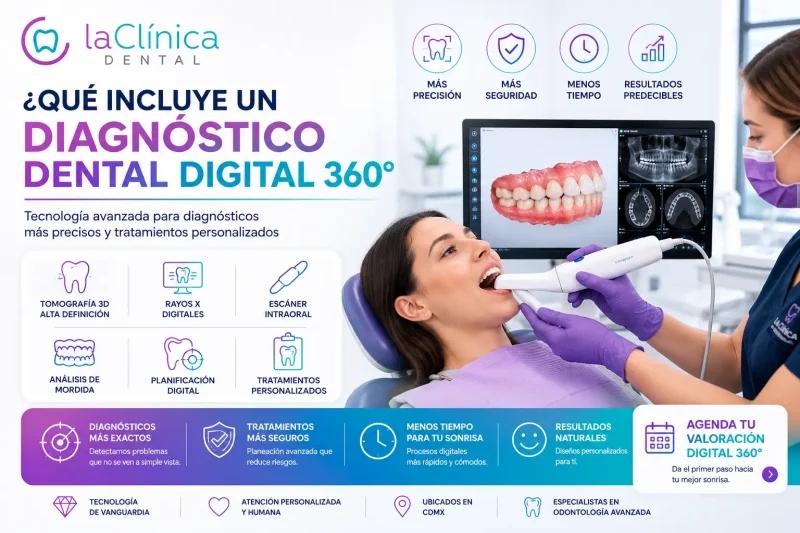
In complex cases, these studies are incorporated into a 360-degree digital dental diagnosis, especially when the patient has missing teeth, old dentures, severe wear, periodontal disease, or needs to be evaluated for dental implants in Mexico City.
With this information, the team can explain what needs to be addressed first, what can be done later, and what options are available to restore function, aesthetics, and stability. If your case requires a comprehensive solution, the next step is to learn how a complete oral rehabilitation plan is developed at La Clínica Dental in Mexico City.
What treatments can be included in the plan?
Comprehensive oral rehabilitation may involve several treatments, but not all patients require the same ones. The treatment plan depends on the diagnosis: teeth that can be saved, missing teeth, the condition of the gums and bone, bite stability, previous restorations, the degree of wear, and the patient’s aesthetic goals.
At La Clínica Dental, treatment is not viewed as a series of isolated procedures. First, we identify which problem most significantly affects oral health and function; then, we sequence the steps to stabilize the mouth, restore chewing function, and achieve a natural-looking smile.
| Treatment | When it can be included | Goal within the plan |
|---|---|---|
| Periodontics | When there is gum inflammation, bleeding, loose teeth, deep tartar buildup, or loss of bone support. | Assess gum and bone health before placing permanent restorations. |
| Root Canal Treatment | When a tooth has an infection, deep pain, or nerve damage, but can still be saved. | Saving strategic teeth and avoiding unnecessary extractions. |
| Planned Extractions | When teeth are fractured, severely mobile, have an advanced infection, or have a poor prognosis. | To remove teeth that can no longer support a stable restoration. |
| Dental Implants | When one or more teeth are missing and the patient has adequate bone, gum, and overall health. | Replacing tooth roots to support crowns, bridges, or fixed dentures. |
| Bone Grafts or Regeneration | When there isn’t enough available bone to safely place implants. | To create better anatomical conditions for implant-based rehabilitation. |
| Dental Crowns | When a tooth is worn down, fractured, weakened, or needs to regain its shape and strength. | Protect natural teeth and restore function, height, and aesthetics. |
| Dental Bridges | When one or more teeth are missing and a fixed solution supported by teeth or implants is needed. | Restore dental continuity and chewing ability. |
| Fixed or Removable Dentures | When multiple teeth are missing and function needs to be restored, depending on the clinical case and budget. | Improve stability, facial support, speech, and confidence when eating. |
| All-on-4 or All-on-6 | When there is total or near-total tooth loss, unstable removable dentures, or teeth with a poor overall prognosis. | Restore an entire dental arch with a fixed implant-supported prosthesis. |
| Veneers, Composite Resins, or Smile Design | When, in addition to restoring function, the goal is to improve the shape, color, proportion, or visible harmony of the smile. | Integrating cosmetic dentistry without compromising the bite or the stability of the treatment. |
| Orthodontics or Preliminary Alignment | When the position of the teeth prevents a stable bite or makes it difficult to perform well-designed restorations. | Preparing the mouth so that crowns, dentures, or veneers function more effectively. |
| Prevention and Management of Bruxism | In cases of clenching, grinding, repeated fractures, or severe wear. | To protect dental restorations and reduce excessive stress on teeth, implants, or restorations. |
For this reason, comprehensive oral rehabilitation must be tailored to each individual. One patient may first need periodontal and endodontic treatment; another may require dental implants in Mexico City; and yet another may be a candidate for a fixed solution such as All-on-4 or All-on-6 in Mexico City.
When the condition also affects the appearance of the smile, the treatment plan may include smile design in Mexico City, veneers, composite resin, or cosmetic crowns. The clinical rule is clear: first, restore function; then, refine the aesthetics.
If you have several damaged teeth, missing teeth, old dentures, or an unstable bite, the next step is a comprehensive oral rehabilitation evaluation in Mexico City. At La Clínica Dental, we review your entire case to determine which treatments are necessary, which can wait, and how to organize the plan in phases.
Does oral rehabilitation always involve implants?
Not always. Comprehensive oral rehabilitation may include dental implants, but not all patients need them. The decision depends on how many teeth are missing, which teeth can still be preserved, how much available bone there is, the condition of the gums, how stable the bite is, and the functional or aesthetic goal being pursued.
At La Clínica Dental, implants are not automatically recommended as a solution. First, a comprehensive evaluation is conducted to determine whether it is best to preserve natural teeth, restore them with crowns, use dentures, place implants, or combine several options as part of a phased treatment plan.
| Clinical Presentation | Might you need implants? | What We Evaluate Before Making a Decision |
|---|---|---|
| One or more teeth are missing | Yes, they can be a common option. | Available bone, gums, space, bite, and overall health. |
| There are teeth that are damaged but can be saved | Not necessarily. | We assess whether they can be saved with root canal treatment, crowns, inlays, or other restorations. |
| There is total or near-total tooth loss | Yes, a fixed prosthesis supported by implants can be considered. | 3D CT scan, bone support, stability, oral hygiene, and the patient’s expectations. |
| There’s not much meat on it | It depends on the case. | We evaluate whether a graft, bone regeneration, or a prosthetic alternative is needed. |
| The main problem is wear or bruxism | Not always. | Bite reconstruction, crowns, composite fillings, or a mouthguard may be needed before considering implants. |
When teeth are missing or a removable denture no longer provides stability, dental implants in Mexico City can help restore support and chewing function. But if the teeth still have a good prognosis, the goal may be to preserve them.
That’s why, before choosing implants, dentures, or crowns, the right first step is a comprehensive oral rehabilitation evaluation in Mexico City. At La Clínica Dental, we analyze the entire case to develop a functional, realistic, and personalized treatment plan.
When is All-on-4 or All-on-6 recommended?
All-on-4 or All-on-6 may be recommended when a person has lost all or almost all of the teeth in one jaw, wears an unstable removable denture, or has several teeth with a poor prognosis. These techniques make it possible to restore an entire dental arch with a fixed prosthesis supported by dental implants.
At La Clínica Dental, this option is considered when the patient needs to regain stability, the ability to chew, and confidence when speaking or smiling. It is not recommended solely for cosmetic reasons: there must be an appropriate clinical basis, precise digital planning, and an evaluation of the condition of the bone, gums, and bite.
| When can it be considered | What is reviewed | Purpose of the treatment |
|---|---|---|
| Total tooth loss | Bone volume, gums, overall health, and bite stability. | Replacing an entire dental arch with a fixed prosthesis. |
| Loose Removable Dentures | Retention, support, discomfort, injuries, and chewing ability. | Improve confidence when eating, speaking, and smiling. |
| Several teeth with a poor prognosis | Mobility, infection, fractures, bone loss, and the possibility of saving teeth. | Avoid partial treatments that do not provide long-term stability. |
| Patient with moderate bone loss | 3D CT scan, implant placement, and the need for grafts or alternative techniques. | Plan a fixed restoration with minimal surgical improvisation. |
The choice between All-on-4 and All-on-6 should not be based on trends or price alone. It is determined by the quantity and quality of the bone, force distribution, type of prosthesis, the patient’s habits, and the complexity of the case.
If you’re looking for a fixed solution for a full arch, check out our guide to All-on-4 and All-on-6 in Mexico City. If you also have tooth wear, bite issues, compromised gums, or several old restorations, the first step should be a comprehensive oral rehabilitation in Mexico City.
How is treatment planned in phases?
A comprehensive oral rehabilitation is planned in phases to address urgent issues first, followed by functional issues, and finally aesthetic issues. This approach prevents hasty decisions and ensures that each procedure is based on a more solid clinical foundation.
At La Clínica Dental, treatment planning begins with a comprehensive diagnosis. Based on this evaluation, we determine which teeth can be preserved, which teeth require treatment, whether there is an infection, whether the gums need to be monitored, whether implants are needed, and which restorations should be placed on a temporary or permanent basis.
| Phase | What is done | Objective |
|---|---|---|
| 1. Diagnosis | Clinical examination, X-rays, intraoral scan, 3D tomography when applicable, and bite analysis. | Understanding the full picture of the case before deciding on treatment. |
| 2. Emergency Care | Pain, infections, deep cavities, fractured teeth, or active inflammation. | Eliminate sources of risk and stabilize the mouth. |
| 3. Periodontal Health | Gum examination, deep tartar removal, assessment of tooth mobility, and evaluation of loss of supporting structures. | Creating a healthy foundation for restorations or implants. |
| 4. Functional Recovery | Implants, dentures, crowns, bridges, root canals, or bite reconstruction. | Restore chewing function, support, and stability. |
| 5. Cosmetic Phase | Smile design, veneers, composite resin, aesthetic crowns, or final adjustments. | Achieving a natural-looking smile without compromising function. |
| 6. Maintenance | Checkups, cleanings, denture adjustments, protective guards for bruxism, and follow-up care. | Protecting the long-term results. |
This phased approach also helps organize the budget. Not all procedures need to be performed on the same day or paid for at the same time. In complex cases, you can prioritize what is necessary and leave cosmetic or definitive procedures for a second stage.
When a case requires advanced diagnostic technology, a 360-degree digital dental diagnosis can be incorporated to assess the bone, bite, teeth, gums, and restorative needs before beginning a comprehensive oral rehabilitation.
How long can a complete oral rehabilitation take?
The duration of a complete oral rehabilitation can range from a few weeks to several months, depending on the complexity of the case. It does not take the same amount of time to restore worn-down teeth as it does to place implants, treat periodontitis, perform bone grafts, or restore an entire dental arch.
At La Clínica Dental, the timeline is determined after the diagnosis. The priority is to ensure that each phase progresses safely: first, managing pain, infection, or gum issues; then, restoring function; and finally, placing permanent restorations or making cosmetic adjustments.
| Case Type | Estimated time | What Can Lengthen the Process |
|---|---|---|
| Restorations with crowns or other restorations | Weeks, depending on the number of teeth. | Bite adjustments, previous root canals, or old restorations. |
| Implant-Based Rehabilitation | This may take several months. | Healing, implant integration, and design of the permanent crown. |
| Cases Involving Bone Grafts | Longer duration. | Regeneration, healing, and evaluation prior to implant placement. |
| All-on-4 or All-on-6 | This may include a temporary phase and a permanent phase. | Bone condition, prosthesis adaptation, and integration times. |
| Cases with active periodontitis | Depends on periodontal control. | Inflammation, tooth mobility, oral hygiene, and the patient’s response. |
For some patients, it is possible to combine procedures to reduce the number of visits; for others, doing so too quickly may compromise the outcome. Successful rehabilitation is not measured solely by speed, but by stability, adaptation, and prognosis.
If you’re coming from another city or have limited time, it’s a good idea to mention this during the evaluation so we can organize your treatment plan. The appropriate course of action is determined as part of a comprehensive oral rehabilitation evaluation, which identifies what can be done first and what requires follow-up.
How much can a complete oral rehabilitation cost?
The cost of comprehensive oral rehabilitation should not be calculated as a single price, because it depends on the diagnosis. Factors that influence the treatment include the number of teeth to be treated, the need for implants, the type of prosthesis, materials, digital imaging, gum health, bite, bone loss, and the number of treatment phases required.
At La Clínica Dental, the estimate must be based on a clinical plan. This makes it possible to distinguish between urgent and ideal treatments, differentiate between necessary treatments and cosmetic procedures, and break the case down into stages when the patient cannot undergo all treatments at the same time.
| Factors That Affect Cost | Why the estimate changes | How it is assessed |
|---|---|---|
| Number of affected teeth | Restoring a single tooth does not cost the same as restoring an entire arch. | Clinical examination and treatment plan. |
| Need for Implants | Implants require surgery, abutments, and prosthetic restoration. | 3D CT scan, available bone, and bite evaluation. |
| Condition of the Gums and Bone | Periodontal treatment, grafts, or prior treatments may be required. | Periodontal and radiographic evaluation. |
| Type of prosthesis or restoration | Materials, design, laboratory, and technical complexity vary. | Prosthetic and functional planning. |
| Aesthetic Complexity | Smile design may require veneers, crowns, composite resin, or proportional adjustments. | Photographs, intraoral scans, and facial analysis. |
| Phased Treatment | Allows procedures and payments to be spread out over time. | Clinical prioritization of the case. |
For cases where tooth loss is the primary issue, you can review the guide on the cost of dental implants in Mexico City. However, if there is also tooth wear, old dentures, compromised gums, or bite problems, the estimate should be calculated as a comprehensive restoration.
The surest way to determine a realistic cost range is to start with a comprehensive oral rehabilitation evaluation in Mexico City. At La Clínica Dental, we assess what needs to be addressed first, what you can expect, and what options are available to restore function, stability, and aesthetics.
Can I pay in stages?
Yes, in many cases, comprehensive oral rehabilitation can be organized in clinical and financial stages. This is useful when a patient needs several treatments but cannot or should not undergo them all in a single phase.
At La Clínica Dental, a phased treatment plan allows us to prioritize what matters most: managing pain, infection, gum disease, or teeth with a poor prognosis; then restoring chewing function; and finally moving toward permanent restorations or aesthetic improvements.
| Stage | What it may include | Benefits for the patient |
|---|---|---|
| Urgent Care | Pain, infection, necessary extractions, root canal treatment, or periodontal checkup. | Prevents the problem from getting worse and reduces discomfort. |
| Functional Phase | Implants, temporary prostheses, crowns, bridges, or bite reconstruction. | Allows you to chew again with greater stability. |
| Final Stage | Final prostheses, permanent crowns, veneers, or aesthetic restorations. | Consolidates the functional and aesthetic results. |
| Maintenance Phase | Cleanings, checkups, adjustments, and follow-up care for patients with bruxism. | Protects the long-term clinical investment. |
Paying in stages doesn’t mean improvising. It means having a clear plan from the start, with clinical priorities and realistic alternatives. This helps the patient understand what needs to be addressed first and what can be scheduled for later.
If your case involves a combination of treatments, request a comprehensive oral rehabilitation evaluation in Mexico City. At La Clínica Dental, we can help you organize a plan so that your treatment progresses in a structured manner.
What if I have low bone density, diabetes, or a fear of the dentist?
Having insufficient bone mass, diabetes, or a fear of the dentist does not automatically rule out comprehensive oral rehabilitation, but it does require a more careful evaluation. These factors can affect the treatment plan, the timeline, the type of surgery, the need for additional tests, and how the patient is cared for.
At La Clínica Dental, these cases are reviewed before beginning any definitive procedure. The goal is to reduce risks, explain options, and tailor the treatment to the patient’s specific circumstances.
| Patient’s Condition | What to Check | How the plan can be adjusted |
|---|---|---|
| Insufficient bone | Bone volume, height, thickness, anatomical areas, and suitability for implant placement. | May require 3D CT scanning, bone grafts, bone regeneration, or prosthetic alternatives. |
| Diabetes | Level of control, wound healing, periodontal health, and risk of infection. | May require medical coordination, periodontal monitoring, and more careful timing. |
| Fear of the Dentist | Anxiety, past experiences, tolerance for procedures, and the need for step-by-step explanations. | This can be addressed through clear communication, taking breaks, pain management, and anxiety management strategies. |
| Severe Bruxism | Biting forces, wear, fractures, muscle pain, and risk to dental restorations. | May require a mouthguard, functional adjustment, and appropriate materials to protect the treatment outcome. |
When there is insufficient bone, implants must be planned with greater precision. In some cases, a fixed solution such as All-on-4 or All-on-6 may be considered in Mexico City; in others, bone regeneration or a prosthetic alternative is required first.
If anxiety is the main obstacle, it’s also a good idea to review the guide on fear of the dentist and pain management. A comprehensive rehabilitation plan should be developed with clinical precision, but also with a compassionate approach.
The first step is a comprehensive oral rehabilitation evaluation. At La Clínica Dental, we assess your clinical condition before determining whether treatment can be performed, in what order, and with what precautions.
Why Get Comprehensive Oral Rehabilitation All in One Place?
Performing a comprehensive oral rehabilitation in a single location allows for the coordination of diagnosis, specialists, clinical phases, aesthetics, and follow-up without fragmenting the case. This is important because oral health issues such as tooth loss, tooth wear, gum disease, or an unstable bite cannot be effectively addressed with isolated treatments.
At La Clínica Dental, the value of a comprehensive approach lies in connecting all areas of treatment: digital diagnosis, periodontics, implantology, prosthodontics, cosmetic dentistry, bite reconstruction, and maintenance. This ensures that patients receive not just isolated opinions, but a structured treatment plan.
| The Advantage of a Single Location | Why It Matters | Impact on the bottom line |
|---|---|---|
| Centralized Diagnosis | All findings are interpreted within the same plan. | This reduces conflicting decisions between treatments. |
| Coordinated Specialists | Implants, gums, prostheses, and aesthetics are planned together. | This improves the clinical sequence and final stability. |
| Less improvisation | We define what comes first, what can wait, and what depends on each phase. | This helps manage timelines, expectations, and the budget. |
| Continuity of Care | Follow-up is conducted with a comprehensive view of the case. | This facilitates adjustments, maintenance, and long-term monitoring. |
| Aesthetics with Function | A smile is designed with bite, support, and oral health in mind. | This prevents results that are aesthetically pleasing but unstable or uncomfortable. |
This approach is especially useful when a patient has several problems at the same time: missing teeth, old crowns, loose dentures, wear and tear, pain when chewing, or a smile that no longer feels natural. In such cases, treating each problem separately can lead to higher costs, more appointments, and less predictable results.
If you need to restore dental function, aesthetics, and stability, schedule a comprehensive oral rehabilitation evaluation. At La Clínica Dental, we evaluate each case as a complete system, not as a collection of isolated teeth.
Oral rehabilitation and natural esthetics: a modern approach
Currently, the most advanced trend in esthetic dentistry is not looking for artificial or exaggerated smiles.
The modern approach focuses on:
- Natural results
- Facial harmony
- Correct function
- Balanced proportions
- Smiles according to the patient’s age and anatomy
Why do some treatments seem cheaper?
| Basic economic processing | Planned digital processing |
|---|---|
| Limited diagnostics | 360° digital diagnostics |
| No CBCT or intraoral scanning | Advanced digital planning |
| Variable materials | Certified premium materials |
| Poor clinical coordination | Multidisciplinary team |
| Increased risk of future adjustments | Increased predictability |
| Limited follow-up | Structured maintenance |
Frequently asked questions about oral rehabilitation
Does oral rehabilitation always need implants?
A comprehensive oral rehabilitation is a holistic plan to restore function, stability, oral health, and aesthetics when multiple problems exist simultaneously: missing teeth, severe wear, outdated dentures, an unstable bite, or pain when chewing. At La Clínica Dental, this treatment is approached as a complete case, not as isolated components.
When is comprehensive oral rehabilitation necessary?
It is necessary when the patient does not require a single treatment, but rather a coordinated solution. It may be recommended if several teeth are missing, there are old crowns, loose dentures, compromised gums, advanced wear, or difficulty chewing. At La Clínica Dental, the first step is to assess what needs to be addressed first and what can be planned in phases.
How does La Clínica Dental know what treatment I need?
At La Clínica Dental, we perform a comprehensive evaluation that may include a clinical examination, digital X-rays, 3D tomography, an intraoral scan, photographs, a bite analysis, and a periodontal evaluation. Based on this information, we determine whether the patient needs implants, dentures, crowns, periodontal treatment, root canal treatment, smile design, or a combination of treatments.
Does oral rehabilitation always involve implants?
Not always. Dental implants may be part of the treatment plan when teeth are missing or additional support is needed, but they are not required in every case. If there are teeth that can be saved, La Clínica Dental may consider alternatives such as crowns, inlays, root canal treatment, dentures, or other restorations before recommending implants.
When is All-on-4 or All-on-6 recommended?
All-on-4 or All-on-6 may be recommended in cases of total or near-total tooth loss, unstable removable dentures, or multiple teeth with a poor prognosis. At La Clínica Dental, this option is determined after evaluating the patient’s bone, gums, bite, overall health, and expectations.
How much does a complete oral rehabilitation in CDMX cost?
The cost depends on the number of affected teeth, the need for implants, the type of prosthesis, the materials used, diagnostic tests, the condition of the gums, the complexity of the bite, and the necessary stages of treatment. At La Clínica Dental, the estimate is based on the diagnosis, distinguishing between urgent, functional, and aesthetic considerations.
Can it be done or paid for in installments?
Yes. In many cases, comprehensive oral rehabilitation can be organized in clinical and financial stages. This allows us to first address pain, infection, and gums or teeth with a poor prognosis; then restore function; and finally move toward permanent or cosmetic restorations. The Dental Clinic can help you develop a step-by-step treatment plan.
Why Choose La Clínica Dental for Comprehensive Oral Rehabilitation?
Because complex rehabilitation requires diagnosis, specialists, technology, planning, and coordinated follow-up. At La Clínica Dental, we evaluate each case as a complete system: gum health, bone, bite, teeth, prosthetics, implants, and aesthetics. If you need to restore function and stability, schedule a comprehensive oral rehabilitation evaluation in Mexico City.
A comprehensive oral rehabilitation is a holistic plan to restore function, stability, oral health, and aesthetics when multiple problems exist simultaneously: missing teeth, severe wear, outdated dentures, an unstable bite, or pain when chewing. At La Clínica Dental, this treatment is approached as a complete case, not as isolated components.
It is necessary when the patient does not require a single treatment, but rather a coordinated solution. It may be recommended if several teeth are missing, there are old crowns, loose dentures, compromised gums, advanced wear, or difficulty chewing. At La Clínica Dental, the first step is to assess what needs to be addressed first and what can be planned in phases.
At La Clínica Dental, we perform a comprehensive evaluation that may include a clinical examination, digital X-rays, 3D tomography, an intraoral scan, photographs, a bite analysis, and a periodontal evaluation. Based on this information, we determine whether the patient needs implants, dentures, crowns, periodontal treatment, root canal treatment, smile design, or a combination of treatments.
Not always. Dental implants may be part of the treatment plan when teeth are missing or additional support is needed, but they are not required in every case. If there are teeth that can be saved, La Clínica Dental may consider alternatives such as crowns, inlays, root canal treatment, dentures, or other restorations before recommending implants.
All-on-4 or All-on-6 may be recommended in cases of total or near-total tooth loss, unstable removable dentures, or multiple teeth with a poor prognosis. At La Clínica Dental, this option is determined after evaluating the patient’s bone, gums, bite, overall health, and expectations.
The cost depends on the number of affected teeth, the need for implants, the type of prosthesis, the materials used, diagnostic tests, the condition of the gums, the complexity of the bite, and the necessary stages of treatment. At La Clínica Dental, the estimate is based on the diagnosis, distinguishing between urgent, functional, and aesthetic considerations.
Yes. In many cases, comprehensive oral rehabilitation can be organized in clinical and financial stages. This allows us to first address pain, infection, and gums or teeth with a poor prognosis; then restore function; and finally move toward permanent or cosmetic restorations. The Dental Clinic can help you develop a step-by-step treatment plan.
Because complex rehabilitation requires diagnosis, specialists, technology, planning, and coordinated follow-up. At La Clínica Dental, we evaluate each case as a complete system: gum health, bone, bite, teeth, prosthetics, implants, and aesthetics. If you need to restore function and stability, schedule a comprehensive oral rehabilitation evaluation in Mexico City.
Schedule a digital assessment for oral rehabilitation in CDMX
Find out what options are available to restore function, stability and esthetics through implants, fixed prosthetics and advanced digital planning. Our team can help you understand if you are a candidate for full oral rehabilitation, All-on-4 or customized treatments based on your clinical case.
Author:
Dr. Rosa María Moctezuma Lozano
National Autonomous University of Mexico
ID No. 1135288
Clinically reviewed and updated content for patient information guidance.
Last editorial review: May 30, 2026.