Published by Dr. Rosa Ma. Moctezuma, Cédula No. 1135288: December 9, 2025.
Reviewed by Dr. Miguel Ángel S.: May 18, 2026.
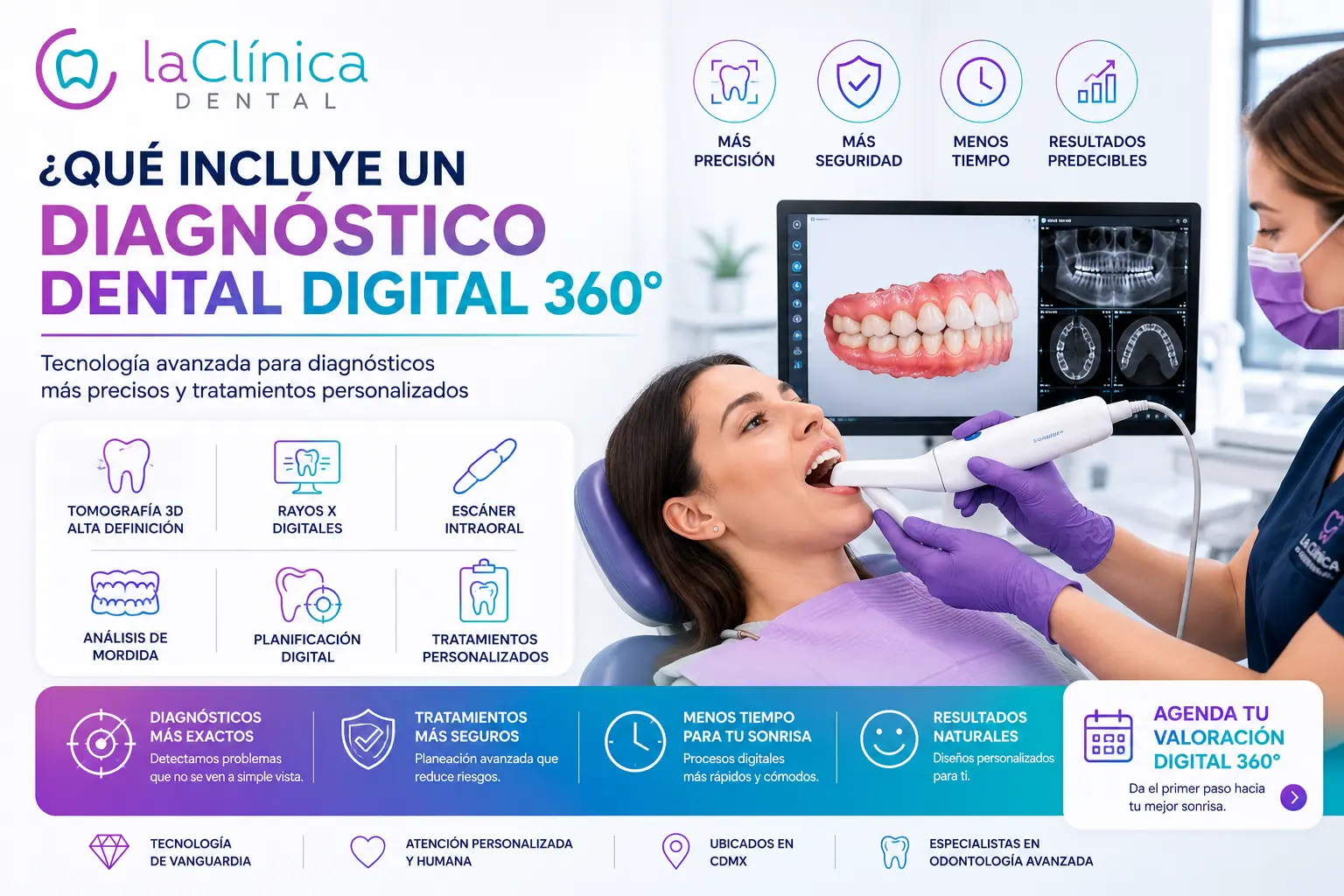
A 360° digital dental diagnosis in CDMX includes 3D tomography, digital X-rays, intraoral scan, functional bite analysis and personalized digital planning to detect dental problems more accurately before starting treatments such as implants, Invisalign, oral rehabilitation or smile design. This comprehensive assessment allows for safer, faster, more esthetic and predictable treatments through the use of advanced dental technology.
Today, the most advanced clinics in digital dentistry use diagnostic tools capable of analyzing teeth, gums, bone, jaw joint and facial harmony from a single clinical platform. This approach improves diagnostic accuracy and reduces errors in complex treatments.
If you want to understand how this technology works, you can review this guide on advanced dental technology in CDMX: 3D X-rays, intraoral scanner and digital design.
Key Definition: A 360° digital dental diagnostic is an advanced dental protocol that combines digital radiographs, 3D tomography, intraoral scanning and functional analysis to comprehensively evaluate teeth, gums, bone and bite prior to initiating dental treatment.
What does a 360° digital dental diagnosis in CDMX include?
A 360° digital dental diagnosis in CDMX includes 3D tomography, digital X-rays, intraoral scan, functional bite analysis and personalized digital planning to detect dental problems more accurately before starting treatments such as implants, Invisalign, oral rehabilitation or smile design. This comprehensive assessment allows for safer, faster, more esthetic and predictable treatments through the use of advanced dental technology.
Today, the most advanced clinics in digital dentistry use diagnostic tools capable of analyzing teeth, gums, bone, jaw joint and facial harmony from a single clinical platform. This approach improves diagnostic accuracy and reduces errors in complex treatments.
If you want to understand how this technology works, you can review this guide on advanced dental technology in CDMX: 3D X-rays, intraoral scanner and digital design.
What is a 360° digital dental diagnosis?
A 360° digital dental diagnosis is a comprehensive evaluation supported by advanced dental technology that allows the analysis of dental, osseous, functional and esthetic structures through high-precision digital images.
Unlike a conventional review, this protocol combines multiple digital tools to obtain more accurate information about:
- Condition of teeth and gums
- Bone quality and volume
- Bite and occlusion
- Temporomandibular joint
- Facial esthetics
- Smile and dental proportions
Chewing function
Tooth position and alignment
Modern digital dentistry seeks minimally invasive, highly personalized treatments with better long-term results.
What studies are included in a 360° digital dental diagnosis?
Digital dental radiography
Digital radiography can detect cavities, infections, fractures, bone loss and alterations that are often not clinically visible.
In addition to providing more accurate images, it uses less radiation compared to conventional systems.
To understand their differences and clinical benefits, you can review this guide on digital vs. conventional panoramic X-rays.
Main benefits:
| Benefit | Clinical Advantage |
|---|---|
| Reduced radiation | Increased patient safety |
| High resolution images | More accurate diagnostics |
| Immediate results | Faster planning |
| Digital storage | Efficient clinical follow-up |
3D dental tomography (CBCT)
3D Cone Beam tomography allows visualization of anatomical structures in high precision and three dimensions.
This study is essential for:
- Dental implants
- Oral surgery
- Wisdom teeth extraction
- Advanced orthodontics
- Complete oral rehabilitation
- Cases with bone loss
CT scans help identify nerves, maxillary sinuses and bone density prior to complex surgical procedures.
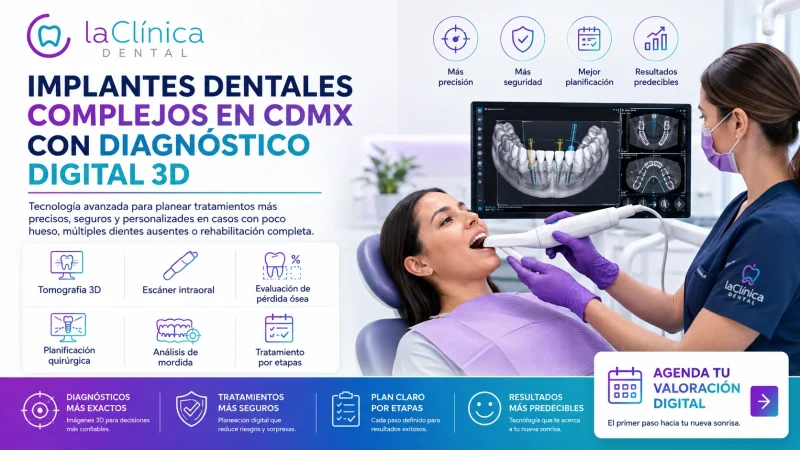
For this reason, treatments such as computer-guided implants rely directly on three-dimensional digital planning.
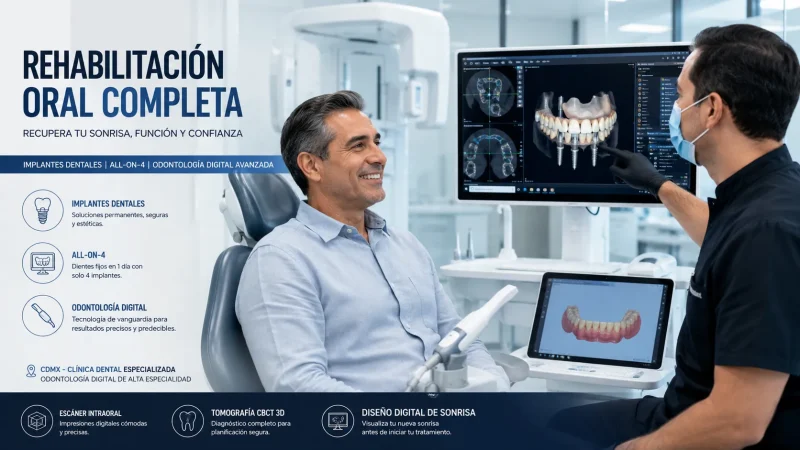
In patients with advanced tooth loss, it is also key for protocols such as All-on-4 and All-on-6 in CDMX or complete rehabilitations .
Digital intraoral scanner
The intraoral scanner replaces cumbersome traditional molds with an accurate digital capture of teeth and gums.
This technology is used in:
- Invisalign
- Dental veneers
- Crowns
- Prosthesis
- Smile design
- Digital oral rehabilitation
Digital scanning makes it possible to visualize 3D models in real time and improve treatment precision.
You can learn more about the differences between the two technologies in this guide on intraoral scanners vs. traditional impressions.
| Digital Scanning | Traditional Printing |
|---|---|
| More comfortable for the patient | May cause nausea |
| Increased precision | Possible deformations |
| Fast results | Slower processes |
| Immediate display on screen | Not immediate |
How does digital diagnostics help in dental implants?
Modern implants depend on precise digital planning.
The 360° dental diagnosis allows:
- Measure available bone volume
- Detect bone loss
- Bite stability analysis
- Design guided surgery
- Reducing surgical risks
- Improve aesthetics and final functionality
Therefore, before starting a dental implant treatment in CDMX, a digital evaluation is essential to determine if the patient requires grafting, sinus lift or advanced techniques.
In addition, factors such as the type of implant and surgical complexity can modify the final budget. You can review this guide about dental implants prices in CDMX.
Digital diagnostics for smile design
Digital esthetic dentistry allows you to simulate results before starting treatment.
Currently, an advanced aesthetic diagnosis may include:
- Digital smile simulation
- Facial analysis
- Dental proportional design
- Color and texture evaluation
- Digital mockup
Customized esthetic planning
This process is key in treatments such as smile design in CDMX, where aesthetic harmony and naturalness are sought.
It is also used to plan treatments with dental veneers in CDMX, esthetic resins and complete cosmetic rehabilitations.
In addition, some patients undergo an esthetic evaluation with digital simulation to visualize possible results before making decisions.
Digital diagnostics in orthodontics and Invisalign
Clear aligners and modern digital orthodontics require highly accurate three-dimensional studies.
Digital diagnostics helps to:
- Bite analysis
- Detect dental crowding
- Simulate dental movements
- Estimate treatment times
- Designing customized aligners
Therefore, treatments such as Invisalign in CDMX rely directly on intraoral scanning and digital simulation software.
What are the advantages of a 360° digital dental diagnosis?
Increased clinical accuracy
Digital technology reduces errors and improves early detection of dental problems.
Personalized treatments
Each treatment is designed according to the patient’s specific anatomy and needs.
Improved patient experience
The studies are faster, more comfortable and less invasive.
Comprehensive planning
It allows the coordination of different dental specialties in the same plan.
Better communication
The patient can visualize images and digital simulations of his treatment.
Who needs a digital dental diagnosis?
A digital dental diagnosis is especially recommended for patients who are looking for:
- Dental implants
- Smile design
- Orthodontics and Invisalign
- Complete oral rehabilitation
- Dental veneers
- Maxillofacial surgery
- Dental tourism
- Complex treatments
- Cases with bone loss
Many patients requiring complete oral rehabilitation in CDMX need comprehensive digital studies to coordinate multiple specialties.
Digital dental diagnostics and dental tourism in CDMX
Digital technology also facilitates the care of international patients.
Currently, many clinics use digital assessments for:
- Review distance learning
- Pre-trip treatment planning
- Reduce clinical times
- Organizing complex rehabilitations
- Optimize long visits
This is especially useful for patients who seek dental tourism in CDMX and wish to have complete treatments in a short period of time.
How long does a 360° digital dental diagnosis take?
Time may vary depending on the studies required, but usually a comprehensive evaluation can be performed in a single visit.
May include:
| Study | Approximate Time |
|---|---|
| Digital radiography | 5 to 10 minutes |
| 3D tomography | 10 to 15 minutes |
| Intraoral scanning | 15 to 30 minutes |
| Clinical assessment | 30 to 60 minutes |
Why is diagnostic accuracy important in modern dentistry?
An incorrect diagnosis can affect the planning of implants, orthodontics, oral rehabilitation and esthetic treatments. Therefore, modern digital dentistry uses three-dimensional tools and computerized analysis to reduce clinical errors and improve treatment predictability.
Conclusion
A 360° digital dental diagnosis in CDMX allows for a comprehensive analysis of oral health through digital radiography, 3D tomography, intraoral scanning and computerized planning. This technology improves diagnostic accuracy, optimizes treatments and allows the development of personalized plans for dental implants, smile design, orthodontics and oral rehabilitation.
State-of-the-art dental clinics offer more complete diagnostics, safer treatments and a more modern experience for national and international patients.
Frequently asked questions about 360° digital dental diagnostics
What does a digital dental diagnosis include?
Includes clinical evaluation, digital radiographs, intraoral scan, 3D tomography and digital treatment planning.
Does dental tomography hurt?
No, dental tomography is fast, non-invasive and painless.
What are the advantages of the intraoral scanner?
Greater convenience, precision and speed compared to traditional molds.
Does digital diagnostics help in dental implants?
Yes, it allows to plan the exact position of the implants and to evaluate the available bone.
What is Cone Beam tomography used for?
Helps to analyze bone structures, nerves and facial anatomy prior to complex treatments.
Does digital diagnostics enhance Invisalign?
Yes, it allows simulating dental movements and fabricating customized aligners.
Is it possible to visualize the result before treatment?
Yes, some treatments include digital smile simulation and virtual mockups.
Does digital radiography use less radiation?
Yes, it generally uses less radiation than conventional systems.
How long does a complete digital dental assessment take?
Usually between 60 and 120 minutes depending on the case.
Is digital diagnostics useful for oral rehabilitation?
Yes, it is essential to coordinate complex and multidisciplinary treatments.
Can international patients send digital studies?
Yes, many clinics accept digital studies for pre-trip treatment planning.
Which treatments require digital diagnosis?
Implants, Invisalign, smile design, oral surgery and complete oral rehabilitation.
What is the difference between traditional and digital X-rays?
The digital ones offer greater precision, less radiation and immediate results.
Does digital dentistry improve treatment accuracy?
Yes, it reduces clinical errors and improves personalized planning.
Does digital diagnostics help detect bone loss?
Yes, 3D tomography allows to measure bone volume and quality with high precision.
What is the difference between a traditional dental diagnosis and a digital one?
Digital dental diagnostics use 3D tomography, intraoral scanning, and digital X-rays to obtain more accurate images and plan personalized treatments, while traditional methods rely primarily on visual assessments and physical impressions.
How accurate is an intraoral dental scanner?
The intraoral scanner provides highly accurate digital images that allow for a more detailed analysis of teeth, gums, and bite, improving treatments such as Invisalign, dental veneers, crowns, and implants.
Can bone loss be detected with a dental CT scan?
Yes. 3D dental CT scans make it possible to detect bone loss, assess bone volume, and analyze anatomical structures before performing dental implants or oral rehabilitation.
Does digital diagnosis help with planning dental veneers?
Yes. Digital diagnostics help with the planning of dental veneers through aesthetic simulations, facial analysis, and digital smile design to achieve more natural and personalized results.
Which specialists are involved in a 360° dental evaluation?
Depending on the case, specialists in implantology, orthodontics, oral rehabilitation, periodontics, oral and maxillofacial surgery, and cosmetic dentistry may be involved.
Does digital planning reduce risks associated with dental implants?
Yes. Digital planning makes it possible to analyze bone, nerves, and anatomical structures before surgery, helping to improve the precision and safety of dental implant procedures.
What kind of evaluations does Invisalign require before starting treatment?
Invisalign generally requires digital intraoral scans, X-rays, bite analysis, and an orthodontic evaluation to create a personalized treatment plan for tooth movement.
Is it possible to get a dental evaluation before traveling to Mexico City?
Yes. Many international patients can submit digital images in advance to receive initial guidance and plan their dental treatments before traveling to Mexico City.
Why Does Advanced Dental Technology Improve Treatments?
Advanced dental technology enables more accurate diagnoses, personalized treatments, and better long-term functional and aesthetic outcomes.
What dental problems can a 3D CT scan detect?
3D tomography can detect bone loss, infections, impacted teeth, fractures, anatomical abnormalities, bite problems, and structures related to oral surgery and implants.
Does intraoral scanning replace traditional impressions?
Yes. In many treatments, intraoral scanning can replace traditional physical impressions thanks to its accuracy and convenience.
Does a dental CT scan use a lot of radiation?
Dental cone-beam computed tomography uses controlled doses that are generally lower than those of other conventional medical imaging studies, depending on the area being examined.
Does intraoral scanning replace traditional impressions?
Yes. In many treatments, intraoral scanning can replace traditional physical impressions thanks to its accuracy and convenience.
Includes clinical evaluation, digital radiographs, intraoral scan, 3D tomography and digital treatment planning.
No, dental tomography is fast, non-invasive and painless.
Greater convenience, precision and speed compared to traditional molds.
Yes, it allows to plan the exact position of the implants and to evaluate the available bone.
Helps to analyze bone structures, nerves and facial anatomy prior to complex treatments.
Yes, it allows simulating dental movements and fabricating customized aligners.
Yes, some treatments include digital smile simulation and virtual mockups.
Yes, it generally uses less radiation than conventional systems.
Usually between 60 and 120 minutes depending on the case.
Yes, it is essential to coordinate complex and multidisciplinary treatments.
Yes, many clinics accept digital studies for pre-trip treatment planning.
Implants, Invisalign, smile design, oral surgery and complete oral rehabilitation.
The digital ones offer greater precision, less radiation and immediate results.
Yes, it reduces clinical errors and improves personalized planning.
Yes, 3D tomography allows to measure bone volume and quality with high precision.
Digital dental diagnostics use 3D tomography, intraoral scanning, and digital X-rays to obtain more accurate images and plan personalized treatments, while traditional methods rely primarily on visual assessments and physical impressions.
The intraoral scanner provides highly accurate digital images that allow for a more detailed analysis of teeth, gums, and bite, improving treatments such as Invisalign, dental veneers, crowns, and implants.
Yes. 3D dental CT scans make it possible to detect bone loss, assess bone volume, and analyze anatomical structures before performing dental implants or oral rehabilitation.
Yes. Digital diagnostics help with the planning of dental veneers through aesthetic simulations, facial analysis, and digital smile design to achieve more natural and personalized results.
Depending on the case, specialists in implantology, orthodontics, oral rehabilitation, periodontics, oral and maxillofacial surgery, and cosmetic dentistry may be involved.
Yes. Digital planning makes it possible to analyze bone, nerves, and anatomical structures before surgery, helping to improve the precision and safety of dental implant procedures.
Invisalign generally requires digital intraoral scans, X-rays, bite analysis, and an orthodontic evaluation to create a personalized treatment plan for tooth movement.
Yes. Many international patients can submit digital images in advance to receive initial guidance and plan their dental treatments before traveling to Mexico City.
Advanced dental technology enables more accurate diagnoses, personalized treatments, and better long-term functional and aesthetic outcomes.
3D tomography can detect bone loss, infections, impacted teeth, fractures, anatomical abnormalities, bite problems, and structures related to oral surgery and implants.
Yes. In many treatments, intraoral scanning can replace traditional physical impressions thanks to its accuracy and convenience.
Dental cone-beam computed tomography uses controlled doses that are generally lower than those of other conventional medical imaging studies, depending on the area being examined.
Yes. In many treatments, intraoral scanning can replace traditional physical impressions thanks to its accuracy and convenience.
Do you want a complete digital dental diagnosis in CDMX?
At La Clínica Dental we use advanced technology such as intraoral scanning, 3D tomography and digital planning to create more precise, comfortable and personalized treatments.
✅ Comprehensive evaluation
✅ 360° digital diagnosis
✅ Esthetic and functional planning
✅ Specialists in implants, Invisalign and oral rehabilitation
✅ Care for national and international patients ✅ Care for national and international patients
Author:
Dr. Rosa María Moctezuma Lozano
National Autonomous University of Mexico
ID No. 1135288
Clinically reviewed and updated content for patient information guidance.
Last editorial revision: May 18, 2026.